 Image by Kerry Pucillo
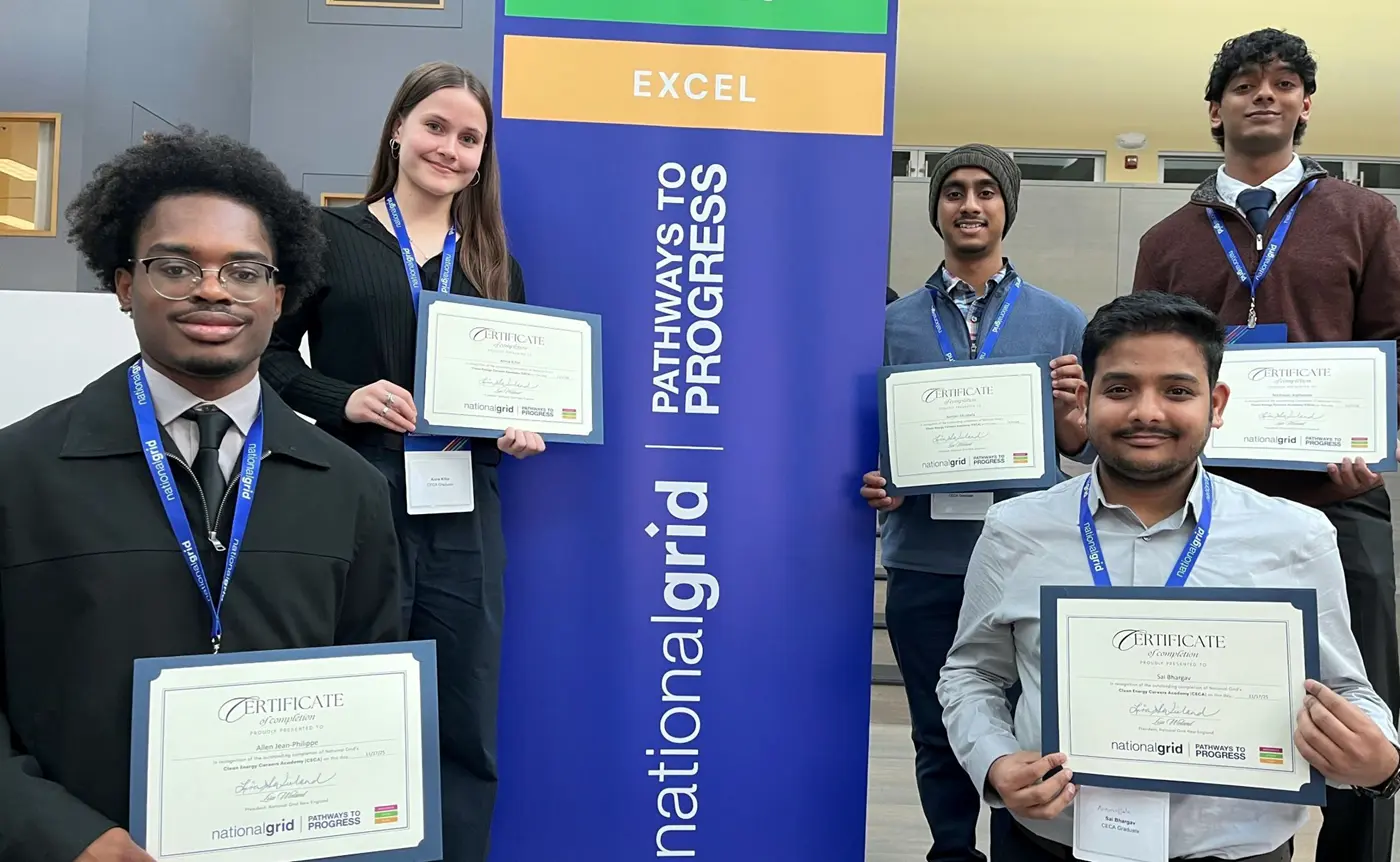
 Eleven UMass Lowell students completed National Grid’s Clean Energy Careers Academy. Clockwise, from bottom left, are students Allen Jean-Philippe, Anna Kifor, Arman Mustafa, Nicholas Alphonso and Sai Bhargav.
Colin Ormond was surprised to learn that careers at energy companies span beyond the engineers who develop electrical systems and the line workers who install and repair power lines.
“In reality, it takes so much more than that,” says Ormond, a senior majoring in political science.
Ormond and 10 other UMass Lowell students learned this – and much more – while taking part in National Grid’s Clean Energy Careers Academy (CECA), an eight-week program designed to provide college students with a better understanding of career opportunities within the energy sector. UMass Lowell participated in CECA for the first time last fall. National Grid awarded academic scholarships to financially eligible students who completed the program.
“Programs like CECA are about opening students’ eyes to the full workforce ecosystem behind the energy industry,” says Ruairi O’Mahony, associate vice chancellor for sustainability and enterprise development. “From policy and project management to community engagement and sustainability planning, there are countless roles shaping the future of clean energy, and we want students to see how their skills and interests can fit into that bigger picture.”
CECA consisted of:
- “Master classes,” in which students learned about how National Grid operates and makes money, electricity distribution and safety, and more.
- Site visits, during which students toured the National Grid Training Center in Millbury, Massachusetts; National Grid’s Mobile Emergency Operations Center in Boston; a National Grid engineering capital project at the border of Massachusetts, New Hampshire and Vermont; the Markley Data Center in Lowell; and the solar and wind farms at Berkshire East Mountain Resort in Charlemont, Massachusetts.
- Mentorship and networking opportunities for students to meet with National Grid executives and rising leaders for career advice.
- Capstone projects, in which students had to solve real-world clean energy and equity challenges. They presented their solutions to National Grid experts and hiring managers.
"CECA helps students understand the many roles and functions that support the energy grid,” says Chima Anidobe, principal workforce program manager at National Grid. “Through master classes, site visits, mentorship and real-world capstone projects, they build practical skills in safety, stakeholder communication, teamwork and problem-solving. They leave with real exposure and a clearer line of sight on how their skills translate into careers at National Grid and across the energy sector."
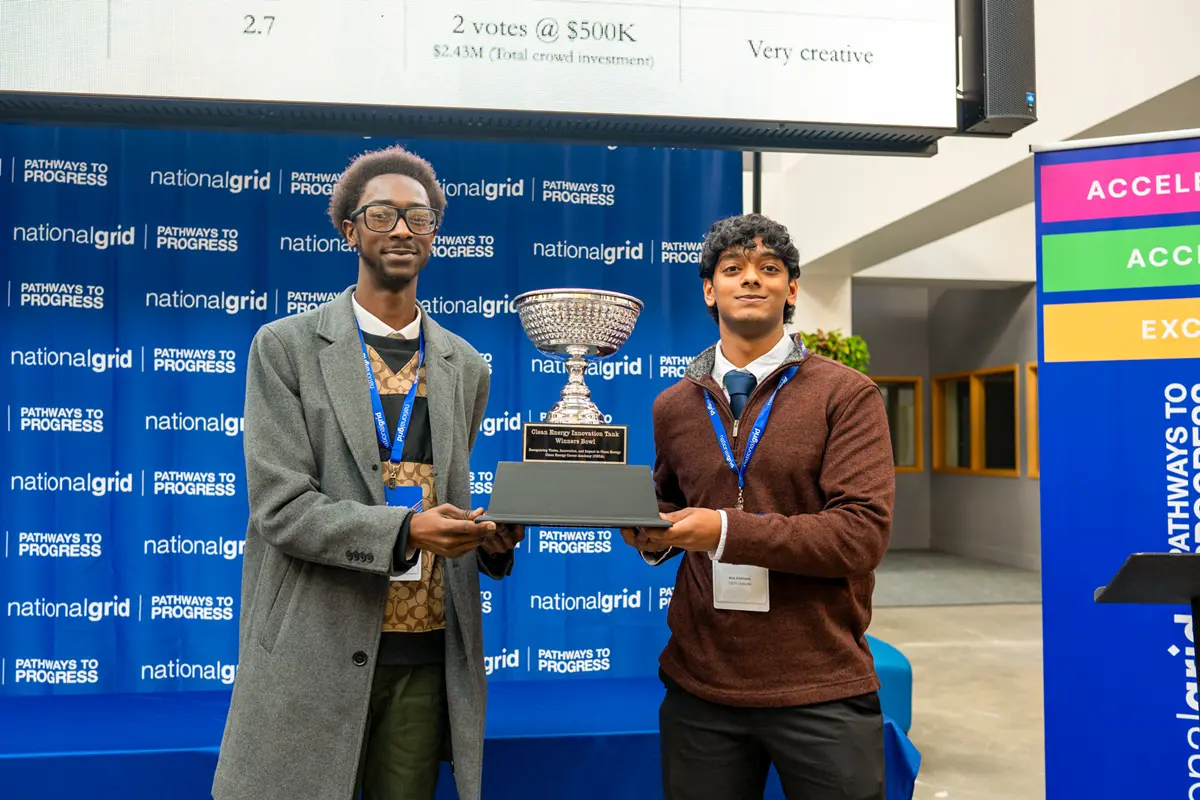 Image by Chima Anidobe
 Nicholas Alphonso, right, and his teammate from Benjamin Franklin Cummings Institute of Technology in Boston won the top prize for their CECA capstone project.
Nicholas Alphonso ’25 joined CECA to gain experience in renewable energy, a field he plans to enter upon finishing his master’s degree in environmental studies with an atmospheric science option.
For the capstone project, Alphonso teamed up with a student from Benjamin Franklin Cummings Institute of Technology in Boston to explore how National Grid can meet its goal of increasing the capacity of the electrical grid by one gigawatt by 2030 to support building and vehicle electrification. Their solution involved using distributed energy resources, such as solar panels, to grow grid capacity reliably and efficiently. Alphonso and his teammate won the top prize for their project.
“I gained extremely valuable insight into National Grid’s core business and operational commitments,” Alphonso says.
Senior mathematics major Anna Kifor solidified her career aspirations through site visits and meetings with industry professionals.
“Before I started the program, I wanted to go into finance and maybe do something in sustainability, but I wasn’t quite sure,” she says. “After this program, I knew I definitely wanted to go into financing for clean energy.”
Ormond discovered that he can expand his passion for policymaking beyond the government and apply it to companies like National Grid.
“This opens up a lot of opportunities for me,” he says.