
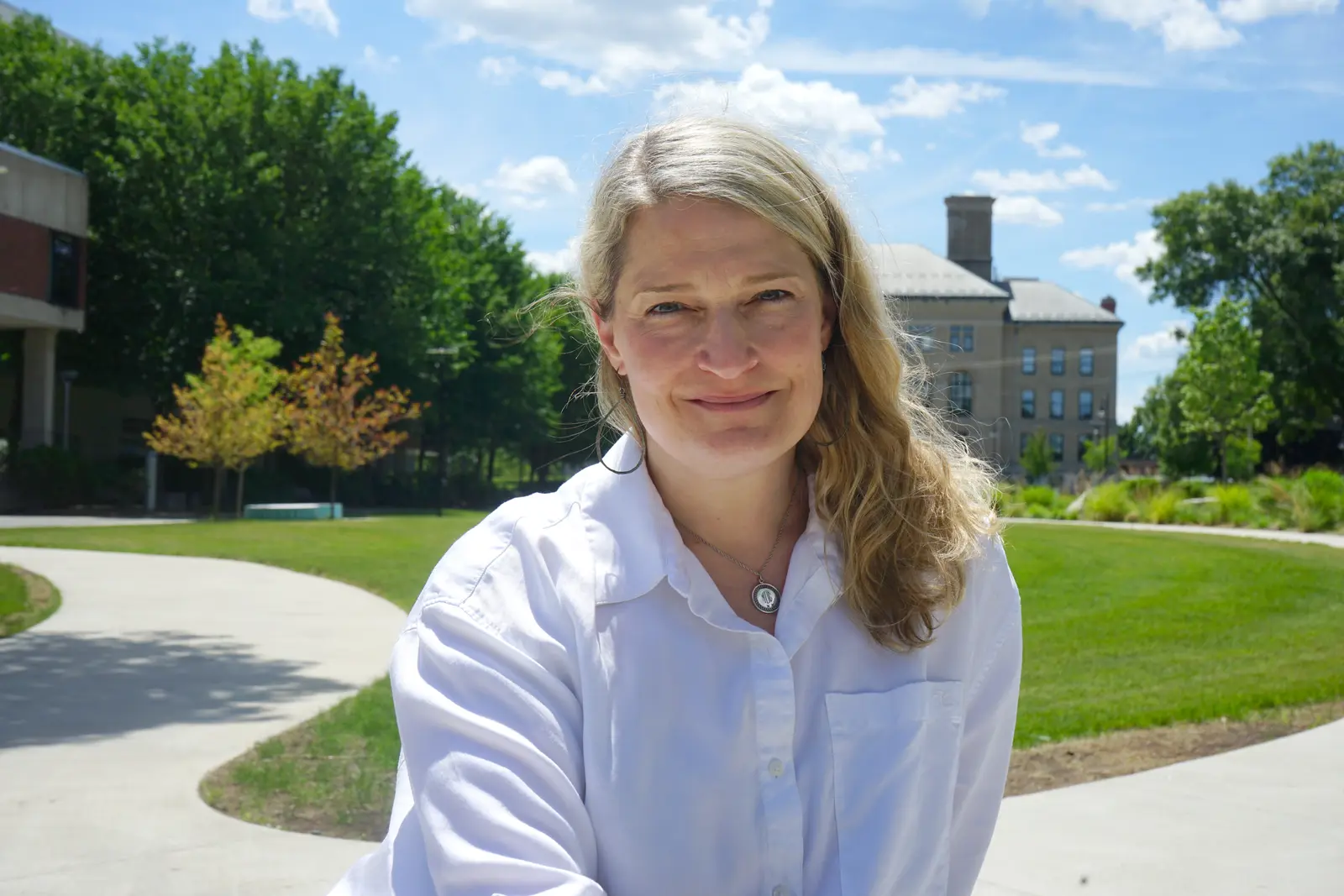
 Image by Celia Hoffman
 Creative Writing Professor Maggie Dietz releases new poetry book, "If You Would Let Me."
During a dry period of writing, Creative Writing Associate Professor Maggie Dietz felt the stirrings of a new poem. Lines from “If You Would Let Me” came to her in waking dreams, she says. Several years later, during a month-long fellowship in Wyoming, Dietz put the finishing touches on a book of poems by the same name.
Her recently released “If You Would Let Me” includes 37 poems that reimagine the myth of Demeter and Persephone, the mother and daughter in ancient Greek mythology whose story has long symbolized the changing seasons and the cycle of life. Although she was initially hesitant to revisit such a familiar myth, Dietz says she soon realized, “This was going to be the book that I needed to write.”
The collection explores motherhood, loss and resilience through the lens of myth, ultimately arriving at a message of hope. "There's hope and there's fear," Dietz says. "But we endure it all."
Dietz joined UMass Lowell in 2011 after teaching creative writing at Boston University and directing the Favorite Poem Project with Robert Pinsky, the former U.S. Poet Laureate. She co-edited three anthologies with Pinsky: “Americans’ Favorite Poems” (1999), “Poems to Read” (2002) and “An Invitation to Poetry” (2004).
Dietz is also the author of “The Kind of Happy” (2016) and “Perennial Fall” (2006), which won the 2007 Jane Kenyon Award for Outstanding Book of Poetry and a Wisconsin Library Association Literary Award for Outstanding Achievement.
In April, Dietz read from “If You Would Let Me” at the 2026 Writers on Campus event at O’Leary Library alongside fellow faculty member Julian Zabalbeascoa, who read from his debut novel, “What We Tried to Bury Grows Here.”
Dietz sat down to discuss the collection, her writing process and her passion for teaching.
What did your writing process for “If You Would Let Me” look like?
This book was a bit different. I had never written a book that had a narrative arc or throughline. That’s not to say every poem in the book is rooted in the myth, but they're all interrelated. I kept thinking about the mythological figure, the goddess Demeter. I was wary of engaging with a myth that is quite well-known and that other artists have taken up in all kinds of ways. But myths don't get tired.
I wasn’t trying to remake the myth so much as to apply it, because aspects of my story were connected to the ancient story. I came to think of it more like a rendition — like the cover of a song. I had an attachment to Demeter — I just couldn't stop thinking about her — so I read many versions of the myth. Mythology was written collectively, by many people, which tells you how perennial and vital it is. I knew it would be important to include some poems that were only obliquely connected to the story of mother and child. Not every poem in the book is spoken by Demeter, but they’re all spoken by a sort of Demeter-like figure.
How much revising do you do? When does a work feel finished?
That's part of why I'm a slow writer. I spend a lot of time on poems, and sometimes I let them sit. Even after I publish a poem in a journal, I'll sometimes change it before it appears in a book. I think any poet would tell you that some poems come out a little more fully formed. Sometimes you have tremendous momentum with the writing. I wrote about 20% of this book in a few weeks on a fellowship in Wyoming, and the rest had been written over several years. The time out west was when I was getting to the end of the book, and I could see what it was. The early drafts felt shaky and fluid, like writing with training wheels. But eventually, I was cruising.
What is the significance of the first poem in the book being the first one that you wrote?
There’s no specific reason. My publisher didn't want me to put it first, but I did. It’s not that it went first because it came to me first. The book wasn’t written chronologically, but it moves through the seasons and ends with spring. That first poem is a villanelle in a book of poems that uses form in all kinds of ways, but that was the most rigid structural poem, and I just thought, “Let's plunk it here and create a certain expectation.” The third poem, “Nobody,” is written in free verse with no punctuation, so readers begin to understand there will be a little bit of instability. Instability is part of what the book is about.
What do you hope that people take away from your poetry?
I think: we humans endure. That is also the epigraph from the Homeric Hymns: “But what the gods give, we humans endure, painful as it is, for our necks are under the yoke.” I was writing a book about endurance and, to some degree, resilience. My first couple of books were concerned with liminal spaces, in-between spaces, and there's an element of that in this book too. But this book depicts a cycle. There's hope and there's fear, and there's hope and there's fear. But we endure it all. I knew the “Cusp” had to come last. I wanted to end in springtime and with the hope of a potential return.
How do you balance teaching and writing?
Teaching is time-consuming, and it uses the same part of your brain as writing. To teach is to be creative. I try not to “profess;” I try more to engage. I don't write lectures, because my classes are small and discussion based. I know some writers who love teaching and feel like it's totally integrated with their writing practice, and some writers who would rather not do it, but do. I'm more on the love meter, as long as I'm keeping the material fresh for myself.
I love introducing students to poems and art. My expectation for them in my class is, you are a poet. You walk in that door, you are a poet. You walk out that door, you are a poet. I also want to build their sense of themselves as writers who have something to say.
When did you know you wanted to pursue teaching?
In my 20s, I was working on the Favorite Poem Project with Robert Pinsky. I was essentially doing arts administration, writing grants and planning events while also teaching at BU. There was this juncture where I had to decide if I wanted to continue with arts administration or teaching. My gut told me that I wanted to teach. I didn't want to sit at a desk, writing emails or grants. I wanted to write poems and essays, and I wanted to engage people.
UMass Lowell does a great job of fostering a space where students can be creative. Writers on Campus gives students the chance to hear from writers at different stages — some early in their careers, some total big shots. Students also publish in “The Offering,” study abroad and get involved with the Kerouac Festival and Mass Poetry.
What’s one piece of advice you give to students?
About three weeks before the end of every semester, I give my students two words of advice: “Don't tank.” A former student even painted the phrase onto a piece of wood, so now I bring it to class as a prop. I know how young lives, especially the lives of UMass Lowell students, can become busy and overwhelming. So much is due at the end of the term, and it can feel too big, so I tell students: “You have worked so hard all semester, and you're almost there. Just do this last push. You've got it."
The other thing I tell students is that nobody gets to decide whether you are a writer or not. I tell every student they are one. If someone tells you otherwise, you don't have to believe them. Rejection is part of every artist's life. You have to have a little bit of fire in your belly that believes, “I'm going to do this. It's in me.”
Where do you see your poetry going next?
I've been thinking a lot about my Catholic childhood. I don't think I'm going to write a bunch of Catholic poems, but I feel like somehow that aspect of my upbringing is going to be incorporated into the next book. I see my next book being different from this one, with the connections between poems less defined and more implicit.