
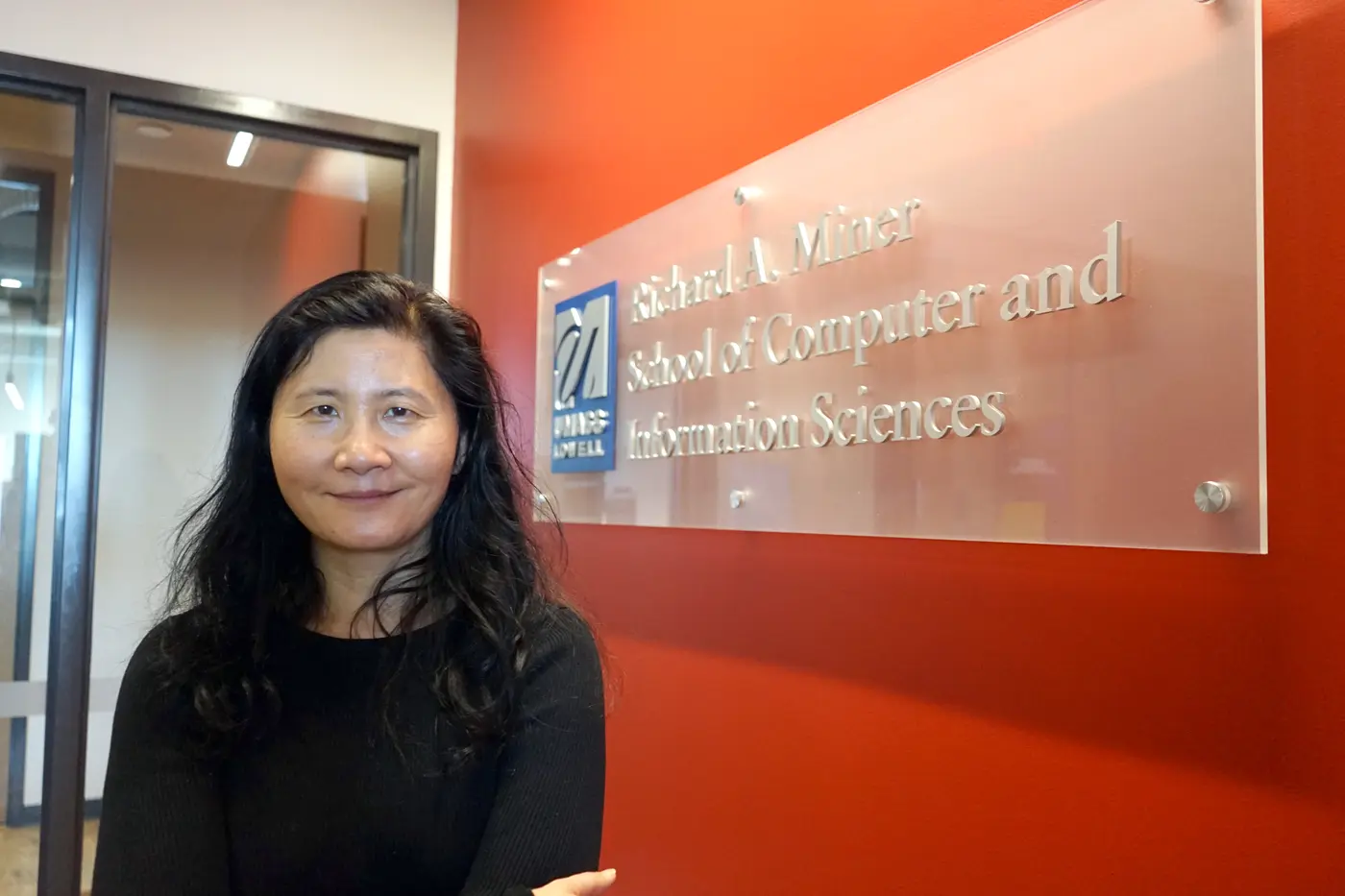
 Image by Ed Brennen
 Professor Hong Yu says that by studying keywords in veterans’ medical records, researchers were able to identify the risk for Alzheimer’s disease 15 years earlier than current standards.
Researchers at UMass Lowell have uncovered an innovative way to spot Alzheimer’s disease long before the first official diagnosis. By using machine learning to analyze clinical notes in electronic health records, a team led by Professor Hong Yu has demonstrated that the risk can be identified up to 15 years earlier than current standards.
About 7.2 million Americans over the age of 65 were living with Alzheimer’s dementia in 2025, according to a recent report by the Alzheimer’s Association. An additional 200,000 Americans have younger-onset dementia. The number of Americans with Alzheimer’s disease is expected to increase to 13.8 million in 2060 and to 100 million worldwide by that year.
While there is no cure, early detection can be a game changer. Early diagnosis allows for behavioral interventions and medications that slow progression in mild cases. It also carries a massive economic impact: In one study, the Alzheimer’s Association estimated savings of $7 trillion in health and long-term care costs thanks to early diagnosis of the disease.
While diagnosing dementia in general is based on outward symptoms, pinning the cause to Alzheimer’s disease requires, for the average patient, either a spinal tap or extensive imaging studies. “The existing diagnostic techniques are invasive or expensive,” says Yu, a professor in the Miner School of Computer and Information Sciences.
Yu was the principal investigator on the study, which received $6 million in funding from the National Institutes of Health. Results from the research were published online in January in “Communications Medicine,” part of the Nature portfolio of journals. The paper’s lead author, Rumeng Li, is a student researcher with the UML’s Center of Biomedical and Health Research in Data Sciences (CHORDS), which brings together experts in diverse fields to improve health through innovative artificial intelligence (AI) and data science approaches. Yu founded the center in 2019 and is its director.
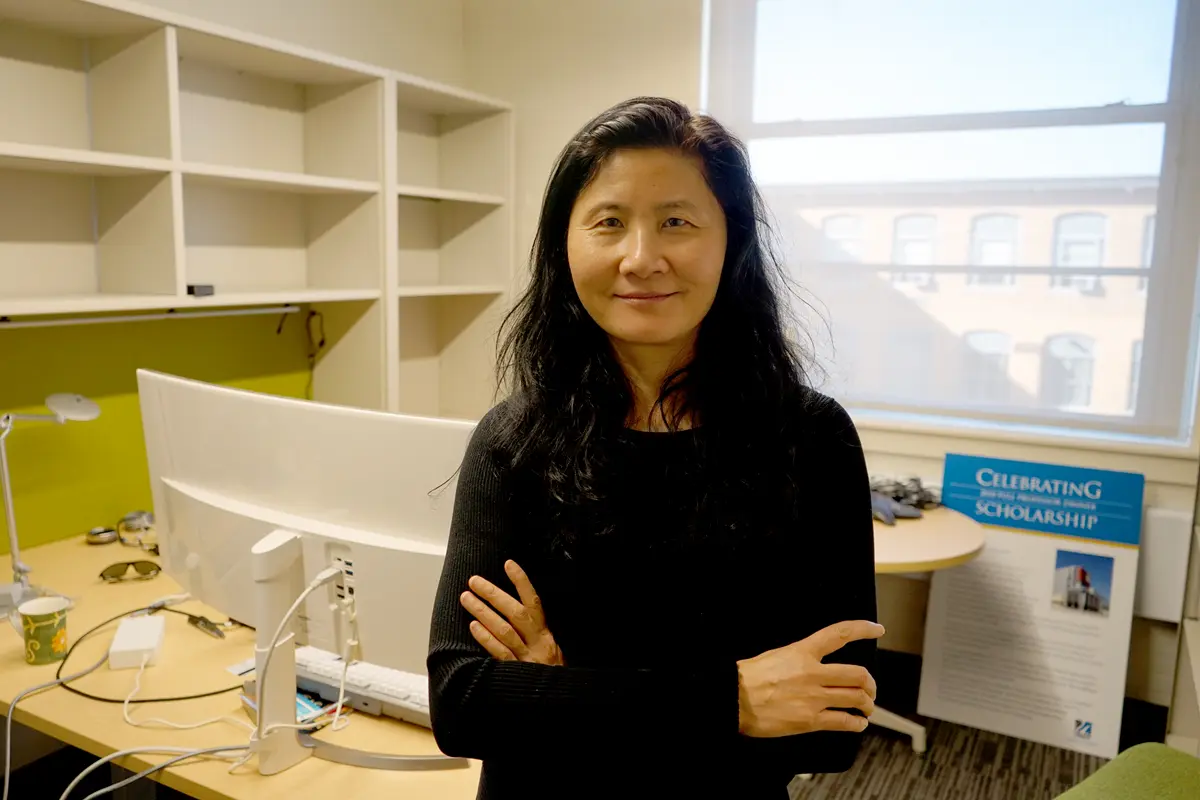 Image by Ed Brennen
 Professor Hong Yu was the principal investigator on the Alzheimer's detection study, which received $6 million in funding from the National Institutes of Health.
Some of the keywords in the collection were medical terms such as “visuospatial,” “dysphagia” and “agnosia.” Others were conversational, such as “mood,” “fluency,” “pain,” “wandering,” “hearing,” “delusion” and “getting lost.”
When the keywords used in the medical records of the patients diagnosed with Alzheimer’s disease were compared with those in the records of the control group, the differences were noticeable almost immediately, allowing the analysis to uncover the increased risk up to 15 years before the official diagnosis was made.
The researchers had access to the records of 61,537 patients diagnosed with Alzheimer’s disease and over 234,000 similar patients without an Alzheimer’s diagnosis. Yu says she’s grateful that the U.S. Department of Veterans Affairs’ Veterans Health Administration makes this data available to researchers.
“We believe this is the most comprehensive electronic health record data set in the United States,” she says. “It includes patients from all 50 states, so it’s truly national data.” Plus, she says, the high quality of care at the VA means that patients stick with the VA for years, making data sets of 20 years’ length available to researchers.
Yu is inspired by both pressing national and social issues and her own experiences to apply fundamental AI principles to data with the aim of finding practical solutions to those problems.
Her team has used data to examine issues such as suicide risk, food pantries and the risk of drug overdose, in addition to the current look at Alzheimer’s disease risk.
“My lab publishes about 30 papers a year. Our goal is to develop innovative AI technologies to help understand human diseases and to change people’s behavior for better health,” she says.
An important part of her research, Yu says, is examining social and behavioral determinants of health, which includes factors such as socio-economic status, education, habits like smoking, access to health care, and social isolation.
“It’s a key risk factor in adverse behavior, such as suicide. It can be a trigger,” she says. More importantly, when such information is added to existing AI models, it makes the predictive model more accurate.
Understanding these factors can help researchers design solutions to improve health outcomes, Yu says: “We can change people’s behavior. They can become healthier.”
She’s looking forward to continuing to work on the Alzheimer’s disease model by adding social and behavioral determinants of health data. Even though the relationship between these factors and the risk for Alzheimer’s disease may be complex, she is hopeful. Yu says, “We can help people.”