
 Image by Brooke Coupal
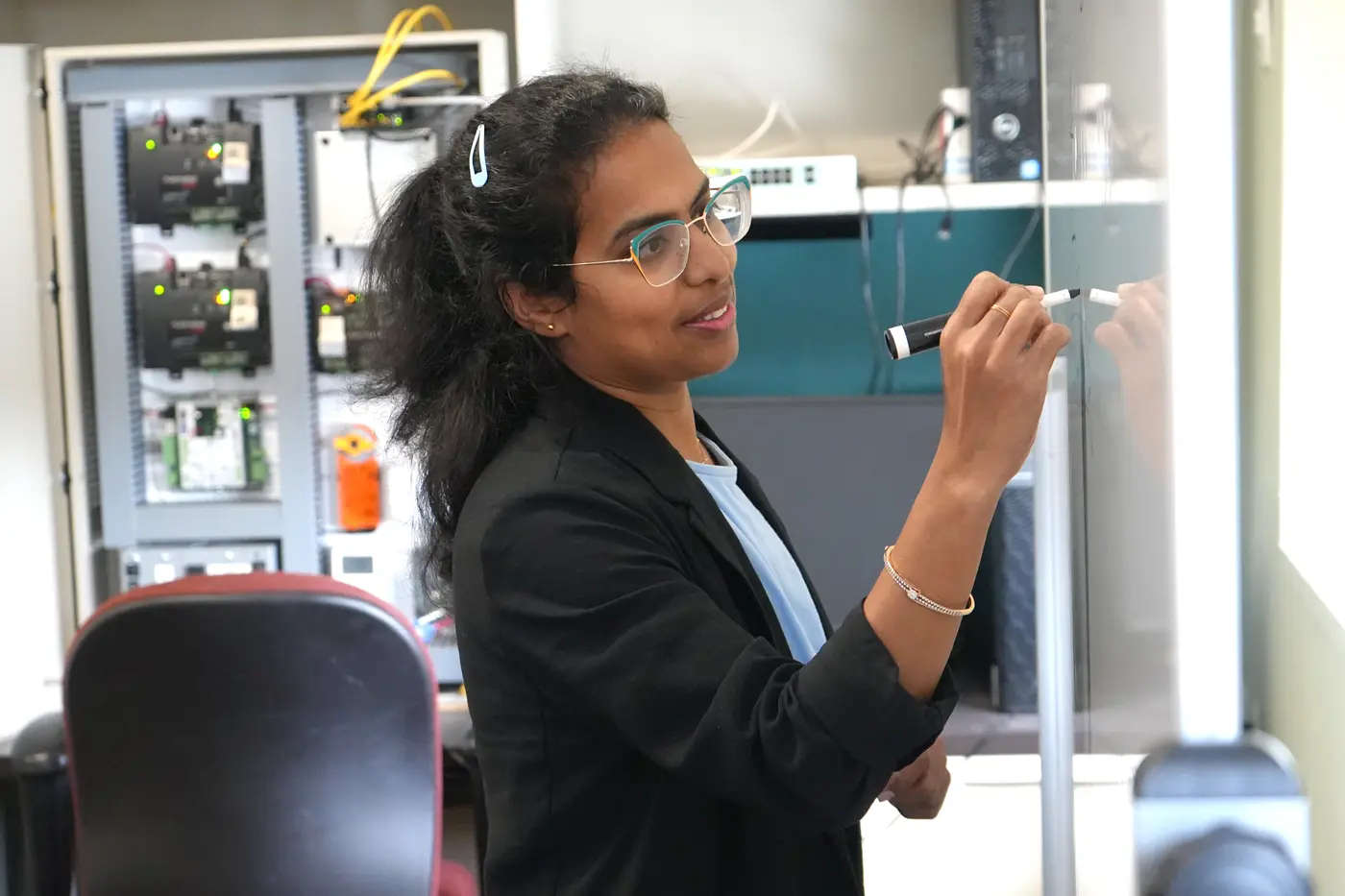
 Miner School Assistant Prof. Anitha Gollamudi is developing a novel framework that automatically places sensitive data into a highly secure area within a computer’s hardware.
The Federal Bureau of Investigation receives more than 2,000 reports of suspected internet crime every day, with cybercriminals often targeting the sensitive data of companies and individuals.
Anitha Gollamudi, an assistant professor in the Miner School of Computer and Information Sciences, is looking to keep that data secure.
Funded by an Office of Naval Research grant worth nearly $800,000, Gollamudi and her lab group are developing a novel framework that automatically places sensitive data into a highly secure area within a computer’s hardware, known as an enclave. This ensures that the information remains protected even if other parts of the system are compromised.
“Our research is building additional defenses against cyberattacks,” says Gollamudi, who is collaborating on the project with Mohamed Elwakil, an assistant professor in electrical engineering and cyber systems at the United States Coast Guard Academy.
Currently, software developers must identify which parts of a computer application should be placed in an enclave, a process that Gollamudi calls “tedious, error-prone and largely repetitive.”
Her framework addresses these issues by automatically identifying sensitive parts of the software and placing them inside an enclave, which tightly controls what can interact with the sensitive data.
“If something is labeled as private, we don’t want to place it in a part of the system that’s labeled public, because public information can be seen by anyone. We want to make sure private information stays protected,” says Wesley Nuzzo ’18, the lead computer science Ph.D. student on this project.
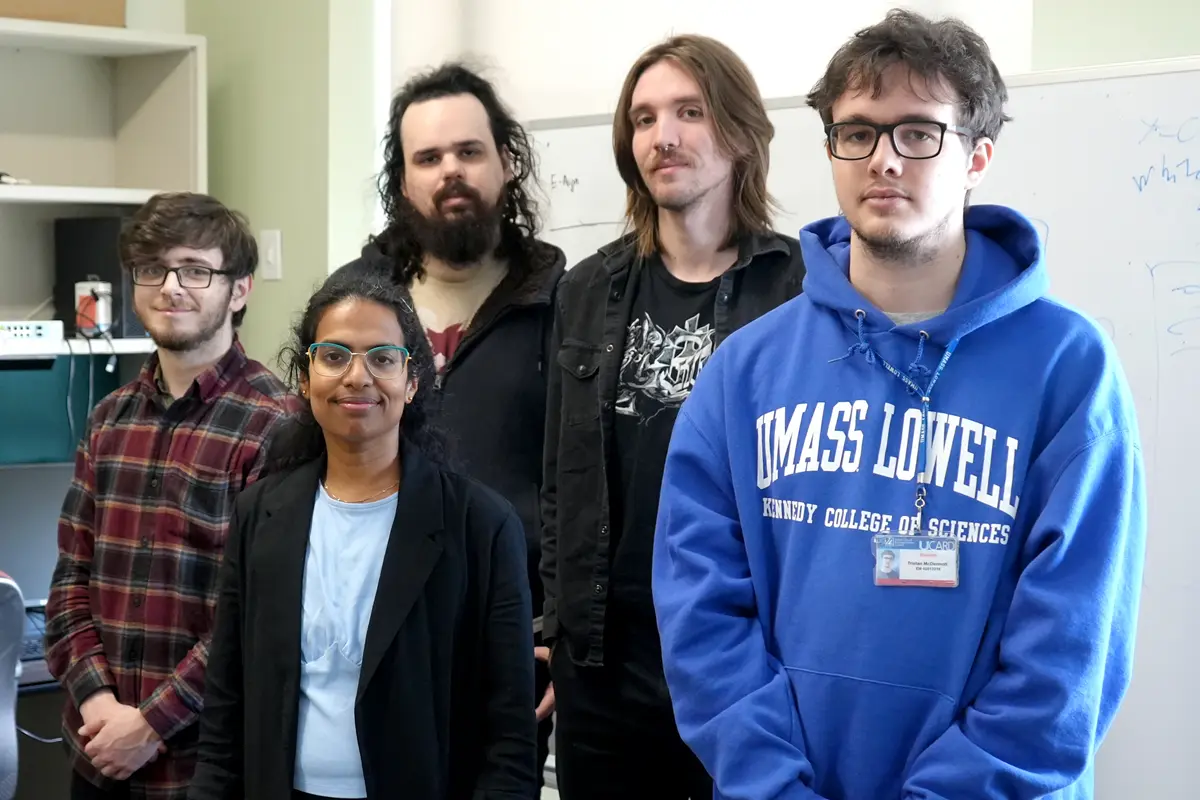 Image by Brooke Coupal
 Assistant Prof. Anitha Gollamudi, front, works with student researchers on her project. Back row, from left, senior Benjamin Houle, Ph.D. student Wesley Nuzzo, Ph.D. student Samuel Dodson and senior Tristan McDermott.
For example, in a hospital setting, the framework would identify patient records and isolate that sensitive data into an enclave. The hospital’s scheduling tool would have limited access to the enclave to schedule a patient appointment with the correct provider, while the hospital’s maintenance tracker would have no access.
“The framework provides a more mathematically secure and guaranteed way of separating private information into an enclave, which is then protected from attackers who gain control of other parts of the system,” says Samuel Dodson ’21, a computer science Ph.D. student and a member of Gollamudi’s lab.
Draper, a nonprofit research and development company and an anchor tenant in the Lowell Innovation Network Corridor, has taken an active interest in Gollamudi’s research because it aligns with the company’s mission to “ensure our nation’s security and prosperity by delivering transformative solutions.” Gollamudi and Draper are collaborating on a separate project, which also aims to enforce security using enclaves. Through that partnership, Gollamudi recommended Dodson for the Draper Scholars Program, which funds his studies and connects him with the company’s experienced engineers and scientists.
“The professional connections are really valuable,” he says. “I meet monthly with researchers at Draper, and they ask questions and share their ideas about our research.”
Senior computer science majors Benjamin Houle and Tristan McDermott are grateful for the experience that they’re gaining in Gollamudi’s lab.
“It’s very exciting to be working on a larger project and learn about the technologies that are used in the industry,” Houle says.
“As somebody who wants to go into programming languages as a career, the skills I’m learning here are important for the jobs I want,” adds McDermott, who is also majoring in mathematics.
Gollamudi can see many fields benefiting from using the framework to keep their sensitive data secure, from the Department of Defense and hospitals to banks and technology companies such as Amazon.
“We want to scale this framework to address real-world problems,” she says.