
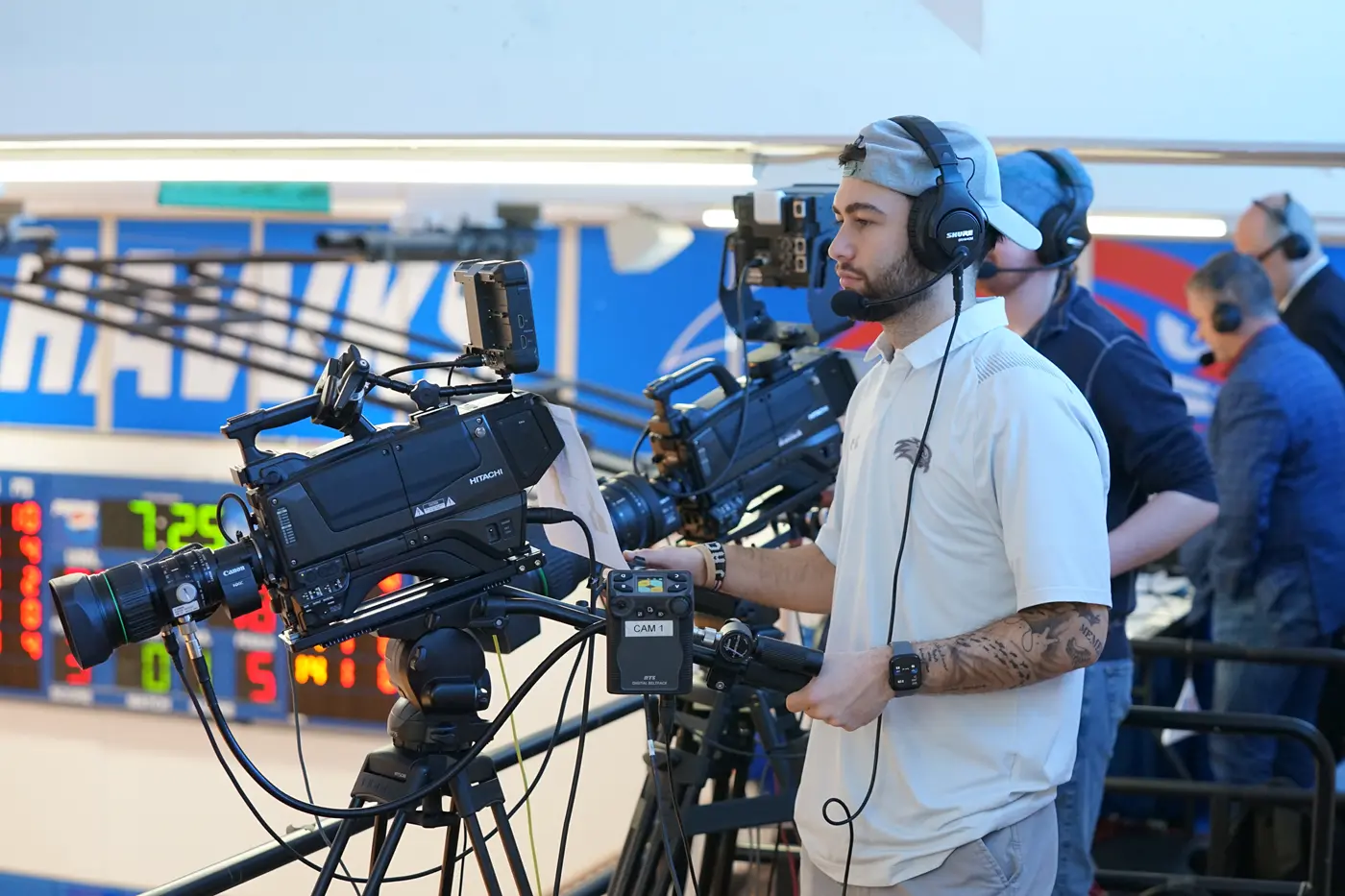
 Image by Ed Brennen
 Senior digital media major Jack Giancotti operates a camera during a recent UMass Lowell men's basketball game against Maine at the Kennedy Family Athletic Complex.
For college students interested in sports media, few classrooms compare to a live Division I broadcast.
At UMass Lowell, digital media majors are gaining hands-on experience behind the camera by working River Hawk athletic events that air on ESPN+, NESN and AmericaEast.tv.
Under the guidance of Grant Weiller, director of multimedia and production for Athletic Communications, students are learning how professional broadcasts come together — using production systems recently modernized by the Office of Information Technology to better support livestreaming across campus.
“It’s been a massive upgrade for us,” Weiller says. “We’re striving toward the standard of higher-echelon Division I programs, and we now have some of the same systems you see at places like Boston College.”
Students of any major can work with Athletic Communications, but Weiller regularly recruits students from the Digital Media Program who are interested in broadcast production, videography and live event coverage.
Associate Teaching Professor Pavel Romaniko, director of the Digital Media Program, says working live athletics broadcasts bridges academic preparation with industry practice.
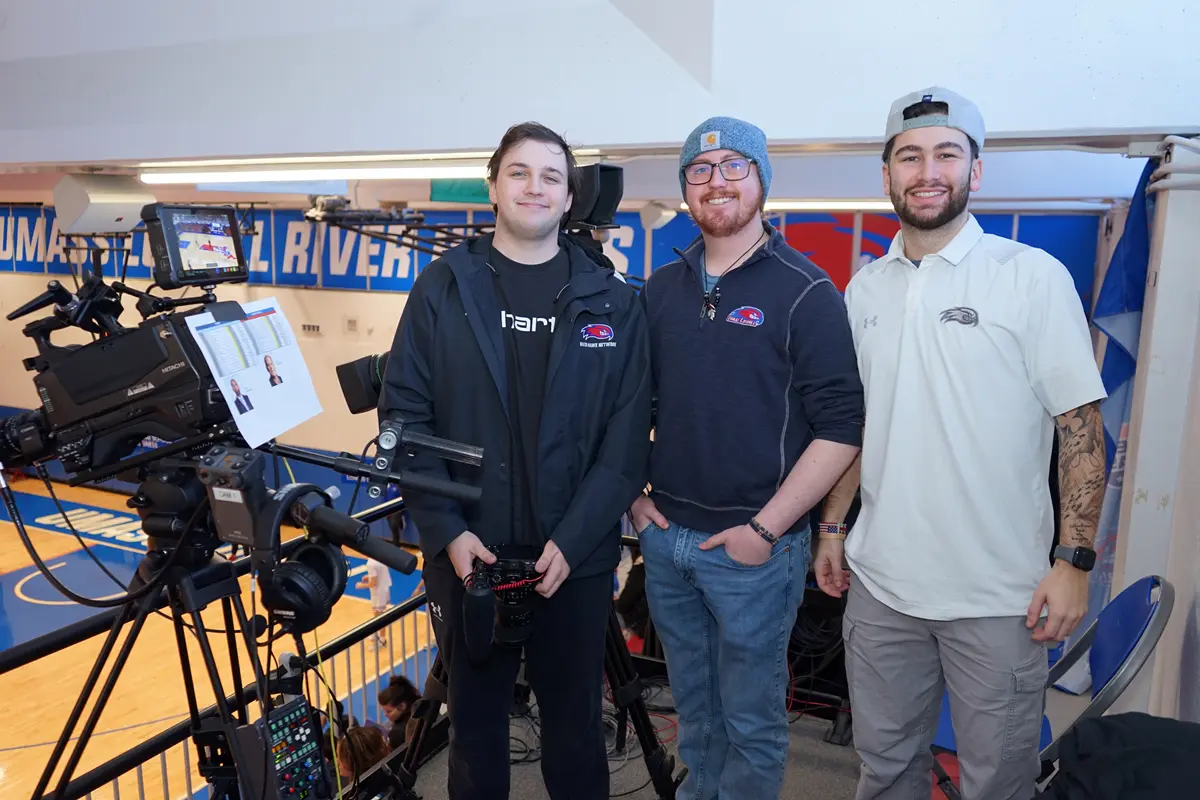 Image by Ed Brennen
 Senior digital media majors, from left, Connor Eastman, Patrick Higgins and Jack Giancotti are honing their video production skills as Athletic Communications student employees.
Romaniko says the program is working to formalize and expand these opportunities, potentially developing a concentration in sports media and live production.
Connor Eastman, a senior digital media major from Milford, has worked with the production team since his second semester on campus. What began as an internship quickly expanded into a wide-ranging role covering nearly every River Hawk sport.
“I’ve always been into photography and videography, and it’s something I want to do after I graduate,” says Eastman, who works about 20 hours a week shooting photos and videos of games and creating social media content.
“It's cool when people enjoy the content we put out, especially the athletes,” Eastman says. “That’s why you do the job.”
Weiller says Eastman has become a key part of the production operation, helping newer students learn equipment and workflows.
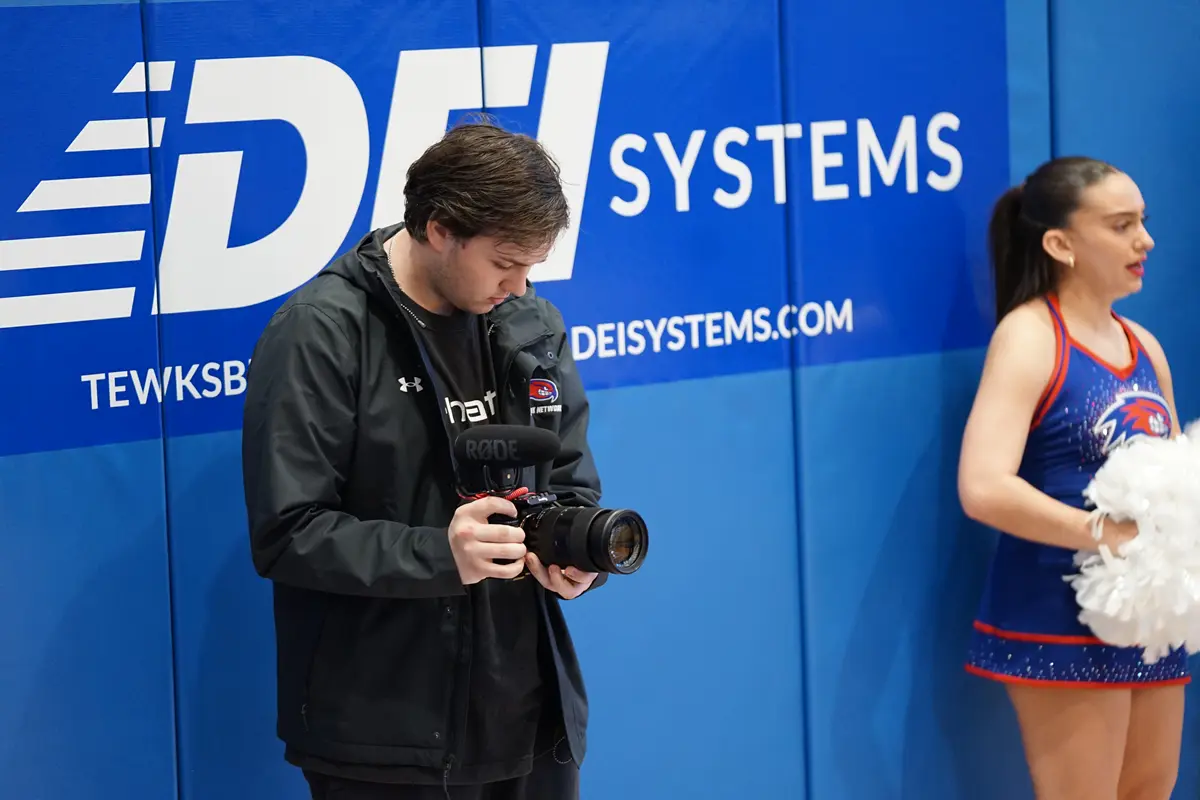 Image by Ed Brennen
 Senior digital media major Connor Eastman works about 20 hours a week with Athletic Communications, shooting video and photos and creating social media content.
“I came to UMass Lowell hockey games as a kid, and now I get to shoot them,” says Giancotti, who is also a camera operator for the Boston Fleet, the Professional Women’s Hockey League team that plays its home games at the Tsongas Center.
Giancotti says he was encouraged by Digital Media faculty to apply for an Athletic Communications internship, which was supported by a $2,500 Moloney Student Scholar award. Since then, he has gained hands-on experience with professional broadcast equipment and connected with freelance camera operators hired by the university who also shoot Patriots, Celtics and Bruins games.
“I knew pretty much nothing about the high-quality cameras and equipment that we have here,” Giancotti says. “When you join this type of role, you get well-versed in all the cameras. Grant and the staff teach you and set you up for future jobs.”
Patrick Higgins, a senior digital media major from Centerville, joined the Athletic Communications team last year. A lifelong sports fan, Higgins originally thought he wanted to work in audio before discovering a passion for camera operation.
“Once I got behind the camera, I fell in love with it,” says Higgins, who originally received course credits for his work and is now a paid intern.
During a recent men’s basketball game, Higgins worked alongside Giancotti from the rafters of the Kennedy Family Athletic Complex, operating a “tight camera” that followed the action closely.
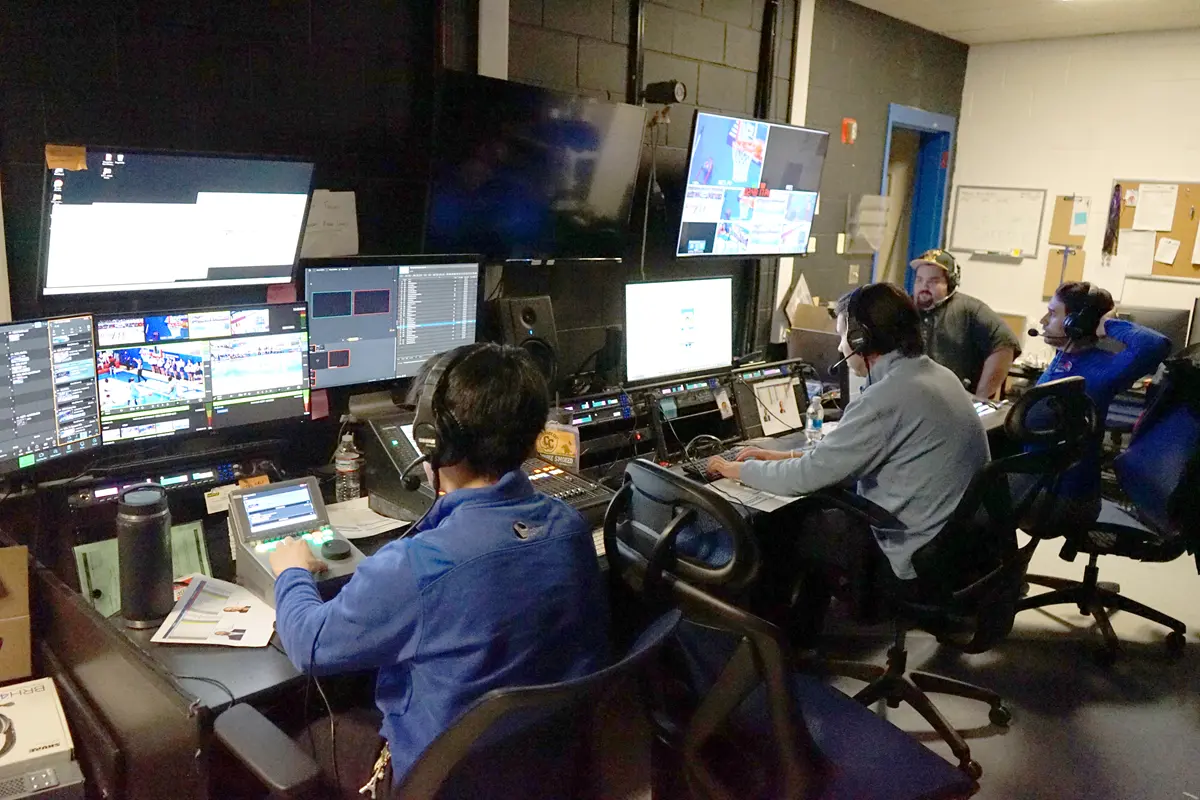 Image by Ed Brennen
 In the production control room at the Tsongas Center, Grant Weiller, right, and his team turn the camera feeds into a polished broadcast.
Behind the scenes, making that “big time” experience possible requires more than cameras and talent.
A multiyear effort led by Information Technology has recently modernized the university’s video production infrastructure, transforming how athletics broadcasts are produced.
According to Senior Network Engineer Chris McGee ’05, the project gained urgency as Athletics expanded its ESPN broadcasts and ran into the limits of a legacy system that relied heavily on “dark fiber” connections.
“We had to manually move fiber cables and cross-connect them for each game,” McGee says. “Sometimes it could take hours between events, and if it was a weekend, we couldn’t always support it.”
The solution was a shift to a network-based production model that uses the university’s existing wired infrastructure. At the center of each broadcast is a “flypack” — a mobile unit that encodes video, audio and communications from the venue and sends it back to the control room at the Tsongas Center. Under the old system, it depended on specific fiber connections, limiting where and how quickly productions could operate.
The new flypack connects through a single network port at each venue, allowing broadcasts to run wherever there is network access and making it easier to expand streaming across campus.
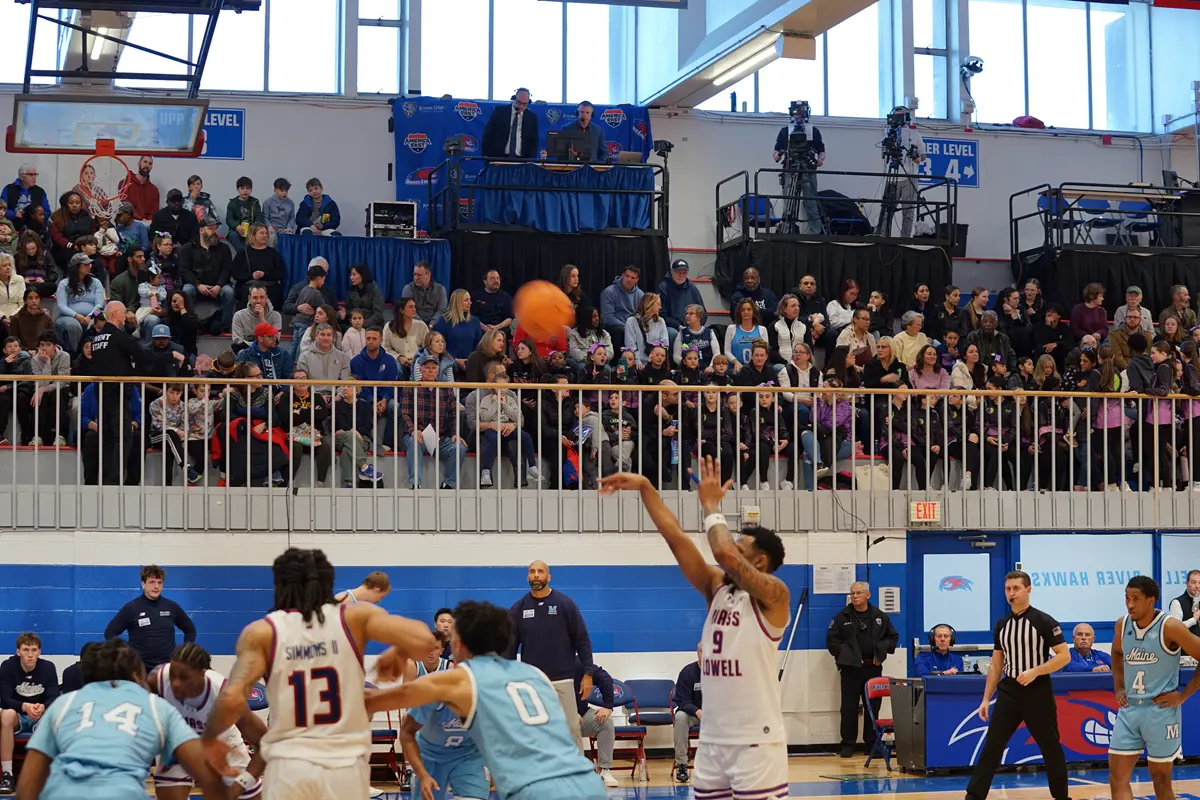 Image by Ed Brennen
 High above the court, camera operators Patrick Higgins and Jack Giancotti follow the action during the UML men's basketball team's recent win over visiting Maine.
McGee notes that because the infrastructure is scalable, it can also support productions beyond athletics, such as an event at University Crossing.
Before the upgrade, camera operators at the venue were connected to Weiller and the production team in the control room at the Tsongas Center through a real-time communications system, though crews sometimes supplemented it with phone calls or Discord messages depending on the setup. The new network-based system streamlines those connections.
“They have one network device that works,” McGee says. “They can focus on producing the game better.”
For students like Eastman, Giancotti and Higgins, that means fewer technical hurdles and more time focused on learning their craft in a real Division I environment.