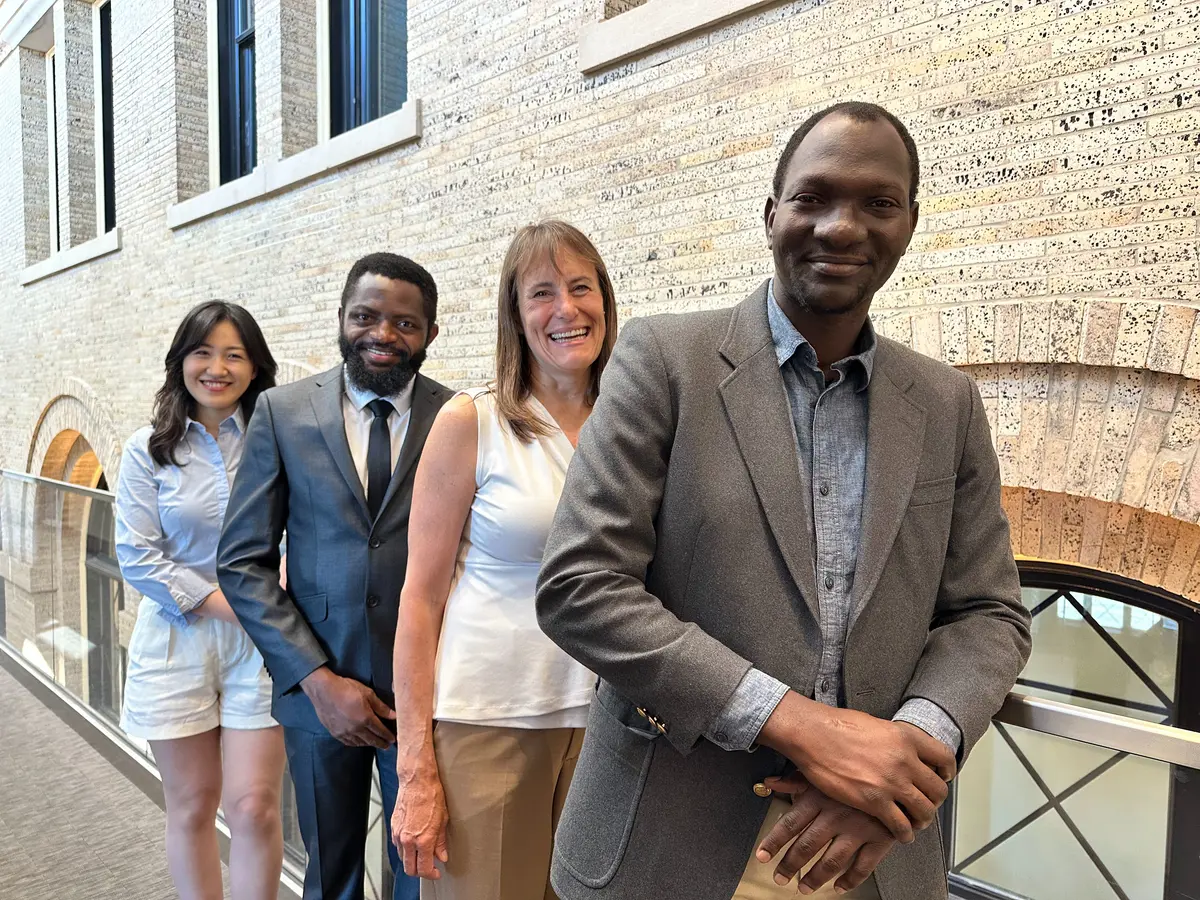
Topics: Research
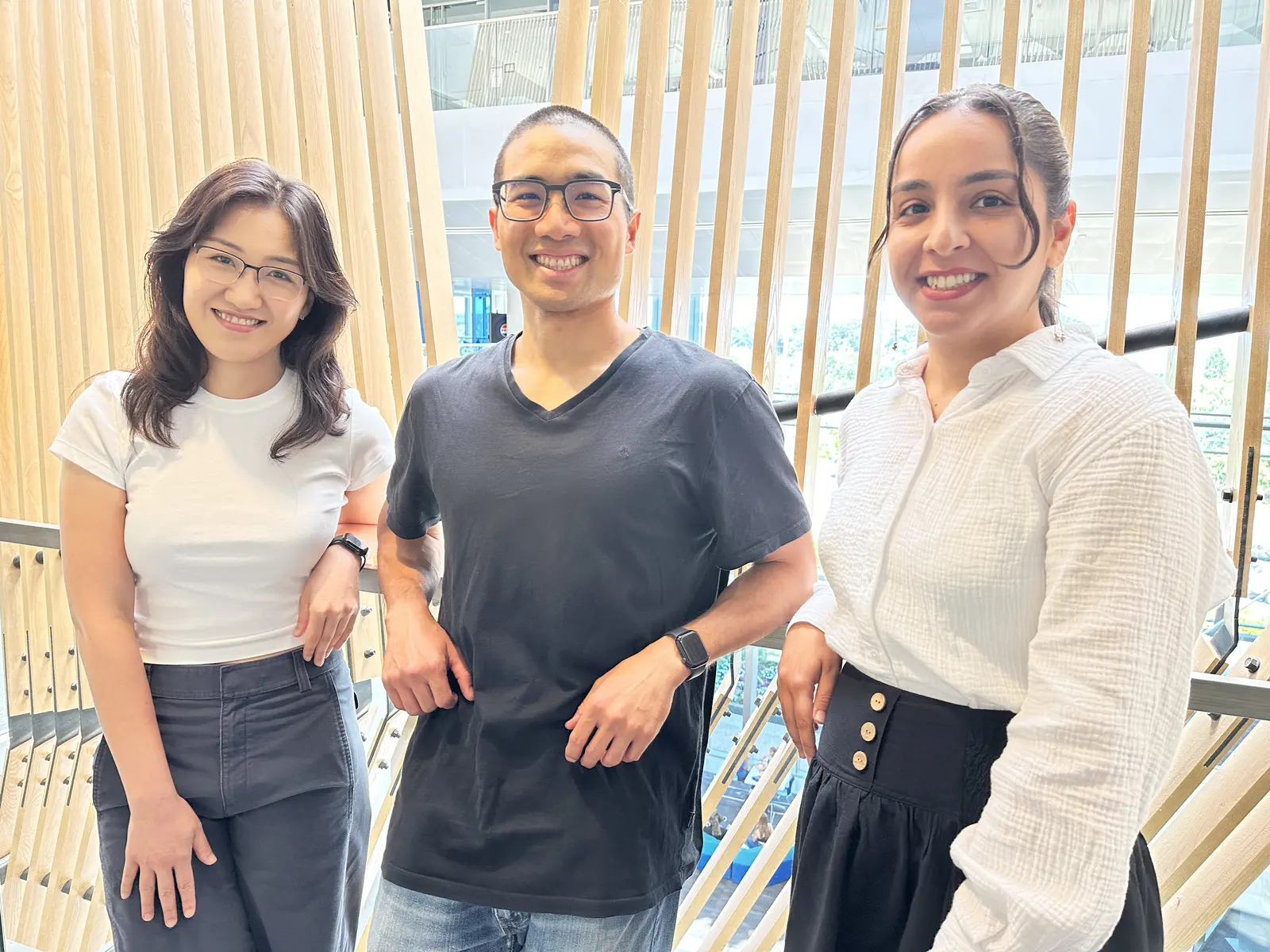 Image by K. Webster
 Computer Engineering Associate Professor Lewis Tseng with Education Ph.D. students Youlim Lee, left, and Negin Yazdani Motlagh, right. Lee and Yazdani Motlagh are research assistants on Tseng's National Science Foundation grant to co-design a data-sharing federation with scientists.
Technology now allows scientists to generate huge quantities of data – for example, thousands of MRIs that map the brain’s neural networks – but researchers’ ability to share that data is lagging, says Electrical and Computer Engineering Associate Professor Lewis Tseng.
Tseng and School of Education Associate Professor Hsien-Yuan Hsu have just been awarded a two-year, $499,490 National Science Foundation planning grant to model a national, artificial intelligence-ready framework for sharing such data to promote scientific discovery.
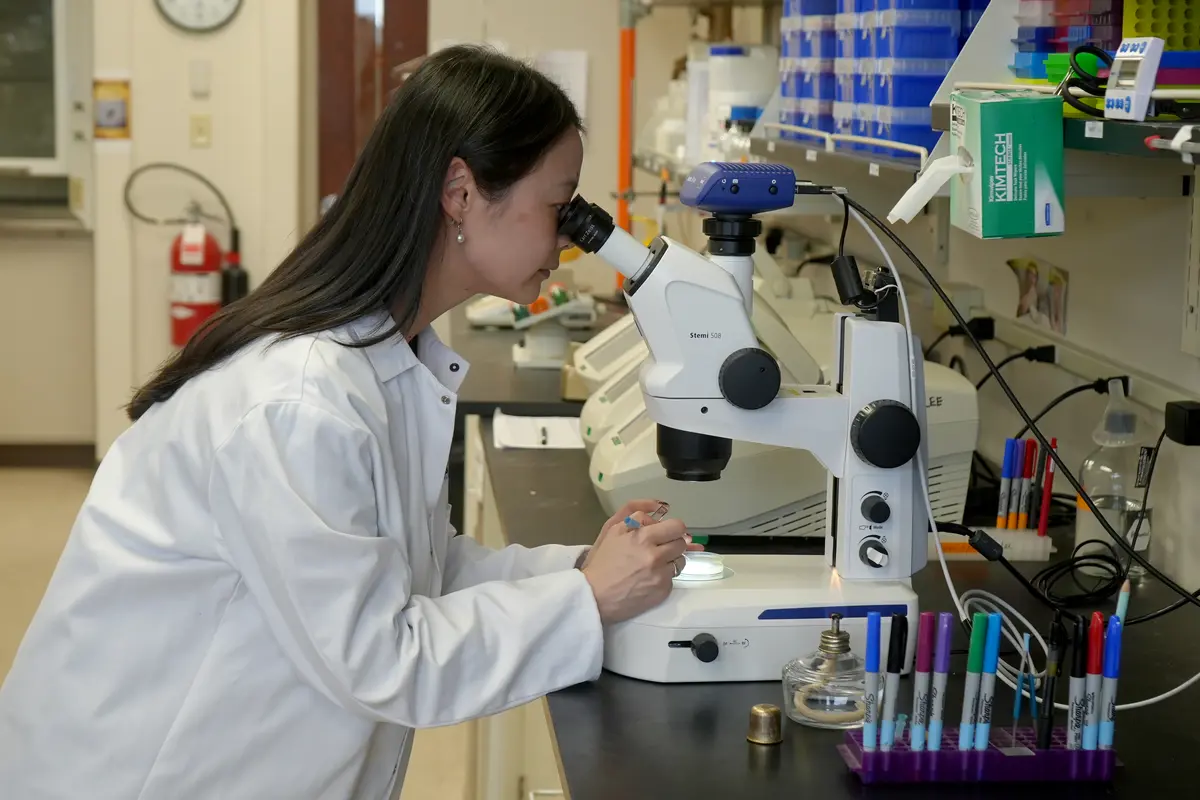
Scientists in biology, geology, meteorology and other disciplines are using increasingly sophisticated instruments that produce reams of data – often so much that the scientists turn to artificial intelligence (AI) for initial analysis, Tseng says.
But they typically encounter problems when they try to collaborate across academic, government or private research institutions that use different platforms and software and have different policies on AI, cybersecurity and intellectual property.
No single national repository can store so much data – especially imaging data, which will be the research team’s main focus to start. So Tseng and Hsu will work with scientists, engineers, computer systems managers and educators to co-design a data-sharing federation that will allow each institution to retain control over its own data and policies, Tseng says.
“Let’s say you make 200,000 ultra-high-definition movies showing materials changing at the atomic scale. How are you going to share that?” he says. “We’re in transition from this manual era to this automated era. It’s like going from horses to self-driving cars.”
Tseng, whose research focus is distributed computing systems – linking multiple computer systems for massive computing power – is the principal investigator on the grant.
His co-principal investigators are Hsu, who specializes in educational psychology and engineering education, and Yu-Tsun Shao, an assistant professor of chemical engineering and materials science at the University of Southern California with expertise in analyzing ultra-high-definition electron microscope films.
They will also draw on the experience of two other scientists: Wen-Ping Tsai, an assistant professor of geology at National Cheng Kung University in Taiwan who uses AI to analyze hydrological data, including satellite images, and Donglai Wei, an associate professor of computer science at Boston College who analyzes magnetic resonance imaging (MRI) exams to better understand the brain’s neural networks.
Using a “teach, explore, design” process, they will co-design one or more federated models that would allow researchers to share their own scientific discoveries, collaborate with each other and find and analyze others’ data.
The design will provide a platform that will enable AI discovery and analysis while incorporating responsible AI practices, Tseng says. The group will also generate educational materials on how to participate in the network.
“How do we involve different communities and users to co-design a decentralized data-sharing system? It is certainly a challenge,” Tseng says. “This is not trivial. We need to ask questions, but we also need to educate them about how we can coordinate resources while respecting institutional constraints.
“We want to build a shared language, understand people’s real workflows and limits, and create an AI-ready design with the people who will operate and use it.”
The research team will also prototype and test selected parts of the design and workflow. Then, Tseng will seek another grant to build a model, test it and refine it while bringing in more scientists, computer staff and institutions.
“The second phase is development and deployment,” he says. “All of the educational materials will be open source … but we also understand that every institution will have its own intellectual property and other rules, and they should maintain control over those rules and their raw data.”
Two School of Education Ph.D. students, Youlim Lee and Negin Yazdani Motlagh, both pursuing the research and evaluation option within the doctoral program, are working as research assistants on the grant. Tseng is also recruiting a Ph.D. student in electrical and computer engineering to assist him.
Lee’s work on AI literacy in schools will be important for developing educational materials for the proposed federation, Tseng says.
Yazdani Motlagh says she is excited about the project because it aligns with her planned area of dissertation research.
“My focus is on the design process (and) how we can successfully integrate AI technology into higher education’s existing workflow,” she says.