
 Image by Ed Brennen
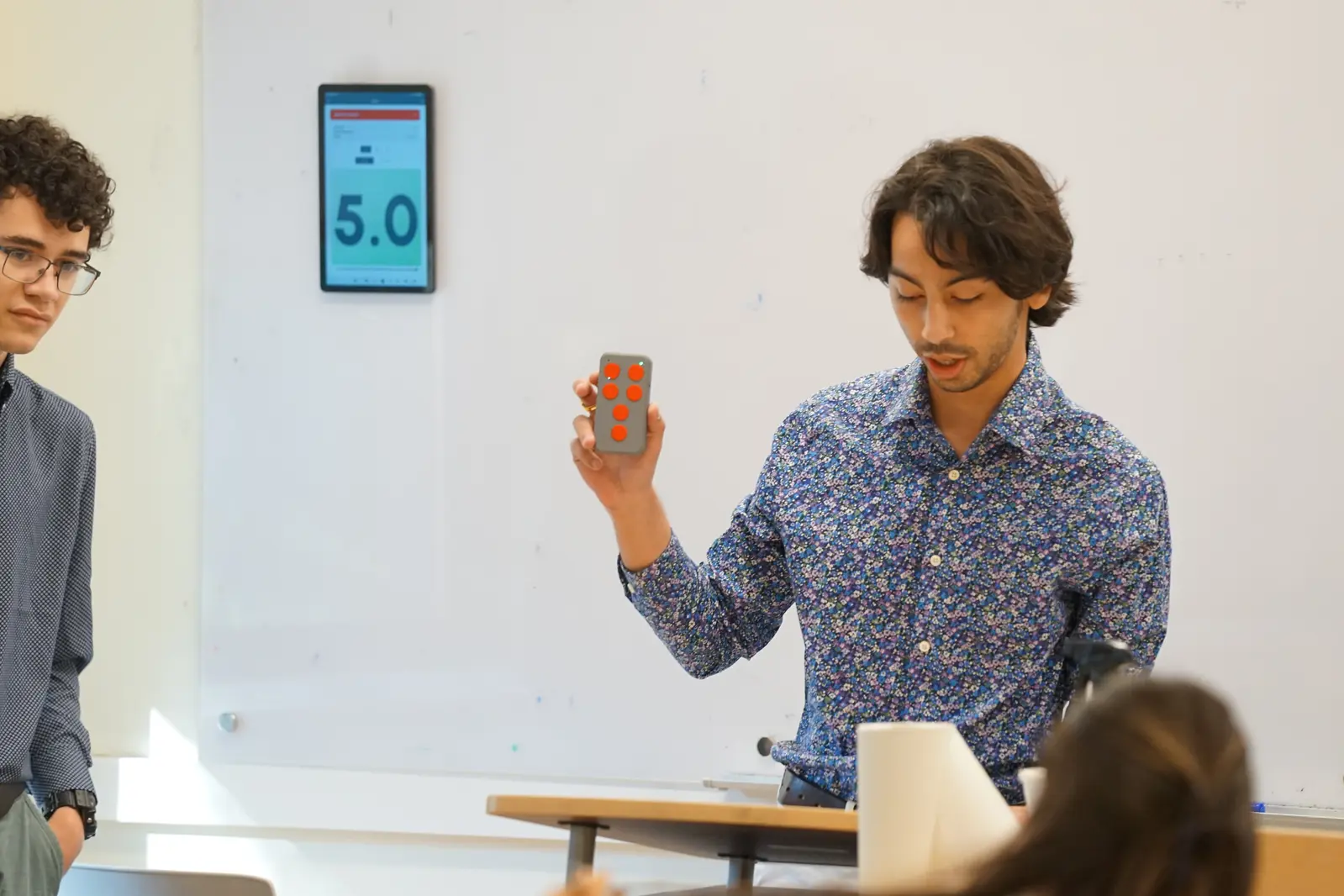
 Jetrin Orenberg '26 introduces the Comprehension Clicker, a device that displays students' real-time understanding of lecture material on a wall-mounted tablet, to a Physics II class this summer.
As a sophomore, Jetrin Orenberg ’26 sat in the back of a Physics II class struggling to follow a lecture.
Rather than raise his hand, he wondered if there was a better way for professors to know when students were confused.
Two years later, Orenberg was back in a Physics II classroom. This time, though, he was watching students test his Comprehension Clicker, a device born out of that experience.
“This is the culmination of two years of work,” says Orenberg, who earned bachelor’s degrees in electrical engineering and computer science and is continuing at UML this fall to pursue a master's degree in computer engineering. “It’s really a full-circle moment.”
Comprehension Clicker gives each student a small handheld device with five buttons, allowing them to anonymously rate their understanding of a lecture in real time, from 1 for “confused” to 5 for “everything is clear.” A sixth button lets students signal that they have a question.
The responses are displayed on a tablet at the front of the classroom, giving the professor a running measure of how well students believe they are following the material.
Orenberg began developing his idea through the Rist DifferenceMaker Institute. Working alone, the Franklin native built a rough prototype housed in what he now calls an “ugly” 3D-printed case.
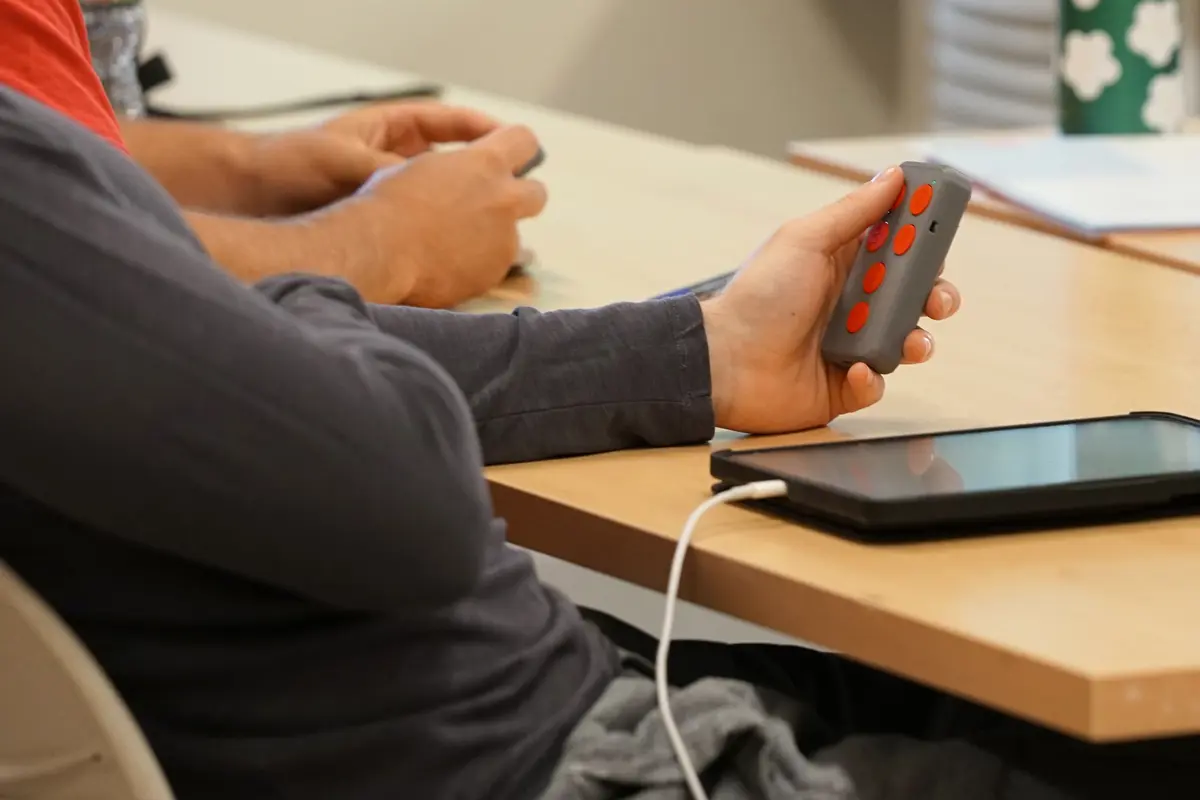 Image by Ed Brennen
 Physics II students try out the Comprehension Clicker during a class this summer at Olsen Hall.
“We wouldn't be here without DifferenceMaker,” says Orenberg, who credits the program with providing funding, mentors and connections to industry events. “That was a kickoff point.”
Orenberg says “we” because Comprehension Clicker is no longer a one-man operation. He turned the project into his senior electrical and computer engineering capstone, bringing fellow students David Green, Kevin Pelletier ’26 and Saif Ansari ’26 onto the team.
“I wanted to be a one-man show. I wanted to do it all by myself,” Orenberg says. “Now, I don't know how I could have done it without these guys.”
Over the past year, the team has transformed the rough prototype into a smaller, sleeker device designed for production. They have assembled classroom-ready units, explored manufacturing partnerships and formed Comprehension Clicker LLC in Massachusetts.
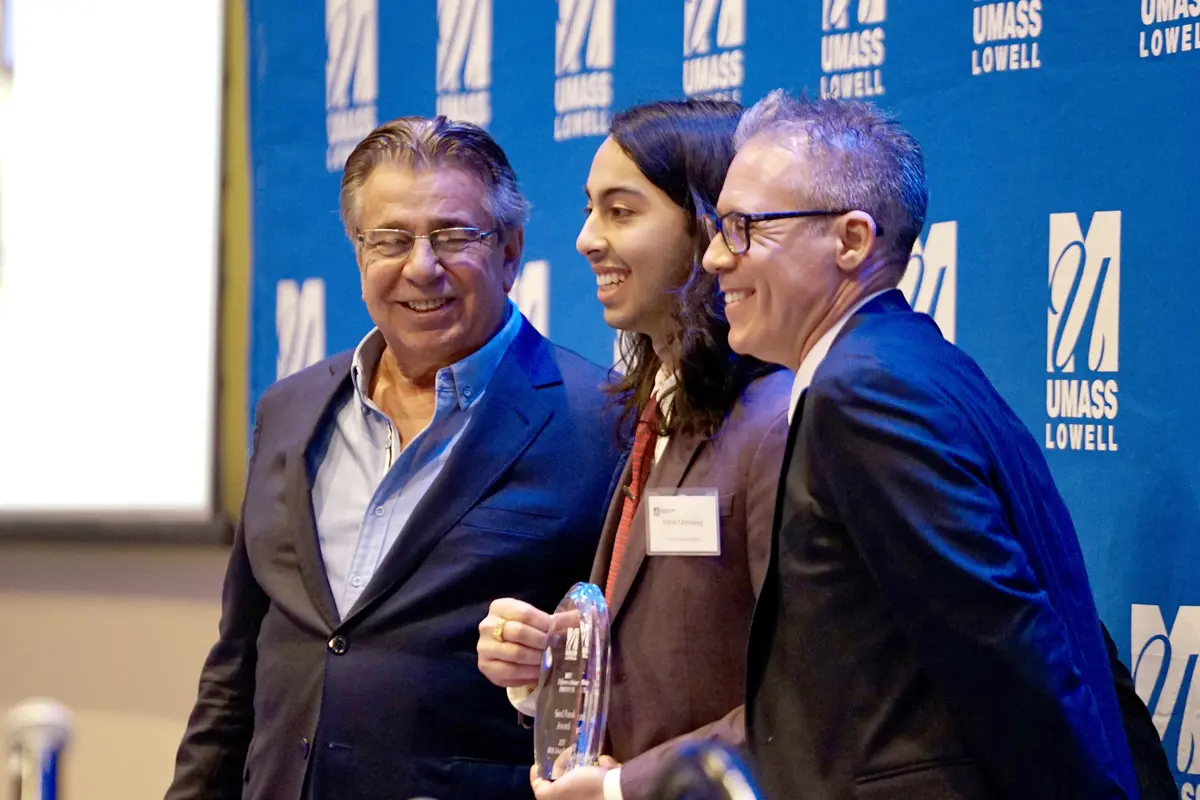 Image by Ed Brennen
 DifferenceMaker judge Brian Rist '77, '22, '22 (H), left, and program director Richard Juknavorian '98, right, pose with Jetrin Orenberg '26 after his Comprehension Clicker won a $2,000 seed fund award at the $50K Idea Challenge.
All of that led back to Physics II this summer.
Orenberg and his teammates approached Assistant Teaching Professor Cecil Joseph about testing the device in his summer course. Joseph’s initial reaction wasn’t exactly what they hoped for.
“My initial response back was, like, ‘No electronics in my classroom,’” says Joseph, who doesn’t allow students to use phones during class.
Then the team explained that Comprehension Clicker was a stand-alone device that couldn't connect to the internet.
“It sounded like a really good idea,” Joseph says.
Joseph was already familiar with classroom clickers, which instructors have used for years to have students answer multiple-choice questions at designated points during a lecture. He says Comprehension Clicker differs by allowing students to continuously signal how well they're following the material, without waiting for the instructor to pose a question.
“It's more real time,” he says.
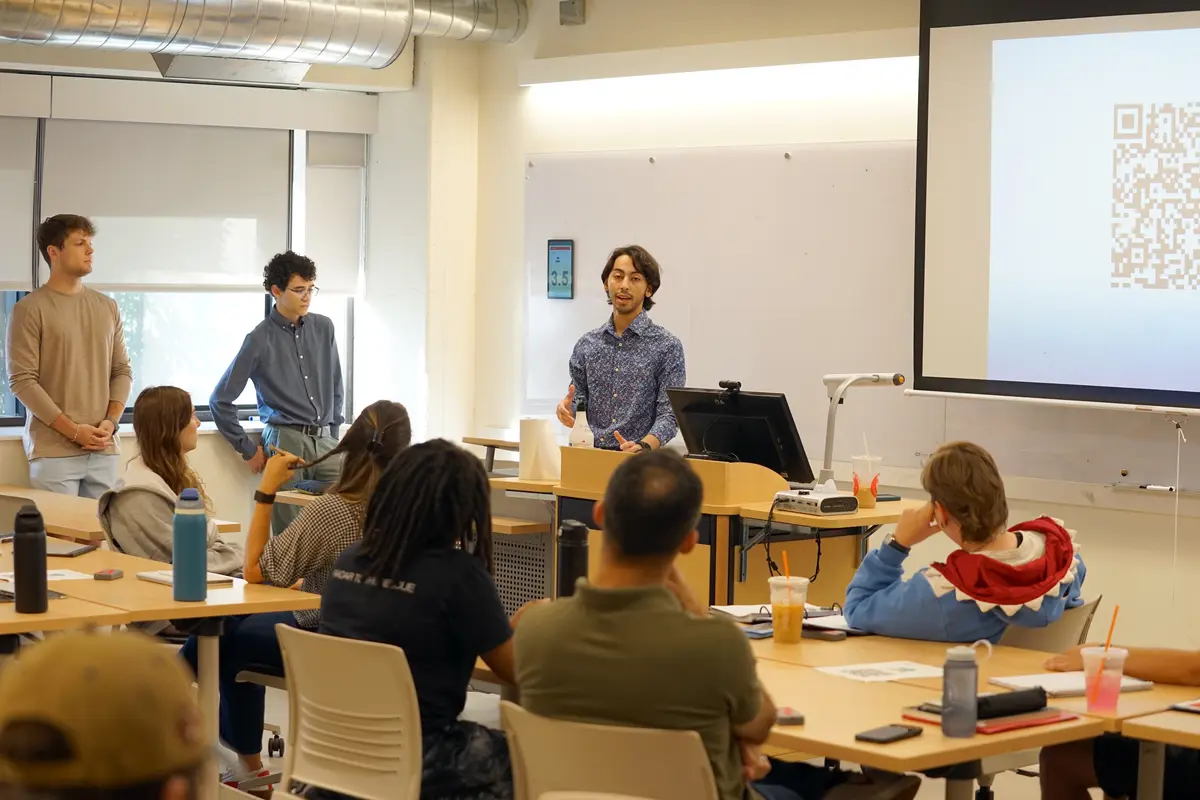 Image by Ed Brennen
 Jetrin Orenberg '26 explains to Physics II students how the Comprehension Clicker works while team members Kevin Pelletier '26, left, and David Green look on at Olsen Hall.
“It was exciting to see the system used in a real classroom for the first time,” says Ansari, who serves as the team’s test engineer. “We learned a lot and are looking forward to improving the system.”
Joseph says the clickers gave him another way to recognize when students were struggling — something they aren't always willing to signal in class.
“Students can be very shy about speaking out,” he says. “Any input instructors can get in terms of real-time feedback is a very good idea.”
At one point, Joseph saw the score drop before he’d even begun working through a math problem.
“I said, ‘Now we have to do some math,’ and the score automatically dropped like 1.5,” he says. “I didn't even do the math.”
Joseph sees particular promise for the device in STEM courses, where concepts continually build on one another. But he says longer trials are needed to answer questions raised by the pilot, including whether students will consistently use the devices and whether declining comprehension late in a 2½-hour summer class reflects the material or simply fatigue.
With the first pilot complete, Orenberg and his teammates are analyzing the data and using what they learned to guide their next round of hardware and software changes. They hope to conduct additional classroom trials as they work toward manufacturing the device at scale.
For Orenberg, the motivation remains the same as it was in that Physics II class two years ago.
“This idea came from a place of me as a student who was struggling,” he says. “This is a device by students, developed for students.”