
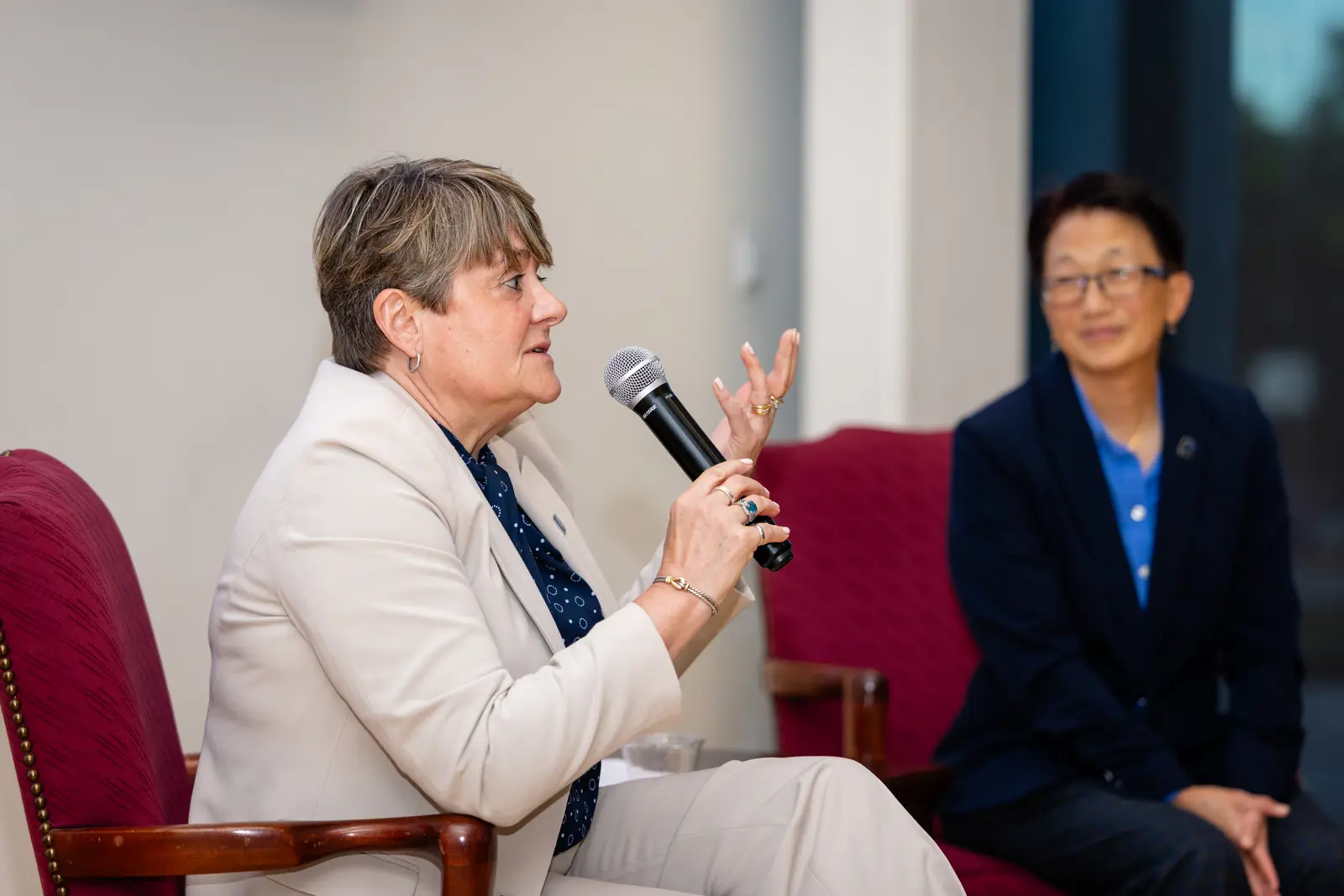
 Image by Henry Marte
 Civil engineering alumna Lisa Brothers '84, left, and Chancellor Julie Chen share career advice for women engineering students during a recent fireside chat hosted by the Society of Women Engineers and the Shah Academy of Innovation and Leadership at the Saab Emerging Technologies and Innovation Center.
Julie Chen never planned to become a university chancellor.
As an undergraduate at MIT, she expected to earn her mechanical engineering degree and enter industry. Instead, coaching field hockey led her to discover a passion for teaching. A position at the National Science Foundation later broadened her perspective on research and higher education.
Chen shared that story with nearly 80 students during a recent fireside chat with UMass Lowell alumna Lisa Brothers ’84, hosted by the Society of Women Engineers (SWE) and the Shah Academy of Innovation and Leadership.
The conversation, moderated by Brothers, the retired president and CEO of Nitsch Engineering, focused on career development, leadership, impostor syndrome, networking and the experiences of women in engineering and STEM.
Here are five lessons students heard from Chen and Brothers:
1. Your career path probably won’t be linear.
As an undergraduate, Chen wasn’t planning on a career in academia. But once her interest in teaching was sparked, she decided to pursue a master’s degree and doctorate. Later, as a UMass Lowell faculty member, she served as a project manager at the National Science Foundation in Washington, D.C., before moving into university administration.
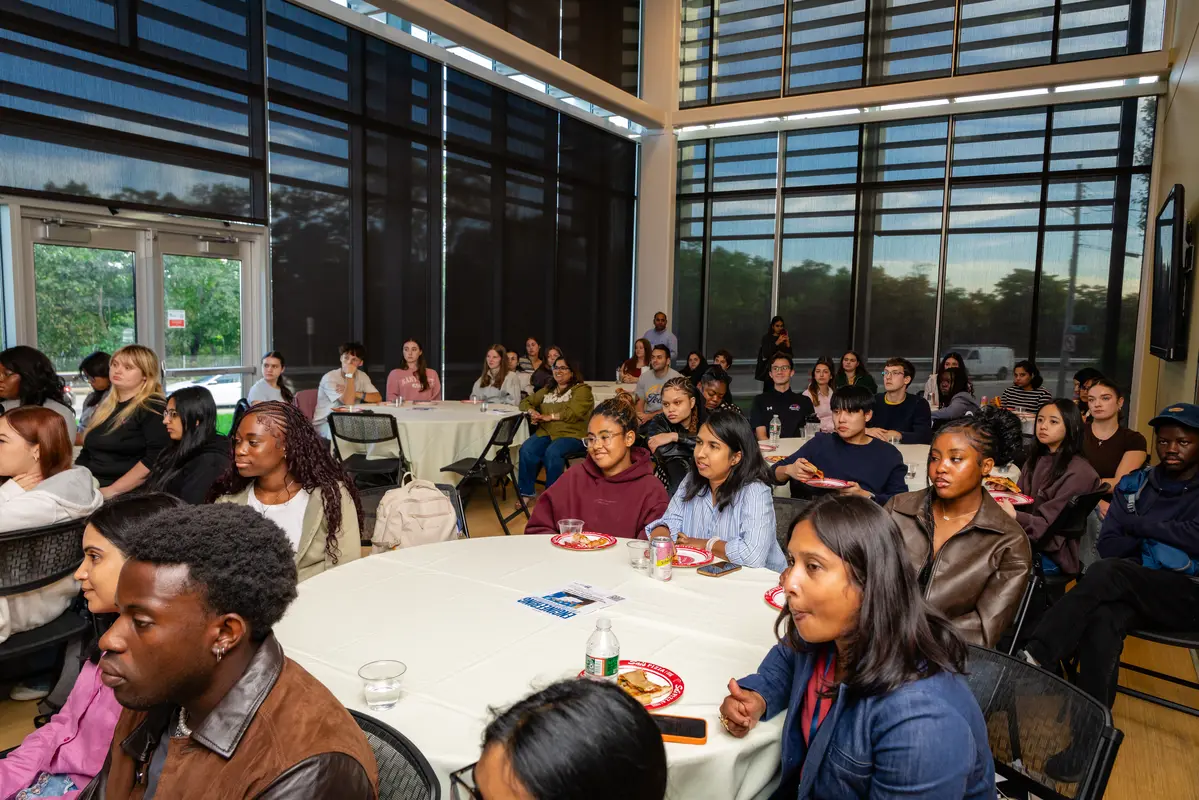 Image by Henry Marte
 Approximately 80 students packed Saab ETIC's Perry Atrium for the fireside chat on women leading change.
Brothers encouraged students to remain open to unexpected opportunities.
“The path is not linear,” said Brothers, who earned a bachelor’s degree in civil engineering from UMass Lowell and an MBA from Northeastern. “Don’t be afraid to stretch. Just step forward.”
2. You don’t have to know everything before becoming a leader.
No one has every qualification or every answer before taking on a new challenge, Chen said. Leaders must be willing to learn and build teams with different expertise.
“Don’t be afraid to ask questions and bring on teammates who know more about something than you do,” said Chen, whose experience as a student-athlete also shaped her approach to leadership.
“You want to form a team of people that have different skills and complementary skills,” she said.
Brothers agreed that leaders should surround themselves with people whose strengths complement their own.
“Diversity of education and thought process — that makes a stronger team,” she said.
3. Impostor syndrome is common — even among accomplished leaders.
Both speakers acknowledged that they have sometimes felt unqualified or out of place in professional settings.
Chen said that throughout her career, she was often one of the only women, Asian Americans or engineers in the room.
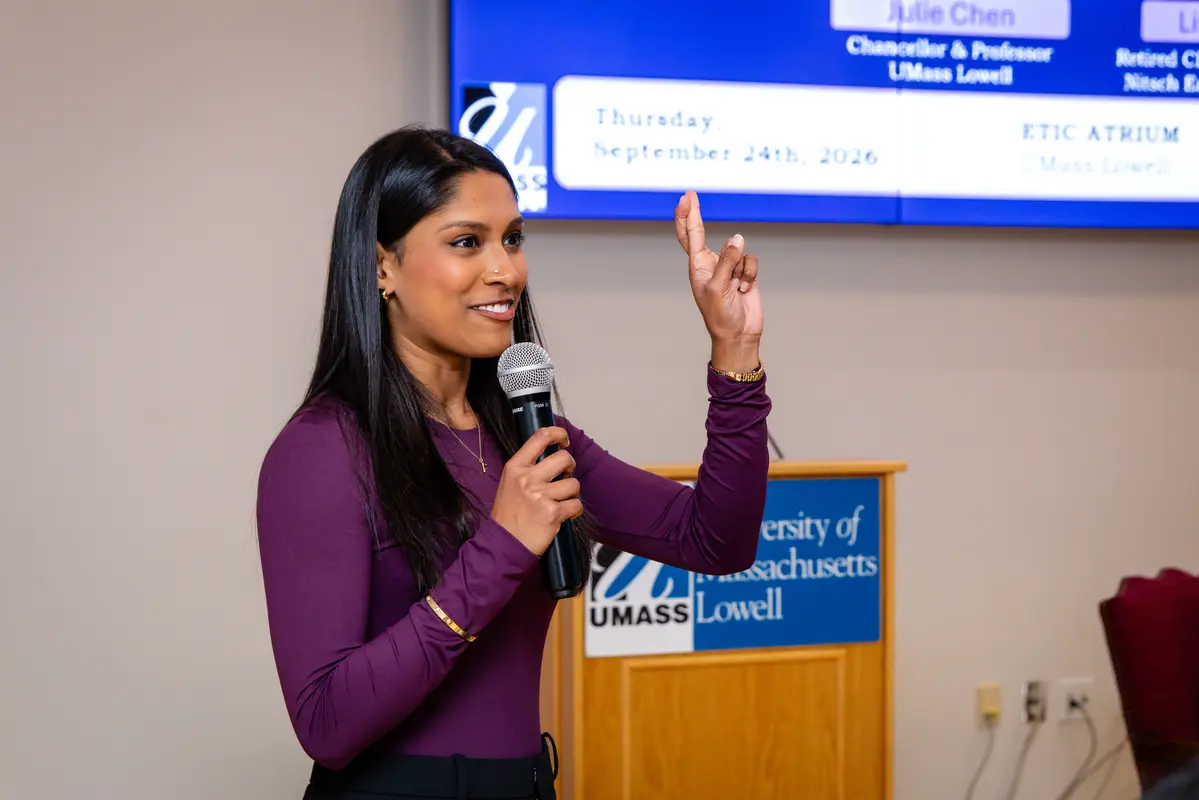 Image by Henry Marte
 Senior civil engineering major Fatin Rahman, president of the Society of Women Engineers, introduces the speakers.
Her advice was to focus on the work in front of you and keep moving forward.
“None of us has everything that you need to be perfect in a role,” Chen said.
Added Brothers: “You might be surprised how many other people around the table have impostor syndrome, too. Don’t think you’re the only one sitting around the table thinking, ‘What the heck am I doing here?’”
4. Build a network that supports you.
Brothers described her professional network as a “kitchen cabinet” — a group of people she could turn to for advice and perspective. She urged students to cultivate those relationships through professional organizations such as SWE.
“It can get lonely sometimes, depending on where you are as a female engineer,” Brothers said. “Make sure that you are engaged in some of those professional societies.”
She was encouraged to see that the audience in the Saab Emerging Technologies and Innovation Center’s Perry Atrium included men as well as women.
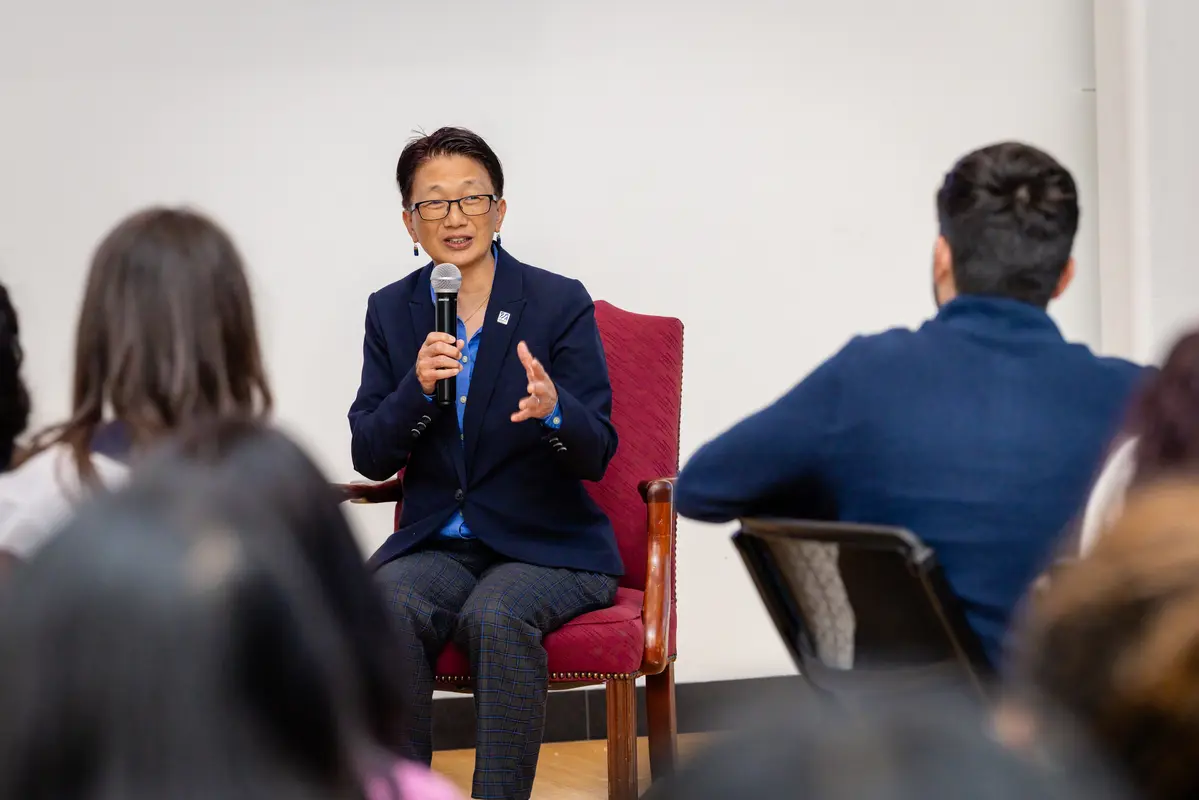 Image by Henry Marte
 Chancellor Julie Chen discusses her journey from MIT mechanical engineering grad to higher education leader.
Chen encouraged students to follow up after meeting someone and to approach networking as a relationship rather than a one-time request for help.
“Don’t talk to them once and then never talk to them again,” she said. “There is a little bit to that repeated interaction in the right span of time so that you stay in their memory banks.”
“It’s not all about you telling them who you are,” she said. “It’s also listening.”
5. Leave the organization stronger than you found it.
Chen and Brothers emphasized that strong leaders prepare others to take on new responsibilities and leave their organizations stronger.
“A big part of your responsibility as a leader, no matter where you are in an organization, is professional development and opportunity for the people who work below you,” Chen said. “It’s about leaving the place better than when you found it.”
Brothers offered an example from her time leading Nitsch Engineering. Several years before stepping down as president and CEO, she told the company’s board when she planned to retire and helped develop a multiyear succession process.
“The best feeling is when you lead something or you create something and you actually can step away from it and it continues to go beyond you, because that is a true spark of leadership,” Brothers said.
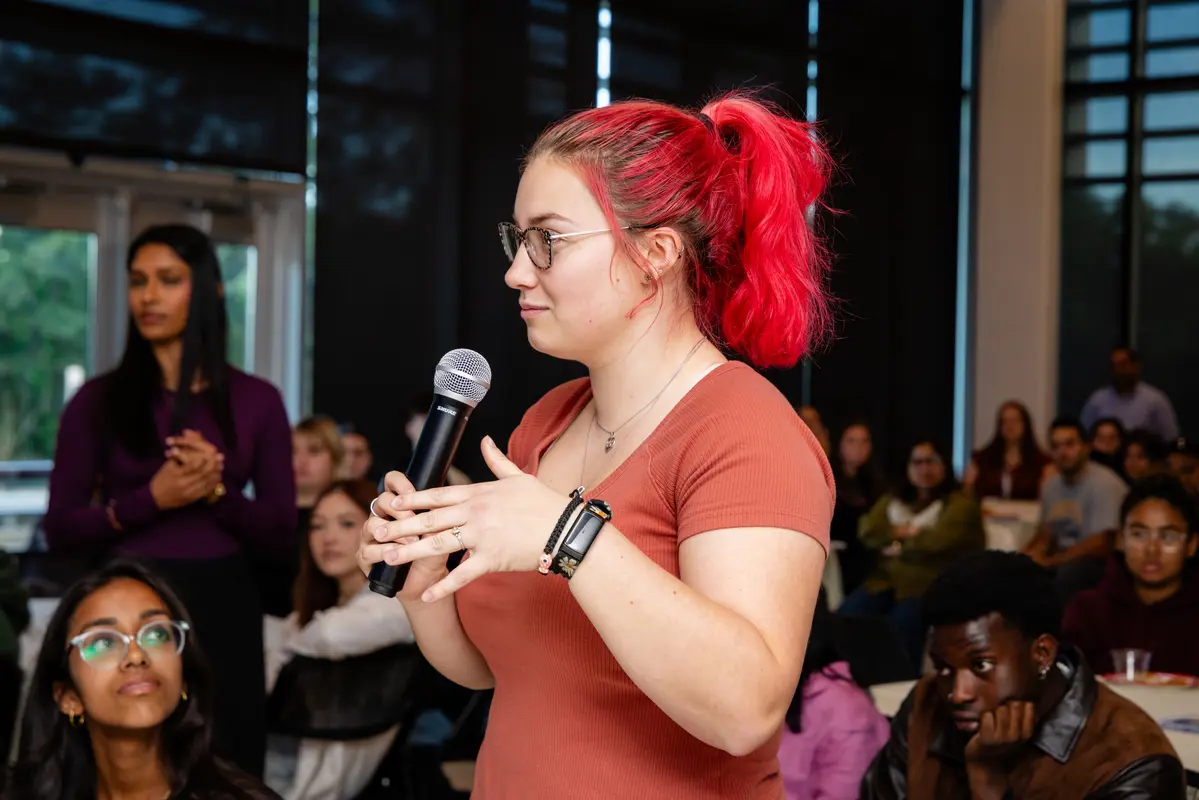 Image by Henry Marte
 Senior civil engineering major Lana Viola poses a question to the speakers.
“It was hard for me to fit in at first, because I was a bit afraid,” she said. “But she gave me a lot of insight, and it really helped me think about the future and how I would want to step up as a leader.”
Lana Viola, a senior civil engineering major from Haverhill, came away from the discussion with valuable perspectives on the realities of building a career in engineering.
“I’ve done a couple internships, mostly with men, so hearing from women coming into the field is really inspiring,” Viola said.
For SWE President Fatin Rahman, the event showed students that accomplished leaders did not begin with everything figured out.
“These are real people who were in the same place, who took the same classes,” said Rahman, a senior civil engineering major. “They just advocated for themselves at certain opportunities, showed up, connected with the right people or put themselves out there, even through failures.”
Seeing how Chen and Brothers navigated those challenges made the path from student to leader feel more attainable, Rahman said.
“It shows you that this jump from being a student, being so confused about what you want to do in your career, to being as established as the chancellor or Lisa is — it shows that it’s possible,” she said. “There are tangible steps you can take to get there.”
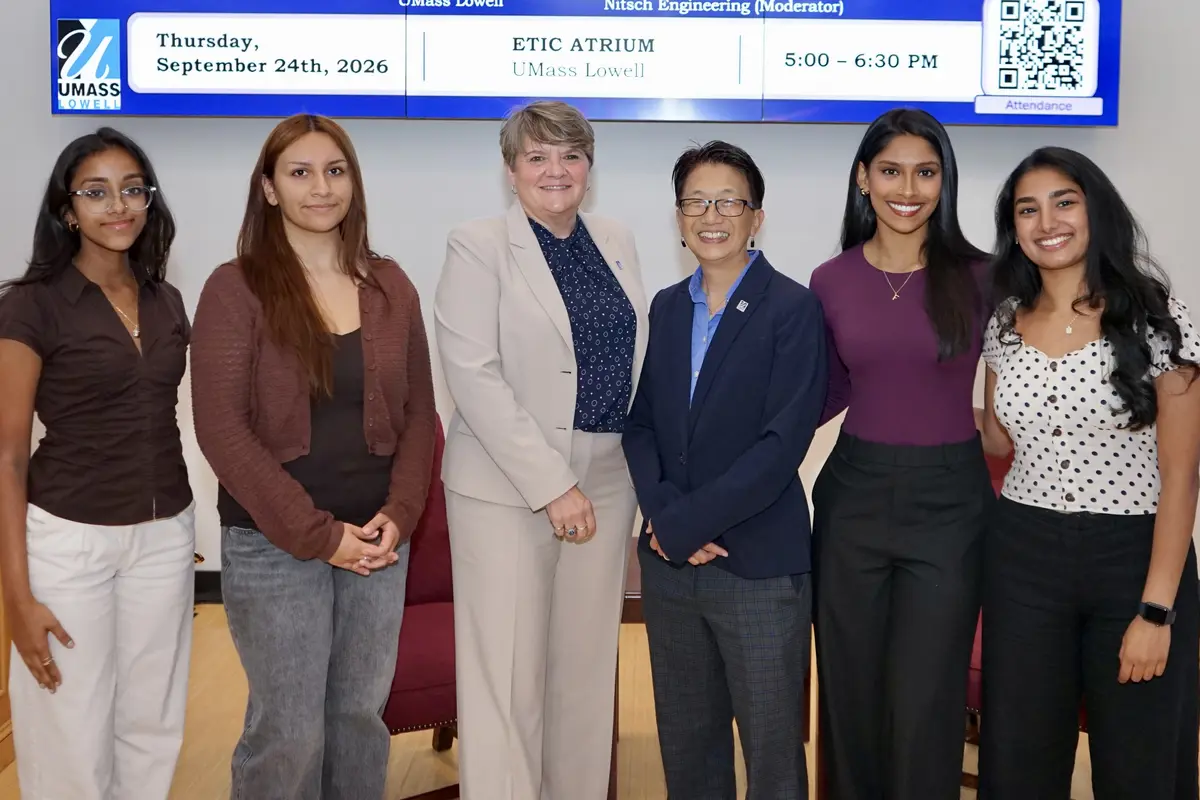 Image by Ed Brennen
 Lisa Brothers '84, center left, and Chancellor Julie Chen, center right, pose with members of the Society of Women Engineers executive board.