
 Image by courtesy
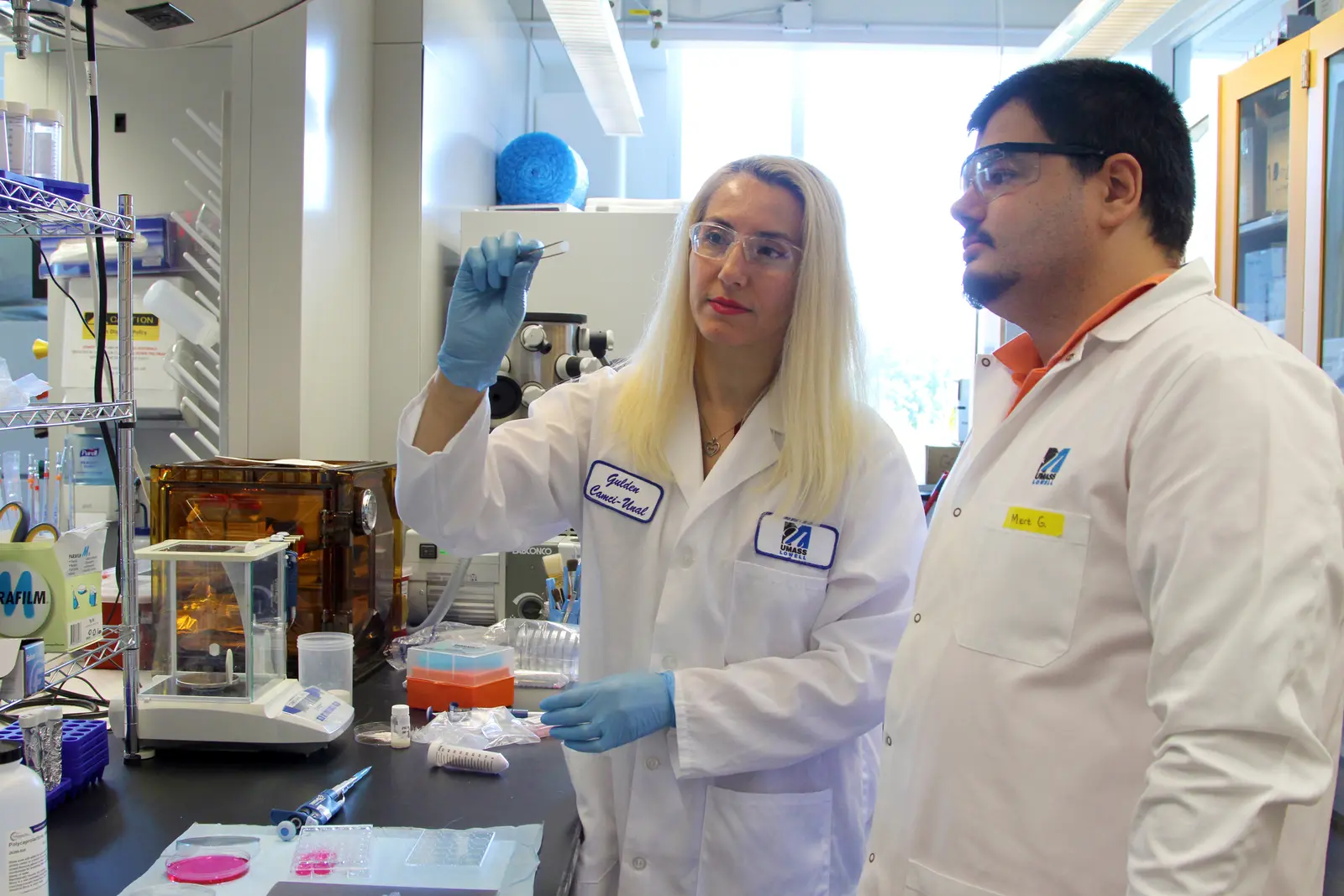
Chemical Engineering Professor Gulden Camci-Unal, left, seen here with Ph.D. student Mert Gezek, was recently named a fellow of the Biomedical Engineering Society in recognition of her groundbreaking research.
In the Francis College of Engineering lab of Professor Gulden Camci-Unal, everyday materials are transformed into advanced technologies for healing. She has developed methods to use powdered eggshells to engineer bone tissue, common proteins as scaffolding for pancreatic tissue, and methods to use paper origami as scaffolding for the reconstruction of many kinds of tissues, including skin and blood vessels.
The Biomedical Engineering Society (BMES) recently recognized these accomplishments by naming her among its 2026 class of fellows. “The fellow grade of membership is a prestigious and highly selective honor recognizing outstanding achievement and significant contributions to the field of biomedical engineering,” according to the organization.
In 2025, Camci-Unal was named to the College of Fellows for the American Institute for Medical and Biological Engineering, an honor that represents the top 2% of medical and biological engineers and includes Presidential Medal of Science and Nobel Prize winners.
Camci-Unal, a professor of chemical engineering, sat down to share the roots of her innovative approach and her thoughts on joining such an accomplished group of colleagues.
How did you develop your interest in tissue engineering?
My interest in the biomedical field comes from my own experience with sports-related injuries. I know firsthand some of the challenges that patients face during the healing process. I wondered if there could be better ways to help the body repair and regenerate itself. I started taking courses related to those areas. My curiosity developed into using science and engineering to address medical problems to improve human health.
You are known for your use of innovative materials such as paper, gelatin and eggshells. How did you come to use these materials?
The ultimate goal of my research is to improve human health and quality of life. We're interested in designing materials that mimic the important features of the native tissue environment. We try to use natural materials from everyday life. We want whatever we develop to be widely accessible in different parts of the world.
Eggshells contain calcium carbonate, which we also have in the native bone tissue. Paper is inexpensive, widely available and easy to manipulate. We’ve found that the material you use doesn’t have to be complicated. There could be existing materials that already mimic different aspects of the tissues that we’re trying to mimic.
Similarly, you've worked on bones, the pancreas and the heart. How do you decide which organ to focus on?
Typically, we start out addressing an unmet clinical need. Once we decide what question to answer, we look at the structure of the native tissue. Then, we come up with materials that can mimic different aspects of the tissue. Ultimately, we want to implant the materials that we're making into the damaged tissue so that we can heal, repair and regenerate them. Sometimes the innovation is in the materials, and sometimes it’s in an unconventional biofabrication technique.
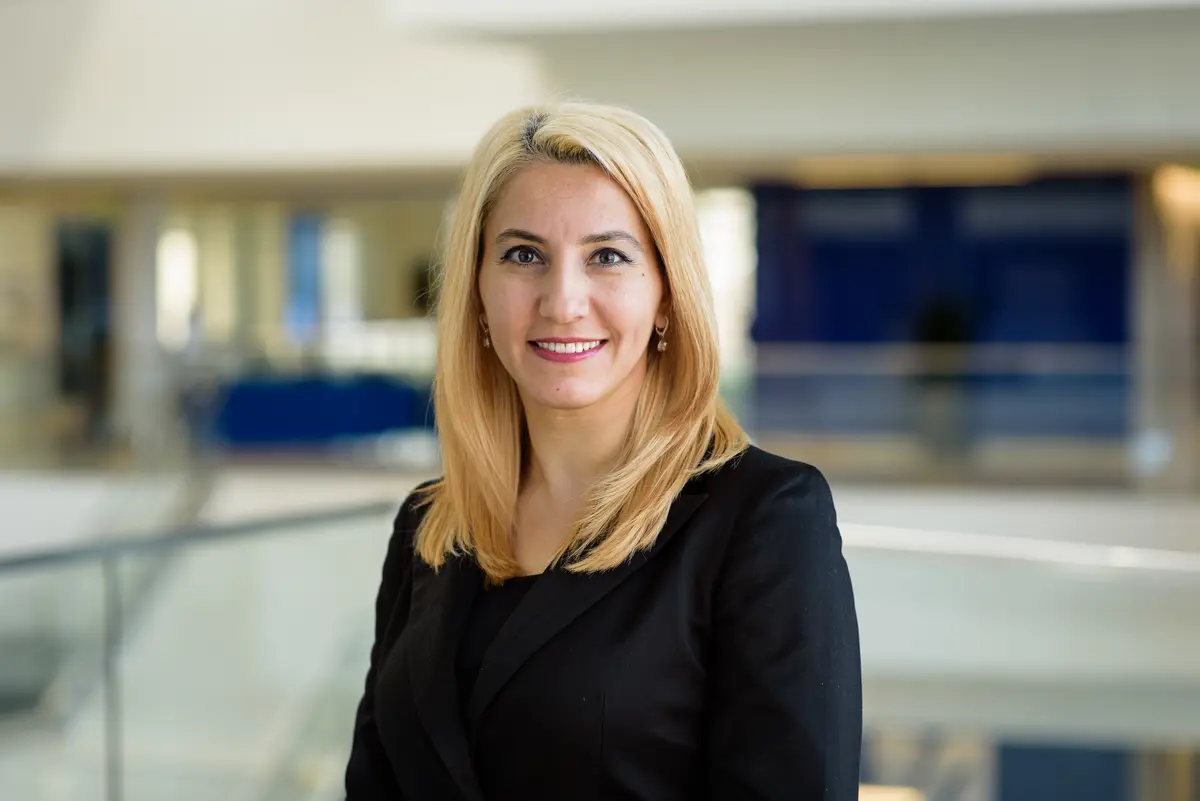
"Being recognized ... reflects the collective work of students, collaborators and colleagues, because research is never an individual effort," says Chemical Engineering Professor Gulden Camci-Unal.
We also use this approach to develop accessible and inexpensive ways of detecting or diagnosing diseases or health conditions. One example is that during the COVID pandemic, we developed a rapid home test that could detect both the virus and its antibodies in as little as five minutes. Again, we worked with accessible materials, here using paper-based microfluidics. From there, we developed various devices. One of these devices can detect multiple tropical diseases – dengue, zika and malaria – simultaneously.
How does teaching fit in with your research?
Students are central to everything we do, both in the classroom and the lab. One of the most rewarding parts of my job as a teacher is seeing my students learn and seeing them become independent scientists and engineers in their classes. One of the most rewarding aspects of my lab is seeing my students learn and become confident individuals.
What does being named a fellow in the Biomedical Engineering Society (BMES) mean to you? What about being named a fellow of the American Institute for Medical and Biological Engineering (AIMBE) last year?
Becoming a fellow is a tremendous honor. BMES has been an important professional community throughout my career, starting from my postdoctoral work. Being recognized by professional colleagues in this community is special. It reflects my work, but also reflects the collective work of students, collaborators and colleagues, because research is never an individual effort.
Receiving the AIMBE and BMES fellowships in consecutive years is significant to me. It’s given me an opportunity to reflect on how much our research program has developed, although I don’t see those recognitions as endpoints; I look at them as encouragement to continue, to keep pushing boundaries, mentoring the next generation of scientists and engineers and pursuing the technologies that can benefit human health.
These fellowships don’t just honor my work, but they also recognize the work of many people. They show the strengths of interdisciplinary research and biomedical study here at UMass. I’m grateful to the students, collaborators, mentors and colleagues who have contributed to this work over many years. I’m excited about what comes next.
So, what is next for you?
There are still important challenges that haven't been addressed in regenerative medicine, personalized medicine and diagnostics. I look forward to continuing to work on those as a team with students and collaborators to develop innovative solutions to those problems.