
 Image by Brooke Coupal
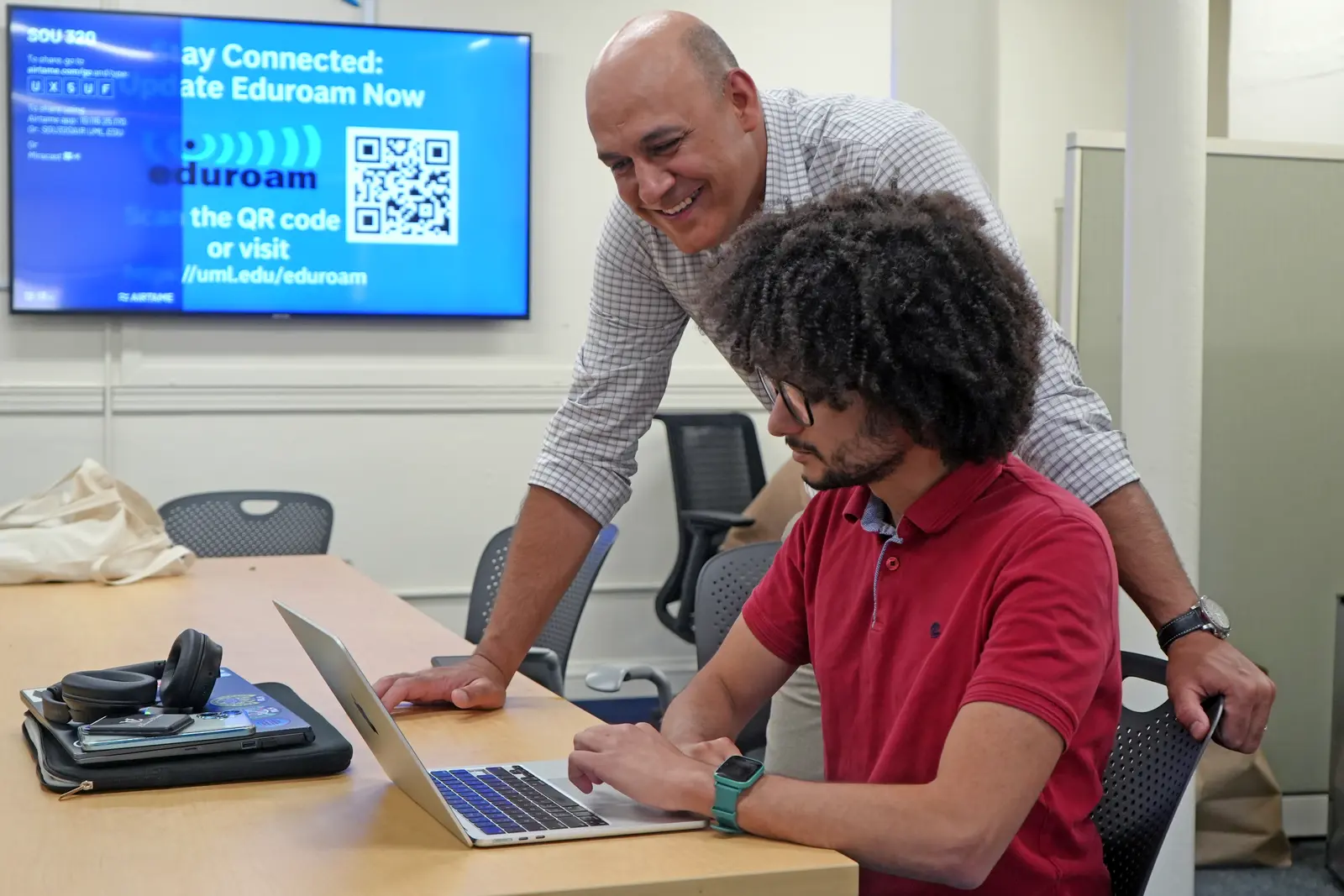
 Asst. Prof. Hadi Amiri, who recently received an NSF CAREER award, checks out the work of computer science Ph.D. student Mohamed Elgaar.
Artificial intelligence systems are becoming a routine part of how people search for information, write, plan and make decisions. But even when these systems produce fluent, confident-sounding answers, they can rely on information that is incomplete, outdated, misleading or difficult to verify.
Miner School of Computer and Information Sciences Asst. Prof. Hadi Amiri is working to make AI systems more trustworthy and reliable by studying how they learn, retain and forget information. His research is funded by a National Science Foundation (NSF) Faculty Early Career Development (CAREER) award worth nearly $500,000 over five years.
“The CAREER award is one of the most prestigious awards that the NSF offers, so it’s both an honor and a responsibility to receive this award,” Amiri says.
As more people rely on AI systems for everything from health care to travel planning, one thing has become clear to Amiri: “These systems can behave in ways that are hard to predict.”
Many AI systems that generate human language rely on neural language models, which learn from massive data sets that may include incorrect or outdated information.
“We do not want AI systems to simply repeat information from their training data or generate misleading results based on patterns they learned during training,” Amiri says. “We want these systems to be reliable and trustworthy.”
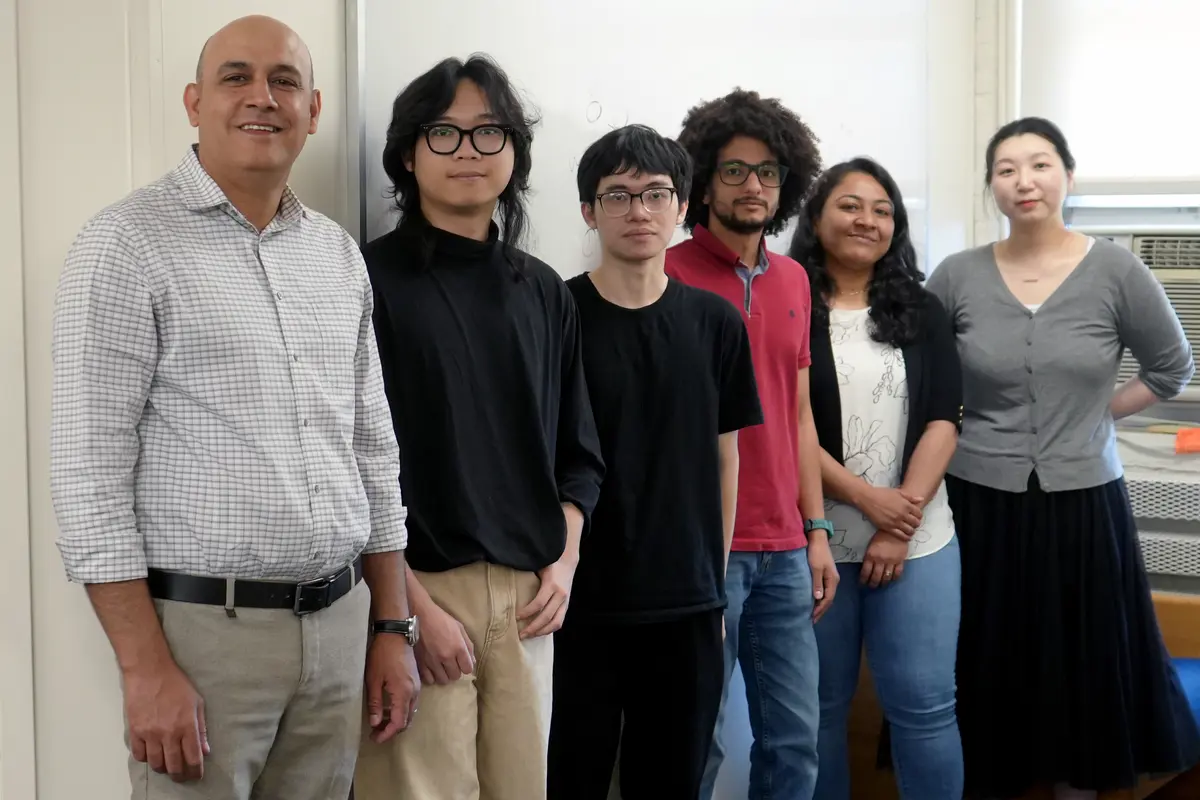 Image by Brooke Coupal
 Asst. Prof. Hadi Amiri, left, works with graduate and undergraduate student researchers, including, from second left, Bond Nguyen, William Nguyen '26, Mohamed Elgaar, Nidhi Vakil and Haeun Kim '25.
By studying neural language models, Amiri will develop “learning timelines” that show when models learn specific language properties such as vocabulary, syntax and text complexity. These timelines could help researchers better align training data with a model’s learning abilities, ultimately leading to more efficient and reliable training. Amiri also plans to develop methods to reduce or remove misleading patterns learned by a model while preserving its ability to generate useful and comprehensible text.
“Human language can be very complex,” Amiri says. “There are many different ways to express the exact same information.”
Amiri will quantify the complexity of training data and develop methods to control the complexity of generated text, helping AI systems produce language at appropriate reading levels for second-language learners, patients reading health information and people with communication or cognitive challenges.
Another issue with AI systems is that they can retain private information. For instance, a hospital patient who initially consented to having their information used in an AI system may later decide to opt out.
“Traditionally, we’d remove the user’s information and then retrain the AI model, but with today’s huge AI models, that is impractical,” Amiri says. “It’s operationally disruptive and computationally very time-consuming.”
Amiri will analyze how neural language models forget information and use that knowledge to build AI systems that are more controllable, efficient and reliable. He plans to host a two-day workshop at which students will test how efficiently AI systems learn, adapt and forget information.
“This type of workshop will be beneficial to students,” Amiri says. “When students move into industry or research roles, they will have hands-on experience using large language models in a more controllable way.”
Graduate and undergraduate student researchers will be assisting Amiri with his project.
“The integration of research and education is crucial to the NSF CAREER award,” he says. “This project will advance reliable AI, while training the next generation of AI researchers.”