
 Image by courtesy
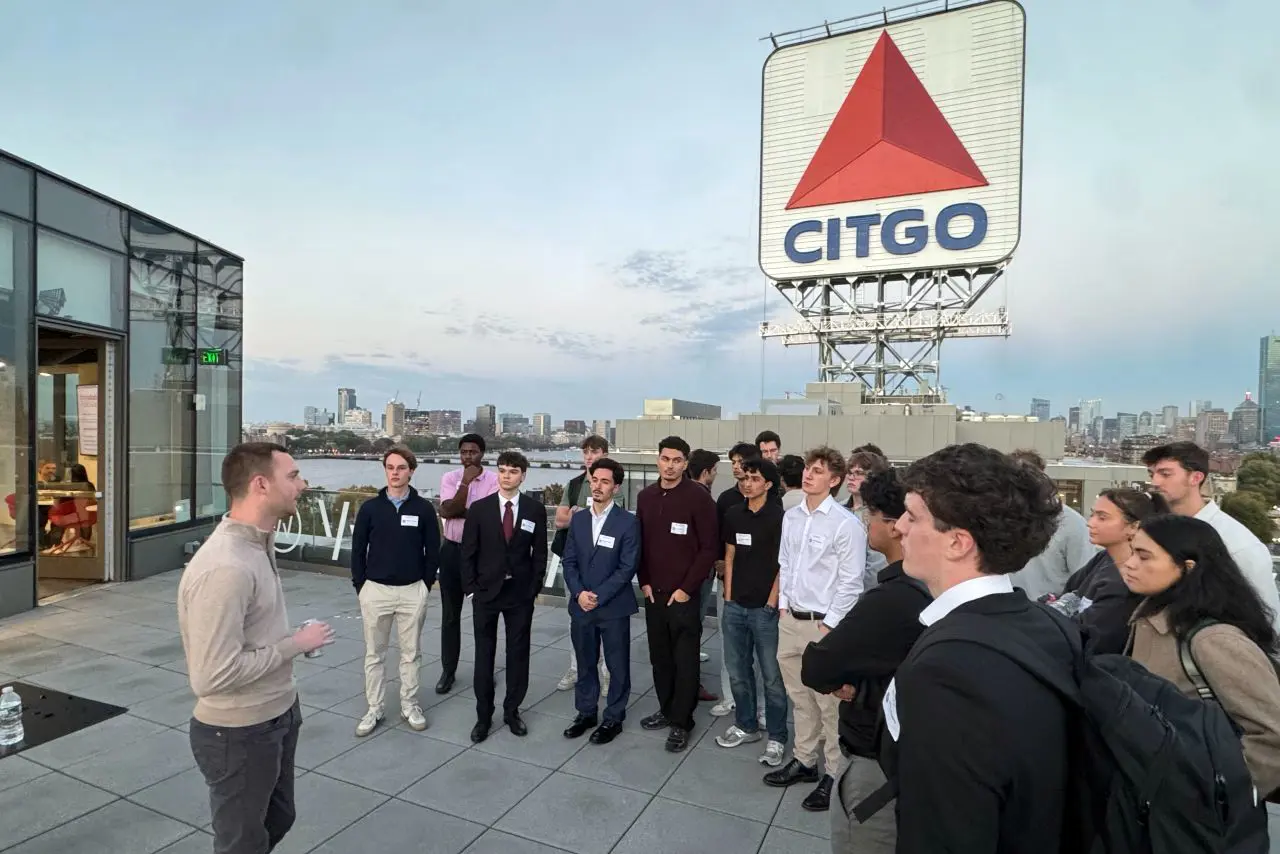
Members of UMass Lowell's new Artificial Intelligence Multidisciplinary Society, or AIM, tour the WHOOP headquarters in Boston's Kenmore Square during a recent industry visit.
Students use artificial intelligence to study, organize their time and solve problems. Employers, meanwhile, increasingly expect college graduates to know how to use the technology.
But many students are also uneasy about what AI could mean for their careers, their creativity and the environment.
A new student organization at UMass Lowell, the Artificial Intelligence Multidisciplinary Society, or AIM, is trying to address that tension. AIM brings students from every major together to explore what AI can do, what it should do and how they can help shape its future.
“Our motto is ‘AI in every major,’” says AIM’s founder and president, Samuel Morse, a senior computer science major from Agawam. “We aim to bridge the gap between the future of artificial intelligence and the UMass Lowell academic community at large.”
A recent Pew Research Center survey found that 55% of adults ages 18 to 29 are more concerned than excited about AI’s increasing use in daily life, while 73% believe AI will lead to fewer jobs in the United States over the next 20 years.
At the same time, a recent survey by the American Association of Colleges and Universities found that 91% of employers consider it important for college graduates to develop AI-related skills while in college. However, only 42% said they were very confident that colleges and universities are preparing students for current and emerging uses of AI in the workplace.
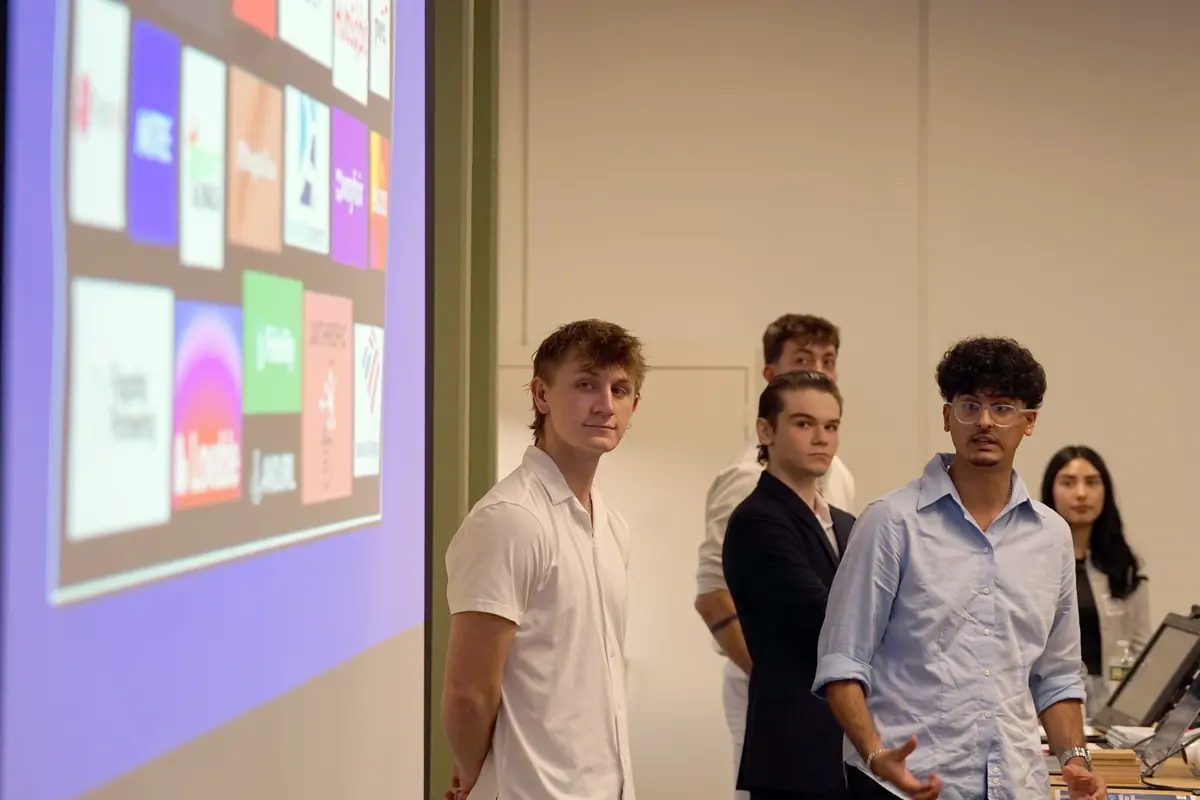 Image by Ed Brennen
AIM student leaders give an overview of the organization's mission during its kickoff meeting earlier this semester at Olsen Hall.
AIM offers a complementary, student-led way to explore those applications across the university — whether or not members are pursuing a degree in AI or computer science.
Founded last spring, AIM focuses on three areas: workshops and competitions, industry connections and collaborative experiences.
One of AIM’s first moves was to connect UMass Lowell with the Massachusetts AI Coalition, a statewide network that brings together companies, industry leaders and college students to strengthen the state’s AI ecosystem. Formed by WHOOP, the Boston-based human performance and wearable-technology company, the coalition includes schools such as MIT, Harvard, Boston College, Boston University, Northeastern and UMass Amherst.
The coalition recently brought students together for Hackachusetts, a statewide AI-building competition, with AIM hosting one of seven sites at UMass Lowell. The daylong event featured 24 projects involving UML students, who developed AI-powered solutions in four tracks: health tech and biotech, robotics, energy and civic action. The competition offered $30,000 in prizes, with finalists invited to present their projects at WHOOP headquarters.
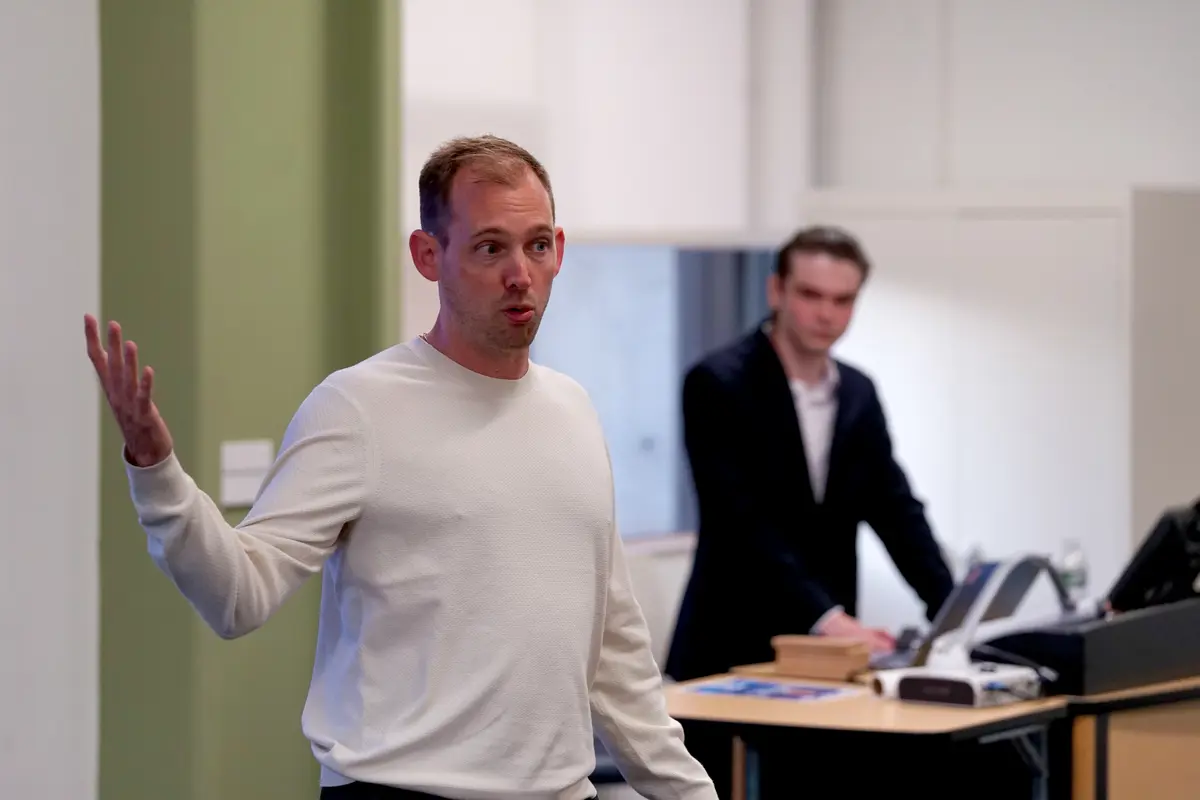 Image by Ed Brennen
AIM President Samuel Morse, right, looks on as Ryan Durkin, WHOOP's vice president of AI and community engagement, discusses his company's role in growing the state's AI ecosystem.
Ryan Durkin, WHOOP’s vice president of AI and community engagement, spoke at AIM’s Sept. 30 kickoff at Olsen Hall. He encouraged students to build projects that demonstrate their skills and give employers something concrete to discuss.
“The number one thing you need to do is build something that you care about and get vocal about it,” said Durkin.
WHOOP recently hosted AIM members for an industry access visit. Students toured the company’s offices, participated in a hands-on session on AI-assisted development and took part in a question-and-answer session with Durkin, software engineers and other WHOOP employees.
Sophomore business major Derek Ellis, AIM’s head of marketing, says it was an opportunity to “bridge the gap between students and industry professionals to advance the mission of AI literacy.”
For Spenser Davis, a junior criminal justice major from Chelmsford, AIM offers a chance to explore how AI can be useful beyond technical fields.
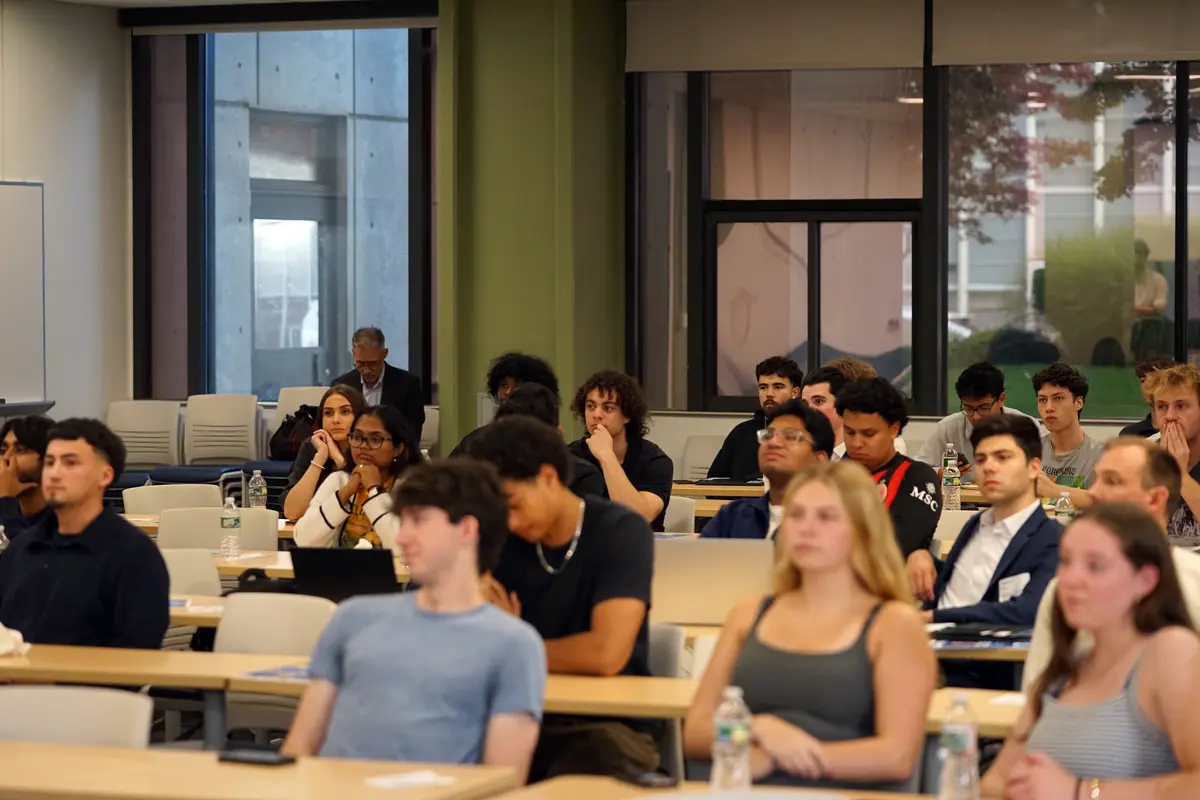 Image by Ed Brennen
AIM's recent kickoff meeting at Olsen Hall drew dozens of students from all different majors across campus.
Davis says it’s important for students from every major to be part of the AI conversation.
“That way everyone gets the gist of AI, and they can learn how to use it to help them,” he says.
The organization’s emphasis on applied experience appealed to Cole Stepanik, a senior finance and accounting student who helped Morse establish AIM as an official Manning School of Business organization. Stepanik began using AI more intensively during his internship last year with Franklin Templeton’s investor services team.
“I use AI every day,” he says. “It’s an investment in my career and my education.”
Stepanik says his experience has also shown him how quickly the technology is changing.
“With how much new information, new models and new technology are coming out every day, it’s just a race,” he says.
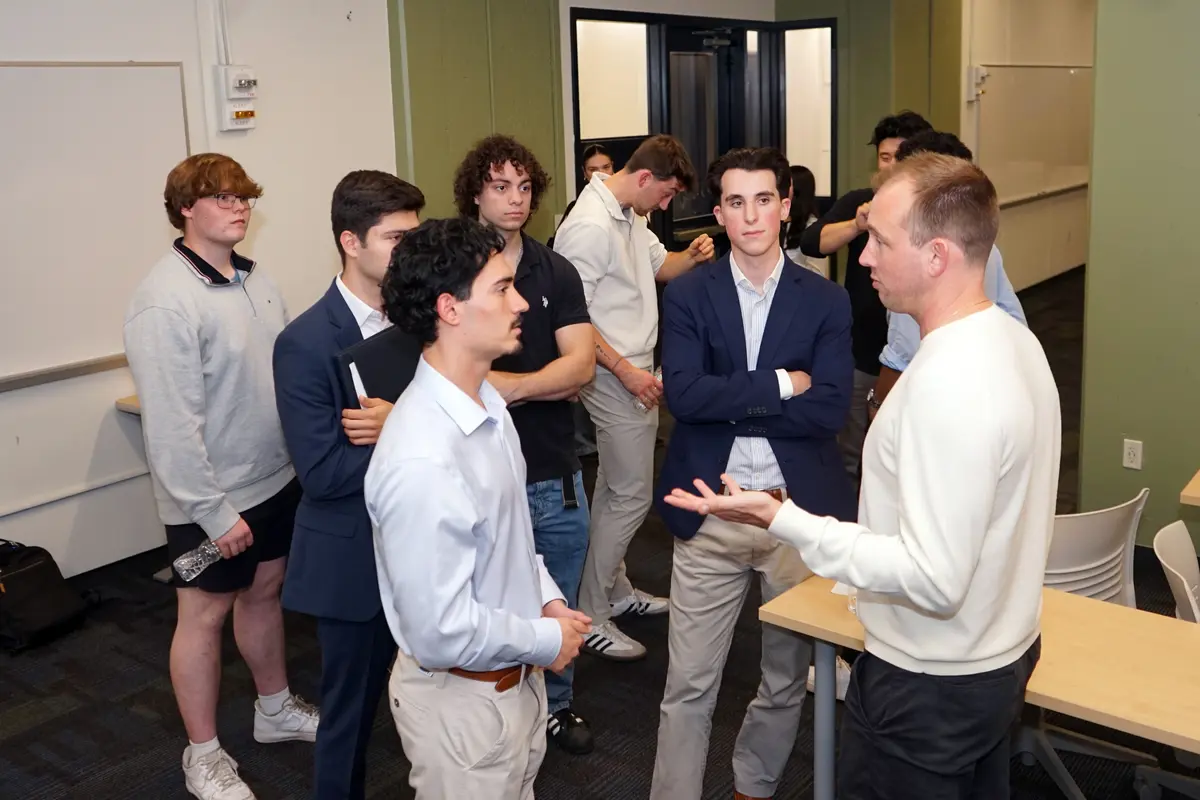 Image by Ed Brennen
Senior business major Anthony Ferriero, left, chats with WHOOP's Ryan Durkin after the recent AIM kickoff meeting at Olsen Hall.
The ethics committee will explore issues such as privacy, bias, accountability and responsible use. The entrepreneurship committee will work with startups and help students explore how AI can support product development and business growth. The physical AI committee will focus on robotics, autonomous systems and other applications involving hardware.
Other committees will connect students with faculty research, sustainability initiatives and opportunities to use AI in communications.
The organization’s interest in AI does not mean it supports every use of the technology. During the kickoff, Morse spoke about pushing back against AI-generated posters on campus, which he said can make communications feel impersonal and replace the creativity students want to see.
“AI is not a replacement for humans,” Morse says. “We still need humans.”