
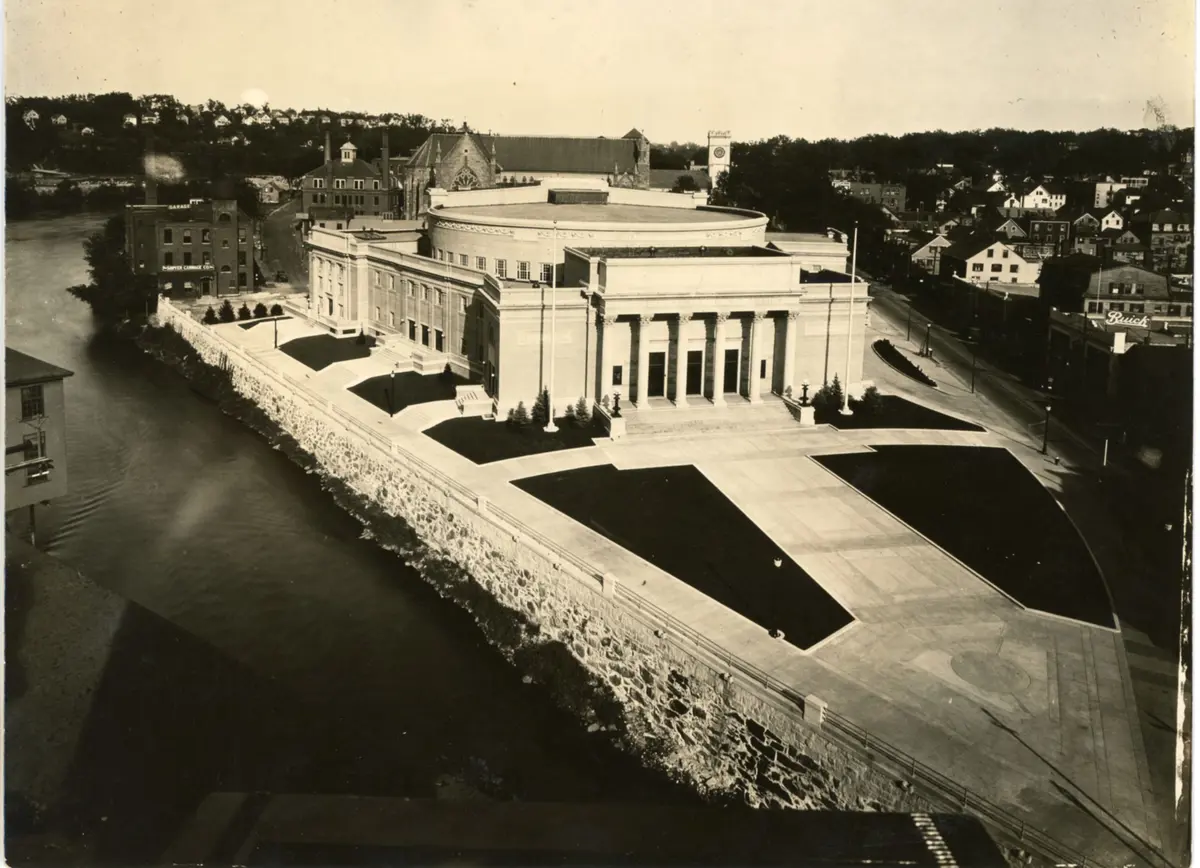
 Image by Center for Lowell History
 James O’Donnell, Jr., Director, O’Donnell Funeral Home
James O’Donnell’s family has been an integral part of the city of Lowell’s history for over five generations beginning in the early 1840s. His great grandfather, James F. O’Donnell, worked as a conductor on the Boston and Maine railroad and, at the age of 55, opened a funeral parlor, James F. O’Donnell and Sons, on Salem Street in downtown Lowell. That business has continued to the present through four generations.
In January of 1930, the family moved the parlor from Salem Street to its current location on the corner of Pawtucket and Fletcher Streets in the Acre section of Lowell. The O’Donnell family was also actively involved in Lowell politics: one great uncle, James E. O’Donnell, served as the mayor of Lowell twice, first from 1912-13 and then from 1916-17, and Jim’s maternal grandfather, James B. Casey, also served as mayor of the city from 1905-1906. Jim O’Donnell’s Involvement with the city has centered on non-profits: he has served on the Executive Board of the MRT and the House of Hope and two area hospitals, and also was a former Chairman for the Greater Lowell Chamber of Commerce. But his primary focus has been on the Lowell Memorial Auditorium (LMA), one of Lowell’s most significant cultural institutions. O’Donnell considers the LMA the “jewel” of the city and he has served on its Board of Trustees for over fifteen years.
The Interview
In the interview, O’Donnell begins with his memories of the city and the transition taking place in the 1970s. He recalls the city with fondness and how the big families of the time provided a sense of community. That sense of community has stayed with O’Donnell, and he returns to its importance throughout the interview. He suggests two factors that have been instrumental for the success of the city. First, that the city always retained its talent. He likes to say that, “You can take people out of Lowell, but you can’t take Lowell out of the people.” And second, the city continues to attract good new people who want to make a difference. The result is one that combines tradition and innovation. One example of that is the number of public private partnerships, especially through the work of the Lowell Plan.
A major portion of the interview is dedicated to the Lowell Memorial Auditorium. Constructed in 1922, it honored the veterans of World War I and serves as a multi-use space. It is the site of naturalizations for citizenship, it provides space for veterans, it includes a theater, and the large auditorium space for concerts and other cultural events such as the Golden Gloves competition. All these events bring people into the city and support its economic development. The importance of the LMA to the city has been long standing. Calvin Coolidge approved the legislation for the building when he served as governor of Massachusetts; when the building was finished in 1922, Coolidge was Vice President of the United States and came by train from Washington to attend the dedication. O’Donnell’s advice to the next generation is straightforward: to have community you have to participate. He has always believed in a moral obligation and responsibility to take what you are given and make it better. In other words, pay it forward.