
920 Central Street
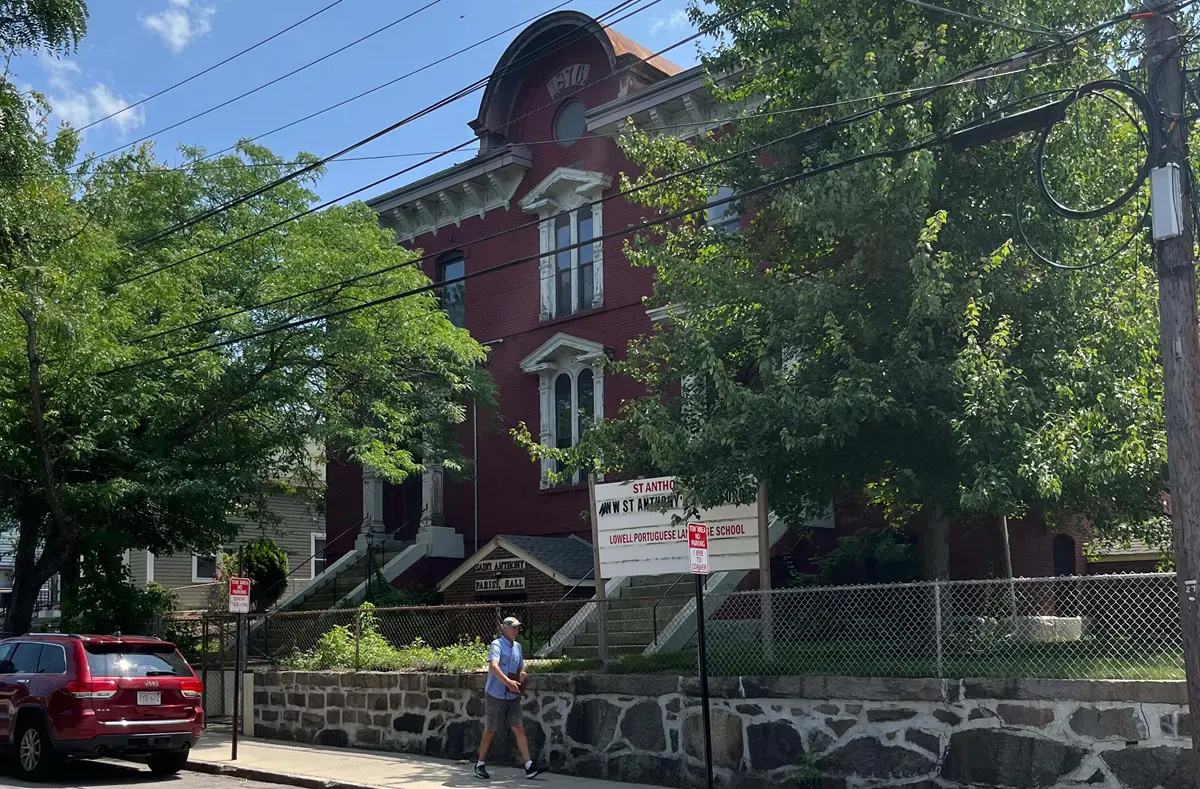
- Historic Name: Lyon Street Primary School (Parish Hall of Saint (St.) Anthony’s Church)
- Uses: Formerly a public school; currently a parish hall
- Date of Construction: 1876
- Style/Form: Italianate
- Architect/Builder: unknown
- Foundation: Granite stone
- Wall/Trim: Brick
- Roof: Pyramidal roof
- Major Alterations:
- Condition: Good
- Included in Hengen survey? Yes
- Related oral interview? No
- Portuguese owned? No (owned by the Boston Archdiocese)
- Recorded by: GGF and MF
- Organization: UMass Lowell
- Date: July 2023
Description
This 2-1/2 story brick building with a stone foundation and a pyramidal roof has Italianate elements, including an ornate, bracketed cornice and portico, a central set of windows with bracketed pediments, and rounded windows with brick, keystone lintels. The date of the building, “1876,” inscribed in granite at the roof level, is encircled by a decorative hood. A rubble granite retaining wall extends along the south and west part of the property.
Description
The completion of the Lyons Street Primary School in 1876 marked the last public school constructed in the Back Central neighborhood. It was the only primary school built with brick; all others, including the nearby Central Street School, were of wood-frame construction. At the time Lyons Street School opened, Irish-Americans were the majority of residents in Back Central.
History
By the early 1900s, when the population of Back Central was nearing its peak and the neighborhood was more ethnically diverse, the problem of overcrowding in the public schools was particularly acute. A measure by the city council to hold a classroom in the basement of the school, instead of providing funds for an annex to accommodate the many students attending classes, was hotly contested by a group of councilman, led by Irish-American Democrat Henry Carr, who represented Back Central. Carr warned of the unhealthy conditions in the basement where there was a water closet and a coal-fired boiler; he also invoked the issue of social class, contrasting the condition of schools in the wealthier Highlands neighborhood with those of the working-class Back Central area. In 1907, despite the overcrowding, the Lyons Street School gained some acclaim when the principal, Alice T. Lee, led a student gardening program with plantings in the school yard, “transforming former unsightly surroundings into one of the beauty spots of the mill city.” In addition to these educational and extracurricular activities, the Lyon Street School also served as an evening school for adults, as well as a polling place for elections.
The economic depression that began in Lowell in the 1920s and worsened by the Great Crash in 1929, resulted in a loss in the city’s population. Quite the opposite from earlier overcrowded conditions in the city’s public schools, the number of students dropped, initiating a series of school closings. In 1932, the city shuttered the Lyon Street School. Within a year, Father Joseph T. Grillo, pastor of St. Anthony’s church, across the street from the school, received permission from the Archdiocese of Boston to lease the building as a parish hall. This arrangement continued until 1958, when the Archdiocese purchased the property from the city. For nearly two years, during the construction project at St. Anthony’s Church, services were held in the former public school. After the church reopened in 1960, the Lyon Street resumed serving as the parish hall.
Sources
- “Strenuous Objection to Class Rooms in Basement of Lyon School,” Lowell Sun, July 26, 1905.
- “School Gardens Benefit Scholars and Teachers,” Boston Sunday Post, December 22, 1907.
- “Two Elementary Schools Will Not Open This Year,” Lowell Sun, September 9, 1932.
- “Mass Held in Parish Hall,” Lowell Sun, April 20, 1959.