
9-15 Bent's Court
- Historic Name: Bent’s Court
- Uses: Tenement residences
- Date of Construction: 1830s-1890
- Style/Form: Unknown
- Architect/Builder: Unknown
- Foundation: Unknown
- Wall/Trim: Wood frame
- Roof: Unknown
- Major Alterations: Demolished 1948
- Condition: n/a
- Included in Hengen survey? No
- Related oral interview? No
- Portuguese owned? No
- Recorded by: Gregory Gray Fitzsimons and Marie Frank
- Organization: UMass Lowell
- Date: September 2023
Description
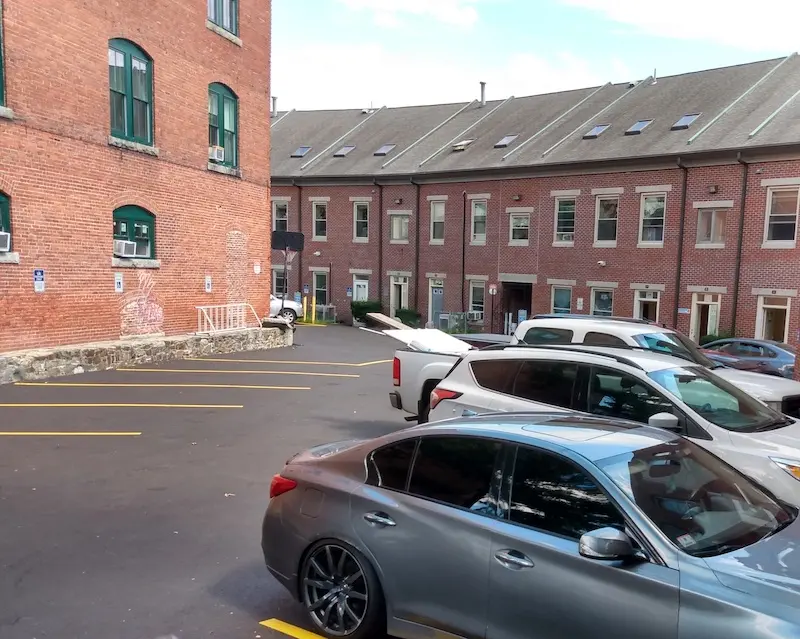
Nothing remains of the tenements of Bent’s Court except an open space off Gorham Street.
History
Development on the site began in the mid-1830s. John Putney, a successful merchant and businessman, moved to Lowell in the early 1830s and began investing in real estate. He purchased lots off Gorham Street and constructed a series of tenements, eventually numbering 25 units. The 1841 map indicates a rectangular building (facing Gorham) that is later identified on the 1850 map as owned by Putney. The 1850 map also includes the first indication of a new street joining Gorham and Central called “Putney Court” with additional structures owned by Putney. Also on the 1850 map, Charles Street has been extended beyond Central to intersect with Gorham. Putney died in 1867 with no surviving family. By the time of the 1879 map of Lowell, the street no longer continued through from Gorham to Central but took a sharp right turn and opened on to Charles Street, a bend that portended its new owner. The 1882 atlas still refers to the area as Putney’s Court but in 1883 and 1891 Major William H. Bent bought the properties. Bent was a prominent citizen of Lowell. Originally from Nova Scotia, he served in the Civil War, moved to Lowell, and soon became a successful layer and president of the Lowell Bar Association. The 1896 map refers to the complex of tenements as Bent’s Court.
Newspaper accounts tout the complex and the location as the heart of Lowell’s southern commercial district. Census reports for the 1880s indicate a large Irish tenancy of laborers and mill operatives. The earliest reference to a Portuguese tenant is Vincent Silva in 1886. In 1891 Bent had an artesian well driven to supply the residents with fresh water. By the mid-90s the tenants also included Lithuanians in addition to Irish, Portuguese, and Yankees. Bent died in 1915 and the property, consisting of 31 tenements and two stores, was divided at auction into four separate lots. The sale stipulated that the ten foot wide alley that ran through Bent’s Court from Charles Street to Gorham Street be maintained. The notice for the sale claimed, “There is no more important property from the standpoint of location or from the standpoint of income in this most valuable Gorham Street section.” The amenities included: “smooth paving, trunk line trolley cars, “White Way” lights, and every other modern municipal advantage….” No other area of downtown Lowell “has shown a more radical improvement within the last decade.”
Through the 1920-40s, census records indicate a continued Lithuanian, Irish, Portuguese and Polish tenancy. However, by the mid-1940’s the court became dilapidated. The property was foreclosed upon in 1948, sold through auction to the city, and demolished. The 1952 atlas still references Bent’s Court but no buildings are indicated. In 1977 the reconfiguration of Gorham Street and later construction of the Crescent Housing Project (1986) further eroded the original site of the legendary landmark. A 1963 Lowell Sun article recalled fondly the number of men born in Bent’s Court that rose to prominence in the city.
Sources
- “Wreckers to Raze Portion of Well-Known City Landmark,” Lowell Sun, April 13, 1948, p. 22.
- “Bent’s Court razed; Candy Parker performs final act,” Lowell Sun, April 22, 1963, p. 239.
- North Middlesex Registry of Deeds
- Lowell Daily Courier, July 9, 1867
- Lowell Daily Courier, July 3, 1891
- Lowell Sun, July 15, 1915, p. 24