
9-11 Bassett Street
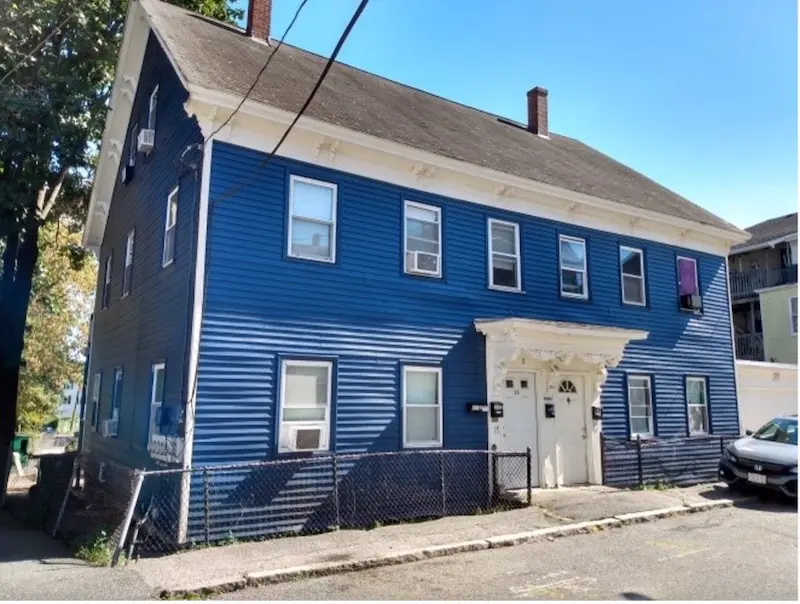
- Historic Name: None
- Uses: Single-family home
- Date of Construction: Circa 1870
- Style/Form: Italianate elements
- Architect/Builder: Unknown
- Foundation: Rubble stone
- Wall/Trim: Vinyl siding
- Roof: Gable roof
- Major Alterations: Most notable are new vinyl windows and shutters; and vinyl siding recently painted blue
- Condition: Good
- Included in Hengen survey? No
- Related oral interview? No
- Portuguese owned? n/a
- Recorded by: Gregory Gray Fitzsimons and Marie Frank
- Organization: UMass Lowell
- Date: July 2023
Description
This 2-1/2 story wood-frame, two-family house was constructed around 1870 and contains Italianate elements including decorative wood brackets under the projecting eaves, and ornate wooden brackets supporting the small projecting roofs at each of the two front entrances. Two brick chimneys extend through the gable ridge. It appears that in the early 20th century the two-family house was divided into four separate apartments.
History
Bassett Street, noted as “Pear Street” in the 1882 city atlas, was named after Gershom C. and Jesse N. Bassett, brothers who were born in Maine and, by the 1870s, were well-known builders and real estate speculators in Lowell. Carpenters by trade, the Bassett brothers designed and constructed a number of houses in the Back Central area. Many of these, including four on Hudson Street (see entry of 30 Hudson Street) were small cottages.
In addition to these cottages, it appears the Bassett brothers, joined by Martin L. Bassett, a son of Jesse, built this two-family dwelling in the early 1870s. It appears in the 1879 Lowell atlas and is noted as a tenement in the 1882 atlas. In 1874, Martin L. Bassett sold the property to James H. Smith, a teamster who owned a house on nearby Whipple Street. It appears that Smith purchased the newly built tenement as a real estate investment, renting the two-family dwelling to various working-class families and small business owners. For example, in 1875, the residence at 9 Bassett Street was headed by Thomas Howarth, a weaver in a textile mill, while 11 Bassett Street was occupied by James E. Hill, who ran a “bowling saloon” on Hurd and Central streets.
By the 1890s, Marcella and Othello Greenwood, brothers who had emigrated from England and became wealthy Lowell grocers and real estate speculators, held the mortgage to the Bassett Street property. In 1920 various tenants lived at 9-11 Bassett Street and the former two-family dwelling had been turned into in a tenement containing four apartments. In one apartment at No. 9 Bassett lived the Donahoe family, headed by Patrick, 65, who worked as a laborer. In the other apartment at No. 9 lived another Irish couple, Frank Marren, 33 a laborer, and his wife Mary, age 20. At No. 11, one apartment was occupied by Julius Gentry, 28, a stationary engineer in the boiler house of the nearby U.S. Cartridge Company, his Irish-born wife, Julia, also age 28, and their two daughters. In the other apartment at No. 11 was John Emerson, age 28, a carpenter, his wife, and five young children. At this time, while Bassett Street, like neighboring streets in this part of Back Central, was still predominately Irish there were also Portuguese, French Canadian, English, Scottish, Lithuanian, and Polish families living here.
In 1931, the Central Savings Bank of Lowell, which held the Bassett Street property and divided it into two fee-simple properties, sold it to two buyers. As described in the bank’s transaction the dwelling had four apartments, each with four rooms, a toilet, electricity, and city water. No. 9 Bassett Street, which was closest to Whipple Street, was bought by Polish immigrants, Leonora and Michael Kasilowski, owners of a butcher shop around the corner at 30 Whipple Street. Both 35 years of age in 1930, Michael and Leonora were born and married in Poland, and emigrated to the U.S., respectively in 1913 and 1914, and settled in Lowell. It appears they bought the building at 30 Whipple Street, a commercial and residential property, in 1929. They continued to live in an apartment in the Whipple Street building while renting No. 9 Bassett Street.
Juozupas and Eva (anglicized from Jieva) Karsokas, Lithuanian immigrants, purchased No. 11 Bassett. Juozupas (anglicized to Joseph) Karsokas (1873-1952) had immigrated to the United States in 1897. For many years he worked as a dyer in a cotton mill. He and his wife Eva (1876-1942) had five daughters all, with the exception of the eldest, born in Lowell. Unlike the Kasilowski family, the Karsokas lived at No. 11. In 1933 Joseph and Eva purchased the entire property. They maintained four apartments, living in one and renting the other three to families also from their native Lithuania. After Joseph died in 1952, the family sold the Bassett Street property. Over the years various owners have used the former two-family tenement as a real estate investment and rented the four apartments to numerous tenants, including in the 1950s to Joseph Sousa, a Portuguese textile worker at Massachusetts Mohair Plush, and his wife Dolores.
Sources
- Sidney and Neff Map of Lowell, 1850.
- Lowell atlases, 1882, 1879, 1906, 1924 and 1936.
- Lowell city directories, 1875-76, 1894, 1906, 1916, 1926, 1936 &1956.
- Federal census, Lowell, Massachusetts, 1880, 1900, 1910, 1920, 1930 and 1940.
- Obituary of Eva Karsokas, Lowell Sun, July 16, 1942.
- Obituary of Joseph Karsokas, Lowell Sun, July 10, 1952.
- “Sales by R.M. Humphrey,” Lowell Sun, May 9, 1931.
- Property deed, Bassett to Smith, April 16, 1874, book 101, pages 49-50, Northern Middlesex Registry of Deeds.
- Property deed, Central Savings Bank to Karoska. November 18, 1930, book 797, pages 303-304, Northern Middlesex Registry of Deeds.
- Property deed, Central Savings Bank to Kasilowski November 18, 1930, book 797, pages 303-304, Northern Middlesex Registry of Deeds.