
893 Central Street Rectory
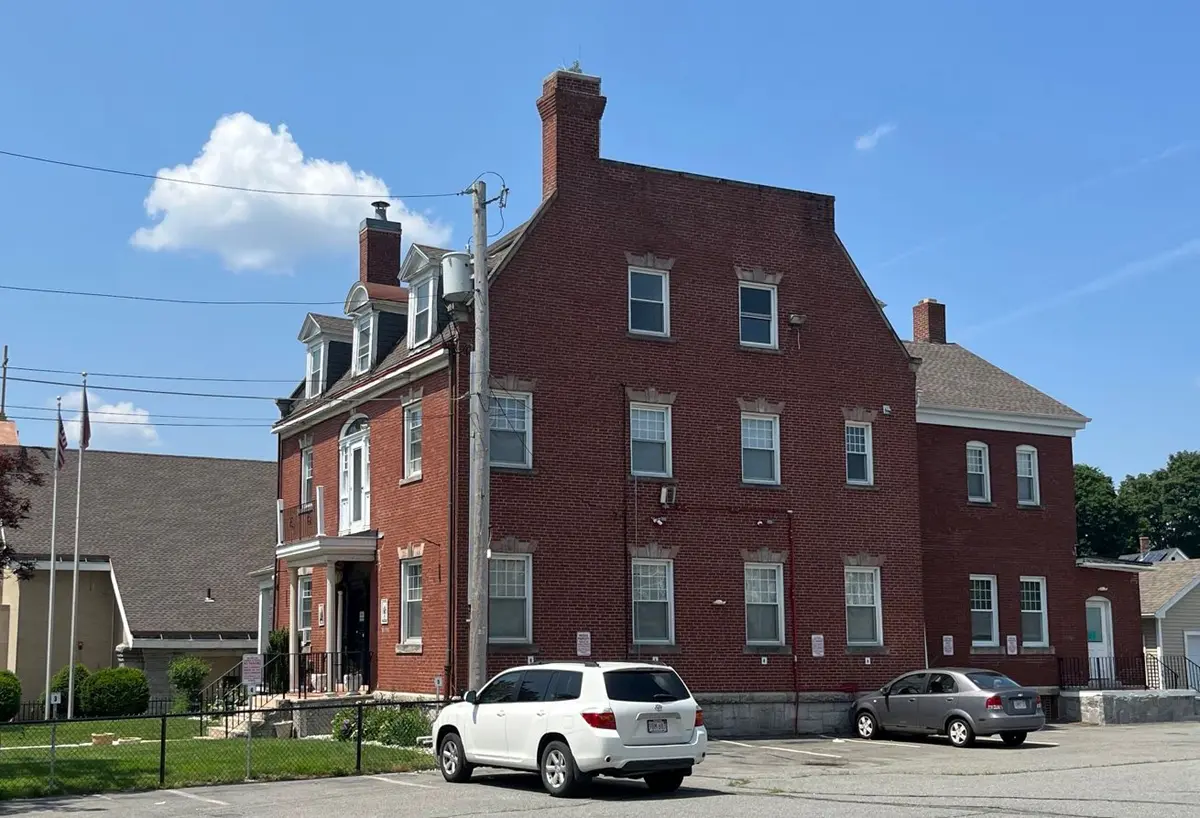
- Historic Name: St. Anthony’s Church Rectory
- Uses: Residence and office
- Date of Construction: 1907
- Style/Form: Federal/Georgian Revival
- Architect/Builder: unknown
- Foundation: Granite stone
- Wall/Trim: Brick
- Roof: Gable roof
- Major Alterations: Two-story, brick rear addition
- Condition: Good
- Included in Hengen survey? Yes
- Related oral interview? Yes
- Portuguese owned? No (owned by the Boston Archdiocese)
- Recorded by: Gregory Gray Fitzsimons and Marie Frank
- Organization: UMass Lowell
- Date: July 2023
Description
This 2-1/2 story brick building with Federal and Georgian Revival elements is the only rectory in Lowell featuring this architectural style. Its main (east) entrance has ionic columns supporting a roof and second-floor balcony, with granite steps leading up to a paneled door with stained glass sidelights and transom, together reflecting a Palladian form. The windows on the first two floors have keystone lintels and three gable-roof dormers extend across the gable roof. The brick gable ends each have a brick chimney and the south façade has a full-length porch extending along the first floor. The stairs leading down from this porch allow access to a side door of church which is connected to the rectory by a small sidewalk. A two-story, brick addition extends off the rear (west) façade of the rectory and was built at an unknown date.
History
In 1902, when the Boston Archdiocese appointed Fr. Joaquim V. Rosa (1872-1964) from the Azorean island of Pico as the first pastor of St. Anthony’s Church on Gorham Street, the young priest lived in a small quarters in the back of the church with the residential entrance on Congress Street. With the purchase of a lot on Central Street in 1906, a new church and rectory were designed, and construction soon commenced. The rectory, situated next to the church, was one of the more impressive and substantial parish houses in the region, constructed of brick and featuring Georgian Revival elements. Fr. Rosa noted that he contributed to the building’s design and also oversaw the landscaping of the grounds with plantings that harmonized with those from his native Pico Island. He moved into the rectory in 1908, a month before the new church was completed.
The fine amenities and spacious interior of the rectory appealed to the second pastor of St. Anthony’s, Bishop Henrique José Reed da Silva, who hailed from Lisbon and was an uncle to King Carlos I of Portugal. The bishop had become an ex-patriot of his native land, following the assassination of the king in 1909 and the Republican Revolution in 1910. He served as pastor until 1924. Fr. Joseph T. Grillo succeeded the bishop at St. Anthony’s and in 1927, with funds from parishioners, the interior of the rectory was renovated. At an unknown date, a two-story brick addition was built off the rear (west) façade of the building. Where there once a landscaped garden along the rectory’s north side, there is now an asphalt parking lot. The exterior of the rectory’s main (east), north, and south façades, however, remains largely unchanged.
Sources
- “Church Will Be Opened May 30,” Lowell Sun, May 13, 1908
- “Men in Action,” The World’s Work, v. XX, June, 1910, p. 12970.
- “Renovating Completed—St. Anthony’s Church and Rectory in Central Street Refinished in Modern Style,” Lowell Sun, August 15, 1926.
- Oral history Interview with Fr. Eusebio Silva, by Douglas DeNatale, January 25, 1988, American Folklife Center, Library of Congress.