
80 Linden Street
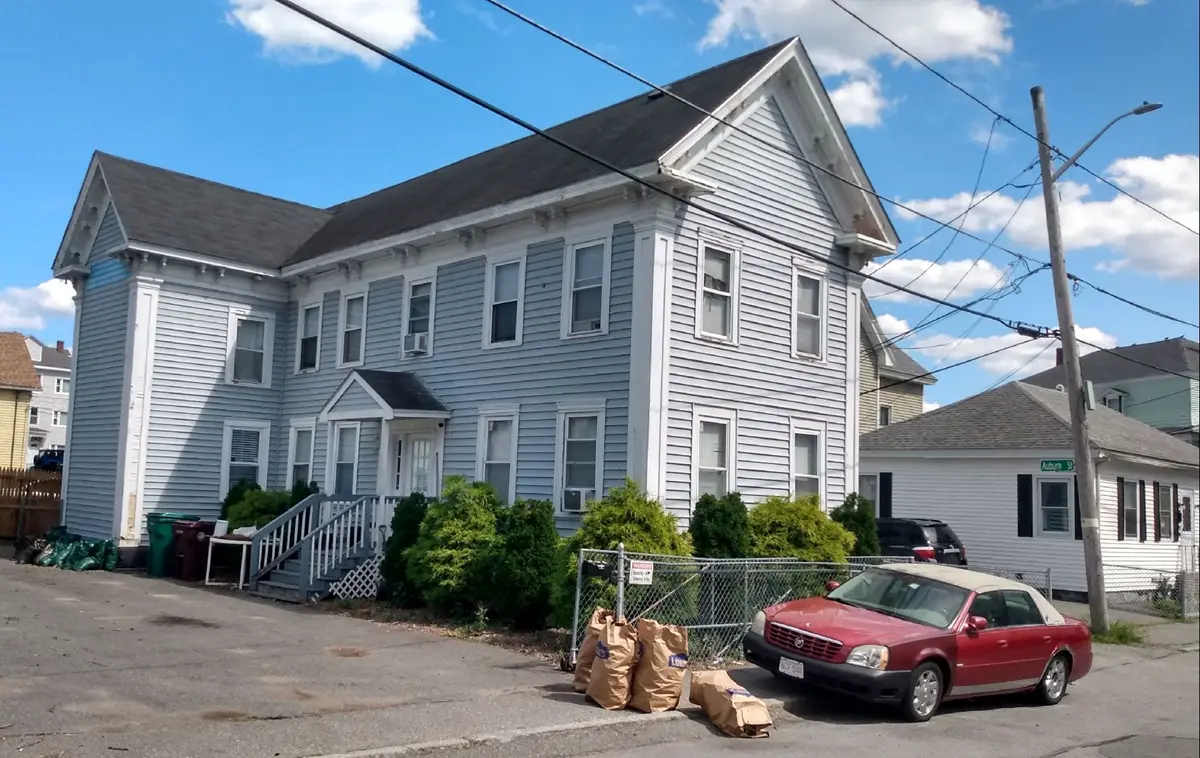
- Historic Name: None
- Uses: Two-family home
- Date of Construction: 1850-51
- Style/Form: Greek Revival
- Architect/Builder: Unknown
- Foundation: Concrete and stone
- Wall/Trim: Vinyl siding
- Roof: Gable roof with intersecting gable roof
- Major Alterations: Most notable are new vinyl windows and vinyl siding; recently installed stairs and projecting gable hood at main entrance
- Condition: Good
- Included in Hengen survey? No
- Related oral interview? No
- Portuguese owned? No
- Recorded by: Gregory Gray Fitzsimons and Marie Frank
- Organization: UMass Lowell
- Date: August 2023
Description
This 2-1/2 story wood-frame with an L-plan was constructed in 1851 and was originally a two-family dwelling. It has a number of Greek Revival elements including a pedimented gable end (with gable returns) facing Linden Street (the west façade) with wooden quoins and below the projecting gable roof are decorative wood brackets. The main entrance, however, is along the north side and has been altered with a modern stairway and deck covered by a recently built gable-roof hood. The L-section also has a gable roof that intersects with the main gable roof. The house rests on its original stone foundation and has a brick chimney.History
In 1849, Theophilus D. Berry (1823-1885) purchased a lot from James Smith, III, on the northeast corner of Linden and Auburn Streets, on which he constructed a two-family house. At the time only a few houses had been built in this part of the Chapel Hill neighborhood. But as a result of the construction of the Middlesex County Courthouse, on Gorham and Elm streets, a great deal of residential development ensued as new streets were added and existing ones were extended. The house that Berry built in 1850-51, in the Greek Revival style, typified this surge in new construction.
Born in Rochester, New Hampshire, Berry moved to Lowell and worked with an established carpenter, Charles W. Wilkins (1791-1871), boarding with him in his house on Middlesex Street. Wilkins hailed from Amherst, New Hampshire, and settled in Lowell by the 1830s. He was likely the carpenter and builder of a number of antebellum homes in Lowell and likely in the Chapel Hill area. In 1849, Berry married Martha Wilkins (a daughter of Wilkins) and subsequently built the two-family wood-frame house on the lot he purchased from Smith. By 1851 he and his wife moved into their new residence. Listed in the 1860 federal census, Theophilus and Martha Berry had no children but shared part of their house with James S. Welch, a clerk at the Wamesit Bank, and his family. Living in the other half of the house was George K. Paul, a skilled gas-fixture fabricator, and his family. Theophilus and Martha Berry had no children.
In 1860 Theophilus Berry sold the dwelling he built to Samuel G. Parker of Chelmsford, a real estate investor in Lowell. Berry subsequently purchased a farm in Lowell, near the Chelmsford line, and gave up the carpentry business. (Evidently Berry did not succeed in farming. By 1880 he moved to another house in Lowell and resumed carpentry work.) Parker sold the Linden Street property in 1865 to a skilled mason, Charles S. Dwinell (1839-1904). Born in Salem, Massachusetts, Dwinell relocated to Lowell by the 1850s, marrying Elizabeth Kelly in 1859. For nearly 20 years, Dwinell lived with his wife in half of the house, renting the other half. By 1880 he left masonry work and opened a grocery store, with his brother, Frank C. Dwinell, on Central Street. Frank Dwinell lived with his brother and sister-in-law, who had no children, while the other half of the house was occupied by Alexander W. Stanley, an English immigrant who worked for a carding machine manufacturer in Lowell, and his wife, Alice, from New Hampshire.
While the area around Linden and Auburn streets had a blend of middle-class and wage-earning residents, by the 1880s several tenements had been established in the neighborhood that were in wretched condition and were public health hazards. In one case, the police investigated a dwelling on Linden Street, behind St. John’s Episcopal Church, where an Irish family was found to be living in squalor and suffering from illness in the severe winter cold. Similar to other residences in Back Central, by the late 19th century many had been converted into tenements, a practice that continued into the 20th century.
Dwinell was the last middle-class, New England-born Protestant to own and reside at the Linden Street property. In 1885 he sold it to Michael Buckley (ca. 1830-1888), who was born in Ireland and settled in Lowell in the 1840s. For many years Buckley had a business selling wood and he and his family belonged to nearby St. Peter’s Catholic Church. Following his demise and the death of his wife, Eliza, in 1902, it appears John F. Buckley, the only male in the family and the operator of a job wagon, inherited the Linden Street property. Unmarried, Buckley remained at 82 Linden, residing there with at least one sister, until his death in 1921.
In 1921, Irish-American lawyer Dennis J. Murphy, who handled the Buckley estate, sold the property to Bridget (Reddy) Bolan (1864-1947). Born in Ireland, Bolan immigrated with her family in 1880 and settled in Lowell. At the age of 23 she wed Patrick Bolan, also born in Ireland, in what proved to be a tumultuous marriage. As young man, Patrick gained the reputation of a hard-drinking street brawler. He worked for a number of years as riveter in a boiler shop and, with Bridget, was the father of two sons and two daughters. The family lived in a tenement on Linden Street, during which time Patrick had a number of run-ins with the law. In one of his most vicious escapades, after consuming copious amounts of whiskey, Bolan challenged a barkeep and group of fellow drinkers in a saloon on Gorham Street to step outside while claiming to be “a roaring lion” who would “devour” anyone who accepted his “invitation.” When no one responded, Bolan picked up and hurled a large stone through the window of the bar. A police inspector nearby heard the crash of glass and proceeded to arrest Bolan, but was able to clap “the Warren County lock” (handcuffs) on Bolan only after clubbing him and engaging in a protracted street fight. At Bolan’s trial, the local judge sentenced the miscreant to five years in jail.
Despite these difficulties, Bridget Bolan raised her three children (two died in infancy) and was able to purchase the house on Linden Street. In 1915, with the whereabouts of her formerly jailed husband unknown, Bridget filed a petition in probate court claiming desertion by Patrick. She was awarded all assets. It was possibly, in part, from these assets that she was able to buy the Linden Street property. She was also able to acquire one other property on Chapel Street. Bridget Bolan lived in the Linden Street house, renting out part of it, until 1944 when she sold it and moved into the (50) Chapel Street residence. Although by the post-World War II years the Irish population in Back Central had dropped considerably, the Linden Street house remained briefly in the hands of an Irish-American, Patrick F. Mahoney. The owner of a furniture store and lodging house on (583) Central Street and a resident of 571 Central Street, Mahoney also dabbled in real estate.
Mahoney soon sold the Linden Street house to a French-Canadian couple, Joseph O. and Valida Deschenes. Joseph worked as a spinner in a textile mill and it appears the couple did not rent the other half of the house. They lived in the two-family house for less than three years before selling it to another older French Canadian couple, Henry E. and Martha Lincourt. Born to French-Canadian immigrants in Lowell and a veteran of World War I, Henry E. Lincourt had spent nearly his entire adult life working in shoe factories, retiring in 1957. Lincourt died in 1962, after which the Linden Street house was bought and sold a number of times, mostly by absentee landlords who rented the two-family dwelling to various tenants.
Sources
- Beard & Hoar, Map of Lowell, 1841
- Sidney & Neff Map of Lowell, 1850.
- Lowell atlases, 1879, 1882, 1906, 1924 & 1936.
- Lowell city directories, 1849, 1855, 1858, 1861, 1875-76, 1885, 1892, 1894, 1906, 1916, 1922, 1926, 1936, 1946 &1956.
- Federal census, Lowell, Massachusetts, 1850, 1860, 1870, 1900, 1910, 1920 & 1930.
- “The Mother had Delirium Tremors and the Home was in a Shocking Condition,” Lowell Sun, January 5, 1889.
- “Patrick Bolan is a Very Bad Man in Liquor,” Lowell Sun, December 4, 1902.
- “In Probate—For Desertion,” Lowell Sun, December 28, 1915.
- Obituary of Bridget Bolan, Lowell Sun, August 11, 1947.
- Obituary of Michael Buckley, Lowell Sun, June 16, 1888.
- Obituary of Eliza Buckley, Lowell Sun, May 31, 1902.
- Obituary of Henry E. Lincourt, Lowell Sun, May 11, 1962.
- Property deed, Berry to Parker, April 27, 1860, book 23, pages 485-486, Northern Middlesex Registry of Deeds.
- Property deed, Parker to Dwinell, November 7, 1865, book 45, pages 287-288, Northern Middlesex Registry of Deeds.
- Property deed, Dwinell to Buckley, October 22, 1885, book 177, page 58, Northern Middlesex Registry of Deeds.
- Property deed, Dwinell to Murphy, July 2, 1921, book 646, page 271, Northern Middlesex Registry of Deeds.
- Property deed, Murphy to Bolan, July 29, 1921, book 647, page 356, Northern Middlesex Registry of Deeds.
- Property deed, Bolan to Mahoney, November 2, 1944, book 1014, pages 228-229, Northern Middlesex Registry of Deeds.
- Property deed, Mahoney to Deschenes, November 17, 1944, book 1015, page 505, Northern Middlesex Registry of Deeds.
- Property deed, Deschenes to Lincourt, December 11, 1947, book 1082, page 583, Northern Middlesex Registry of Deeds.