
8-10 Cherry Street
- Historic Name: none
- Uses: Apartment building (8 Cherry); Single/multi-family house (10 Cherry)
- Date of Construction: ca. 1840s and ca. 1908 (8 Cherry); ca. 1840s (10 Cherry
- Style/Form: 10 Cherry has Greek Revival elements
- Architect/Builder: unknown
- Foundations: Rubble stone
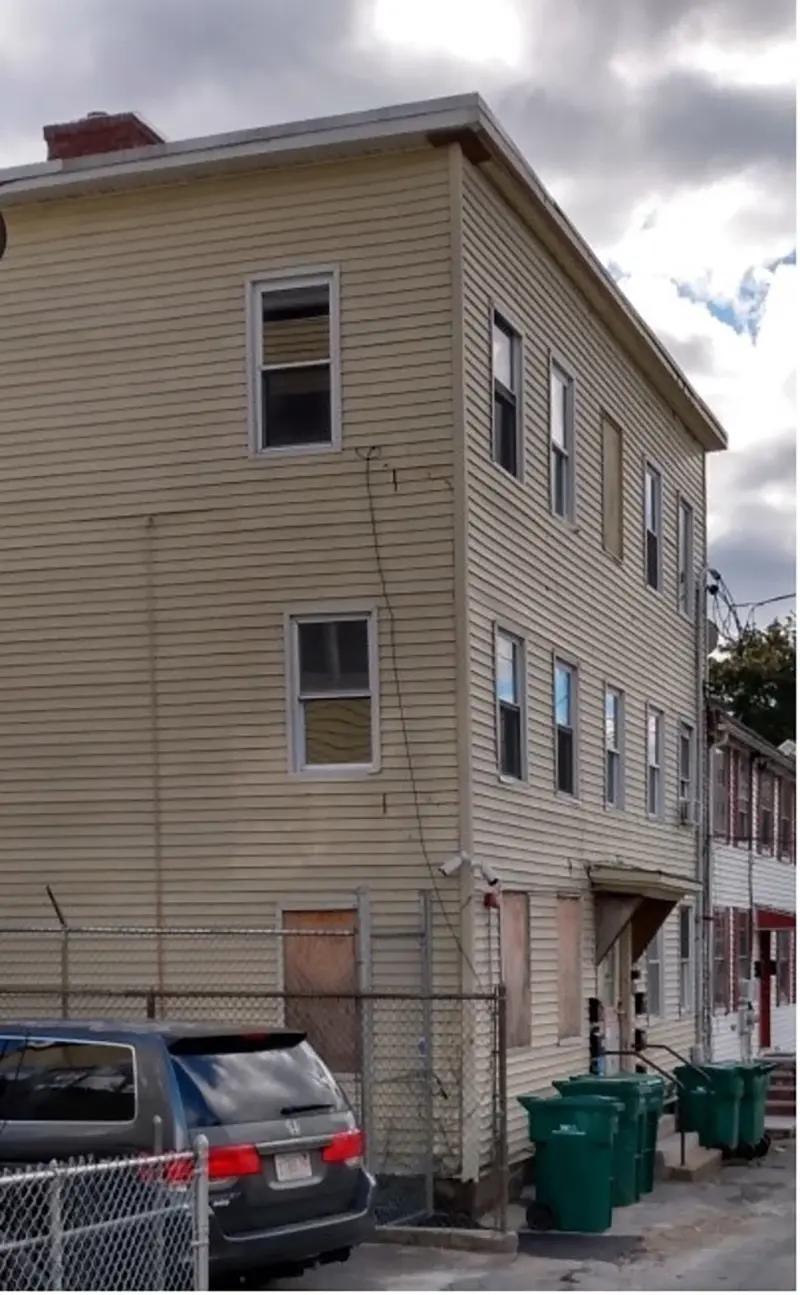
- Wall/Trim: Vinyl siding
- Roof: Flat roof (8 Cherry); gable roof (10 Cherry)
- Major Alterations: Both buildings have been altered with vinyl windows and siding
- Condition: Fair
- Included in Hengen survey? No
- Related oral interview? No
- Portuguese owned? Yes (1915 & 1919)
- Recorded by: GGF and MF
- Organization: UMass Lowell
- Date: August 2023
Description
Originally called Merrill’s Court, Cherry Street is one-block long, narrow alley that still conforms to its original configuration from its inception in the 1840s. It slopes down from Chapel Street as it curves toward its intersection with Linden Street. The most historically significant dwelling on this street faces Linden Street at the intersection with Cherry. This 2-1/2 story, Greek Revival, wood frame dwelling with a gable roof and rounded window below the ridge at the gable end was originally the rectory for St. John’s Episcopal Church on Gorham Street. Although it was extended in the 19th century along Cherry Street off its rear (east) façade, with a 2-1/2 story wood-frame, gable roof addition, it is the best preserved house in vicinity of Cherry Street.
The multi-family dwelling (originally a two-family house) at 10 Cherry Street dates from the 1840s and was one of the first houses built on this street, originally called Merrill’s Court. The 2-1/2 story, wood-frame dwelling built in the Greek Revival style retains much of its original appearance, although there are a number of late-19th century additions to the rear (south) façade. It has a gable roof with two brick chimneys extending through the gable ridge. In recent years it has been altered with vinyl siding and vinyl windows and a brick and concrete front stairway leading to the two front door entrances is of recent vintage.
The three-story, wood-frame apartment building with a flat roof and center entrance at 8 Cherry Street was constructed around 1908 by a Chelmsford builder-contractor and likely contains some of the original heavy timber members of the two-family house that was built here in the 1840s. It was likely similar in appearance to the Greek Revival house (10 Cherry Street) that adjoins the apartment building on the west façade. It has also been altered with vinyl siding and windows, along with a metal cornice that likely replaced the wood cornice from the early 20th century.
History
Merrill’s Court was initially developed in the 1840s, shortly before the nearby Middlesex County Courthouse was completed. Joshua Merrill (1802-1889), for whom Merrill’s Court was named, owned numerous lots on Chapel Hill and developed a number of properties in the vicinity of the courthouse. In 1836 he acquired the property that became Merrill’s Court.
Born in Milford, New Hampshire, and raised on a farm, Merrill received his education in the rural schools of his hometown before becoming a school master and then settling in Lowell in 1827. He secured a teaching job in a public school initiated by the Hamilton and Appleton Cotton Mills and quickly gained the reputation of an energetic and talented educator. He also proved to be a successful in business, opening a bookstore and publishing company on Central Street in Lowell’s downtown. In addition, Merrill engaged in real estate development, notably in the city’s growing Chapel Hill neighborhood.
Merrill contracted with local carpenters to build dwellings on the north side of Merrill’s Court, including two tenements, the largest of which was an L-shaped building that fronted Linden Street across from the courthouse. Most of the early male residents living in the tenements and other dwellings on Merrill’s Court were skilled artisans, including masons and carpenters. Merrill had a house built that he and his family occupied on the corner of Chapel Street and Merrill’s Court. The Merrill family lived there for many years before moving to the Centreville neighborhood on the north side of the Merrimack River. The departure of the Merrills from Chapel Hill after the Civil War reflected a pattern of Protestant New England families moving away from this neighborhood and into other more suburban sections of the city. This coincided with Chapel Hill becoming a more densely urban area containing a growing number of tenements and rental dwellings. Its population was also undergoing dramatic change with a rising tide of working-class and middle-class Irish Catholics settling in this locale.
It is not known who constructed the two-and-one-half story, Greek Revival, gable-roof dwelling that became 10 Cherry Street, but it was one of the first residences built along Merrill’s Court. In 1837 Joshua Merrill sold this empty lot to a fellow Lowell grammar school teacher, Sanford King. By the late 1840s a wood frame house stood was erected on this lot, along with an adjoining wood-frame house (which became 8 Cherry Street) to the east. This adjoining dwelling was likely built in the same style (gable roof with Greek Revival elements). The property had also been in the hands of Joshua Merrill but he sold it to his father-in-law, Ezekiel Dow, of Plaistow, New Hampshire. Ezekiel Dow and his heirs, who never moved from their New Hampshire farm, rented the house at 8 Cherry Street (it remained in the family until 1894) and it appears that Sanford King also used the house at 10 Cherry Street as a rental property. He sold it in 1852 to William J. Rockwood of Amherst, New Hampshire. But soon after, Adam Bedell, who operated a Merrimack Mills boardinghouse with his wife, purchased the house from Rockwood. Adam and Catherine W. Bedell never lived in the house, continuing the practice of renting it. Most of the tenants who resided here between the years 1850 and 1880 were either skilled artisans or textile workers.
In 1881 Winslow F. Stone (1835-1894), a machinist with the Boott Cotton Mills, bought the house at 10 Cherry Street from Catherine Bedell. For many years Stone lived in a Boott Mills boardinghouse. His wife, Mary A. (Fish), from Corinna, Maine, died in 1869, just two years after her marriage to Winslow and six months after giving birth to her first child, Arthur W. Stone (1869-1949). Winslow never remarried and lived with his mother Charlotte L. Stone and two younger sisters. He, his mother, and sisters moved into the Cherry street house. His son Arthur, who lived for a few years in Corinna, Maine, with his late mother’s family, graduated from Lowell High School, then Amherst College, after which he studied law. He passed the Bar exams in Massachusetts and Maine, returning to Lowell after marrying Elzora May Josselyn in Corinna. For a number of years he lived with his wife in part of the Cherry Street house while working as an attorney. The couple left Lowell in 1901, moving to Dexter, Maine, where Arthur Stone was subsequently appointed a judge in a district court.
By 1910 three families occupied 10 Cherry Street: one was Sarah G. Stone, age 69, and her sister Charlotte L., age 72; the second was an Irish widow Bridget Burns, 56, and her daughter Delia, 27, who worked as a weaver in a cotton mill; and the third was Irish immigrants Martin P. Dunn, 27, who operated a lunch cart, and his wife Nellie, 23. In 1915, Sarah Stone, who had assumed ownership of the property, sold the house to a Portuguese couple, Frank (Francisco) and Maria Tosta.
Born on the Azorean island of Terceira, Francisco Tosta Freitas (1869-1944) immigrated to the United States in 1892 and settled in Lowell. He obtained a job in a cotton mill, likely the Appleton or Hamilton Mill. Tosta met and married Maria da Gloria Netto, also from Terceira, in 1898. For a few years he and Maria lived in a Charles Street tenement with his wife’s family, including her father José S. Netto, her mother Maria Netto, and her younger brother Manuel E. Netto. They had their first child, Manuel, in this tenement. Francisco and Maria were active at St. Anthony’s Church and Francisco was also heavily involved in the Portuguese Benefit Society, one of the city’s early Portuguese fraternal and mutual aid associations. By 1906 the Tosta family moved into another tenement on Middlesex Street, near the corner of Pearl Street, in the shadow of the massive Appleton Mill. Francisco soon received a promotion to the highly skilled position of loom fixer and by 1915 he had saved enough money to purchase the house at 10 Cherry Street. He and his family, which included four children, all born in Lowell, resided here until early February 1919. Francisco Tosta sold the house to Manuel Floria and his wife Guilhermina, and, similar to a number of other Portuguese in Lowell, moved his family to California where he operated a dairy farm in San Bernardino County.
Manuel and Guilhermina Floria were relatively recent Azorean arrivals to the United States. Guilhermina Candida (Silva) Floria (1893-1962), who was born in Guadalupe, Graciosa, had settled in Lowell in 1908, with Manuel Sousa Floria (1889-1978), born in São Mateus, Graciosa, immigrating two years later. They married in Lowell in 1912 and both worked in textile mills. By 1920 Manuel had been promoted to the position of cloth inspector at the Tremont & Suffolk Mill. Guilhermina and Manuel had three sons, but it appears she continued to work in factories as a young mother. Eventually she secured a job as an examiner of finished goods at the Suffolk Knitting Company (which operated in the former Appleton Mill complex after the cotton manufacturer moved South in the mid-1920s). To supplement the family’s income, the Florias rented part of their house on Cherry Street to two other Portuguese families. This included Joseph and Sophia Santos and their two young daughters, and Mary E. Rodrigues, a widow, her two school-age daughters, and a younger sister.
It is unclear why Manuel and Guilhermina sold their Cherry Street home; perhaps it was for financial reasons. But in 1924, they sold it to Catherine Monahan, a widow, born in Ireland, who ran a Lowell variety store (on Bartlett Street) and owned a house nearby on Linden Street. Manuel and Guilhermina then resumed renting their residences. For a few years one of their abodes was next door at 8 Cherry Street. Monahan, however, quickly sold 10 Cherry Street to an older and single Irish American woman, Sadie C. Hughes, who worked as a telephone operator and lived with her widowed mother in the Lower Belvidere neighborhood. In 1926, however, Hughes sold the Cherry Street dwelling to John (João) R. Mendonça (1891-1984) and his wife Delia. Born on the island of Madeira, Mendonça, at the age of 20, immigrated to the United States, entering through Ellis Island, New York, and settling in Lowell. His wife, born in 1897, was from Graciosa and immigrated with her family in 1902. João and Delia met and married in 1913 when João was working as a loom fixer for the Boott Cotton Mills. Delia worked as a weaver. In 1926 Mendonça and his wife bought not only the Cherry Street property, but also a house at 71 Kinsman Street several blocks away from Cherry Street in Back Central. For many years the Mendonças rented the Cherry Street house while residing at 71 Kinsman Street. João continued to work as a loom fixer although he moved to the Merrimack Mills by the 1930s. In 1943 he and Delia, who had no children, decided to move to California, settling in the Bay Area in the town of Vallejo. They remained there for the rest of their lives.
Despite their move west, the Mendonças continued to own the Cherry Street house until 1956 when they sold it to another Portuguese couple, José and Maria Pereira. It appears they also bought the Cherry Street property for rental income. José and Maria operated a provisions store on Moody Street near the downtown and lived in an apartment nearby on Hanover Street in the Acre neighborhood. They continued to rent the Cherry Street house to Portuguese tenants, typically two households residing in the dwelling. Four years after José died in 1958, Maria sold the Cherry Street property to another Portuguese couple, Francisco and Georgina Silva. Francisco was employed at Wakefield Industries, a company that made cabinetry for phonographs and operated in factory space in the former Boott Cotton Mills, and he lived with his wife and family in a Charles Street tenement prior to purchasing the Cherry Street house.
It appears that Francisco and Georgina Silva rented the Cherry Street property to various tenants. They lived in a house they purchased in 1958 on Chapel Street, about six blocks from Cherry Street. Eventually, Georgina Silva moved into the Cherry Street house and rented parts of it to two other Portuguese women. (It is not clear what became of her husband Francisco.) She sold the property in 1975 to Mary Machado who had been a tenant in the Cherry Street house since the 1960s. In more recent years, Maria DeVasconcelos has owned 10 Cherry Street.
Next door and adjoining 10 Cherry Street, the three-story, wood-frame apartment building replaced the original dwelling that, as noted, was likely erected in the Greek Revival style and was a 2-1/2 story building with a gable roof. Also, as noted, this property had remained in the hands of the Ezekiel Dow heirs until 1894, when Frank Merrill, a son of Joshua and Elvira (Dow) Merrill, assumed ownership. Frank Merrill had taken over his father’s stationary and printing business and took control of some of the family’s properties. He sold the 8 Cherry Street dwelling to Sarah A. (Foster) Banfill (1823-1918) in 1898. Born in Canada, Sarah Banfill lived in Dracut and was the widow of Joel Banfill (1819-1881) from Vermont who, for many years, operated a dry goods business in Lowell and was a relatively wealthy member of the city’s Protestant middle class. Sarah evidently knew the Merrill family and bought the Cherry Street house as a rental property. Her tenants around 1900 included the McKenzie family from Scotland and the Moran family from Canada, though likely of Irish descent. The adults in these two households were skilled artisans, although Frank Moran, head of the Moran family, was a streetcar conductor.
After five years as owner, Banfill sold the property in 1903 to Lucian Hauver, who lived in East Chelmsford, near the Lowell line, and was a carpenter and contractor. It was Hauver who greatly altered the dwelling at 8 Cherry Street, erecting on its foundation (and perhaps using the structural frame of the ante-bellum house) the three-story apartment that stands today. After completing this major alteration, Hauver rented apartments in his building. One advertisement noted that an apartment with four rooms, all on the same floor, with modern plumbing, was available for $1.75 per week (about $60 today). In 1910 two members of the McKenzie family continued to live in Hauver’s building along with three other households. While none were Portuguese, all of the adult family members of these households worked in either cotton or woolen mills.
In 1915 Hauver sold the apartment building to Portuguese immigrant Manuel E. Netto (1881-1959). Born on the island of Graciosa, Manuel E. Netto, at the age of three, immigrated to the United States with his family, including his father José S. Netto, mother Maria, and siblings, one of which was his older sister, Maria, who would marry Francisco Tosta. (As noted above Maria and Francisco Tosta owned and lived at 10 Cherry Street before moving to California. They may very well have informed Manuel E. Netto of Hauver’s interest in selling the apartment building.) The Netto family moved to Lowell soon after leaving Graciosa and they represented the very beginning of the First Great Wave of Portuguese immigrants to the United States who settled in Lowell. José S. Netto obtained a job in a cotton factory, likely the Appleton Mill, which was the first of Lowell’s large textile manufacturers to employ Portuguese and house them in the company’s boardinghouses near Back Central.
By 1900, Manuel E. Netto’s parents operated their own boardinghouse on Charles Street. Living in the household was Francisco and Maria Tosta. Manuel Netto had become a partner in a successful grocery business owned by Antonio M. Bettencourt with the store on Gorham Street. In 1908 Manuel, age 26, married Maria Oliveira, age 20, at St. Anthony’s Church. His father had been one of the key figures in establishing St. Anthony’s in 1901.
After their marriage Manuel and Maria, who anglicized her name to Mary, lived briefly in a tenement on Summer Street, before moving to an apartment on Gorham Street near Bent’s Court. In addition to working in the grocery business, Manuel speculated in real estate, acquiring properties in the Ayer’s City section of Lowell and then the Cherry Street apartment building in 1915. Curiously, it appears that the couple did not move into the Cherry Street building, but rented rooms there, while remaining in their Gorham Street apartment. They had two daughters, Mary, born in 1909, and Margaret, born in 1917.
Through his partnership with Bettencourt, Netto became a well-known businessman in Lowell. In 1918, however, he decided to move to California. Before his departure, he received a well-attended and spirited farewell party that was covered in the Lowell Sun newspaper. Perhaps he was planning to send for his wife and two daughters after settling out West. But Manuel Netto never did so and started a new life first in El Centro, in southern California, before moving to San Luis Obispo where he purchased a ranch and dealt in cattle.
In 1922, the city seized Manuel Netto’s Cherry Street property for back taxes and the property was then auctioned in a sheriff’s sale. Mary Netto, who had moved with her daughters into the Cherry Street apartment building after being abandoned by her husband, was able to purchase the property in her name. For a number of years, she worked as a book binder at the Courier-Citizen Printing Company, and she listed herself in the city directory as a widow, despite the fact that her ex-husband was alive and prospering in San Luis Obispo. (Eventually he married a Portuguese-American woman who was 24 years his junior. In doing this he may very well have become a bigamist—there is no indication he ever received a divorce from his first wife.) Mary Netto continued to live in the Cherry Street building and rented the apartments. Typically she rented to three other households. Most were Portuguese. And one Portuguese couple who lived here was Manuel and Guilhermina Floria, who were friends of Mary Netto and had owned 10 Cherry Street before selling it and renting in Netto’s apartment building. At various times, her other tenants included a few Irish and Polish families. Almost all of the adults who lived here were wage earners and worked in the city’s textile mills. By 1936, however, the Lowell Five Cents Savings Bank assumed ownership of the property. Mary Netto subsequently moved into an apartment on Gorham Street near Gallagher Square in the southernmost part of Back Central, before leaving the neighborhood altogether in the 1950s.
Since the 1930s, the apartment building has home to various working-class individuals and families, including a number of Portuguese Americans, all renting from absentee landlords. The building has been seized at least three times for back taxes, including most recently in December of 2023.
Sources
- Beard & Hoar, Map of Lowell, 1841.
- Sidney & Neff Map of Lowell, 1850.
- Lowell atlases, 1882, 1879, 1906, 1924 & 1936.
- Lowell city directories, 1837, 1844, 1849, 1855, 1858, 1864-65, 1875-76, 1894, 1900, 1906, 1910, 1916, 1923, 1926, 1929, 1936, 1950, 1956 & 1975.
- Federal census, Lowell, Massachusetts, 1850, 1860, 1870, 1880, 1900, 1910, 1920, 1930, 1940 & 1950.
- Federal census, Cucamonga, California, 1940
- Federal census, Chino City, California, 1930
- Federal census, San Luis Obispo, California, 1940
- Obituary of Joshua Merrill, Lowell Courier, November 11, 1889.
- Obituary of Lucian H. Hauver, Lowell Sun, March 22, 1937.
- Obituary of Arthur W. Stone, The [Dexter, Maine] Eastern Gazette, March 31, 1949.
- Obituary of Guilhermina Floria, Lowell Sun, November 15, 1962.
- Obituary of Frank Tosta, San Bernardino County Sun, March 29, 1944.
- “Portuguese Benefit Society Dance,” Lowell Sun, November 30, 1900.
- “To Let,” Lowell Sun, April 7, 1904.
- “Real Estate Business,” Lowell Sun, October 2, 1915.
- “Farewell Reception,” Lowell Sun, December 12, 1918.
- In “Legal Notices,” Lowell Sun, June 15, 1922, the sheriff’s sale of 8 Cherry Street is noted and the tax delinquent owner, Manuel E. Netto, is stated as living in El Centro, California.
- For a list of the properties acquired by Joshua Merrill in the 1830s-1850s see Northern Middlesex Registry of Deeds, Grantee Index (pre-1855), pp. 238-242.
- Property deed, Merrill to Dow [spelled Dowe], March 24, 1851, book 68, pages 254-255, Northern Middlesex Registry of Deeds.
- Property deed, Merrill to King, April 15, 1837, book 28, pages 166-167, Northern Middlesex Registry of Deeds.
- Property deed, Rockwood to King, February 24, 1853, book 79, pages 104-105, Northern Middlesex Registry of Deeds.
- Property deed, Bedell to Stone, October 7, 1881, book 148, pages 246-246, Northern Middlesex Registry of Deeds.
- Property deed, Floria to Monahan, March 4, 1924, book 711, page 364, Northern Middlesex Registry of Deeds.
- Property deed, Hauver to Netto, July 20, 1915, book 541, pages 220-221, Northern Middlesex Registry of Deeds.
- Property deed, Hughes to Mendonça, June 21, 1926, book 738, page 44, Northern Middlesex Registry of Deeds.
- Property deed, Tosta to Floria, February 15, 1919, book 598, pages 191-192, Northern Middlesex Registry of Deeds.
- “Real Estate Transactions,” Manuel E. Netto to Mary O. Netto, sheriff’s sale, Lowell Sun, September 2, 1922.
- Property deed, Silva to Machado, September 12, 1975, book 352, page 342, Northern Middlesex Registry of Deeds.
- “Instrument of Taking: 8 Cherry Street, December 19, 2023,” Northern Middlesex Registry of Deeds.