
7 Walnut Street
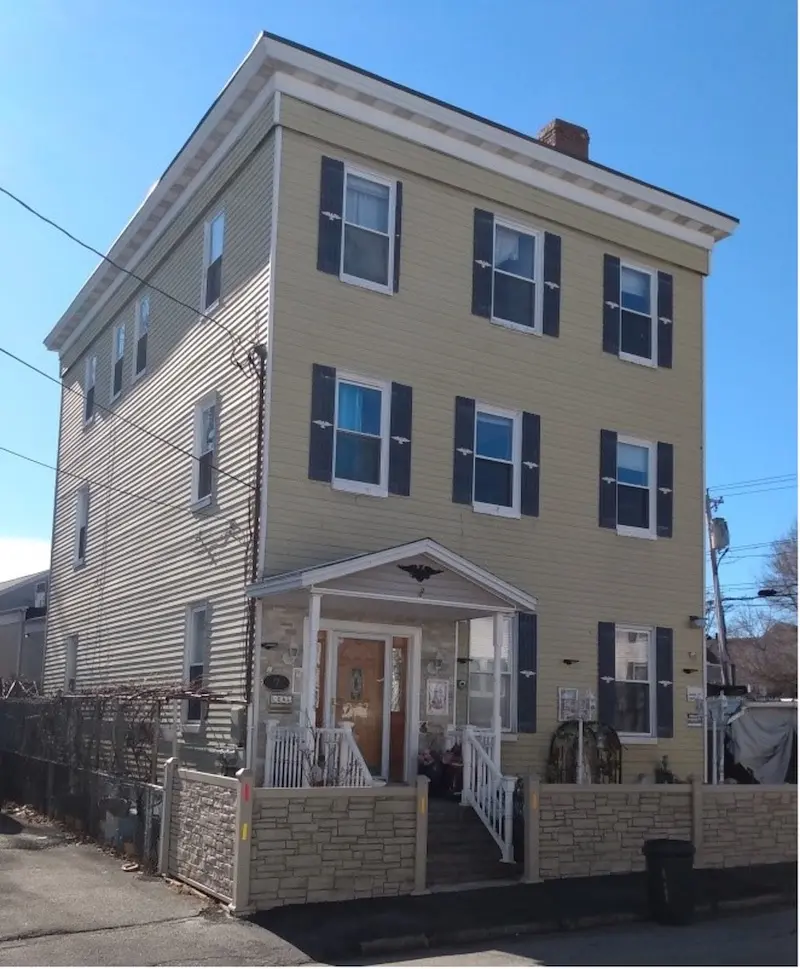
- Historic Name: None
- Uses: Tenement/commercial; multi- and single-family house
- Date of Construction: Circa 1840s; moved to current location in 1924
- Style/Form: Italianate elements
- Architect/Builder: Unknown
- Foundations: Rubble stone
- Wall/Trim: Vinyl siding
- Roof: Flat roof
- Major Alterations: Vinyl windows and siding
- Condition: Good
- Included in Hengen survey? No
- Related oral interview? No
- Portuguese owned? Yes (1948)
- Recorded by: Gregory Gray Fitzsimons and Marie Frank
- Organization: UMass Lowell
- Date: August 2023
Description
This three-story, wood-frame building, about 28 feet by 36 feet in plan, was originally built as a 2-1/2 story residence on the opposite side of the street from the Middlesex County Courthouse, and facing Gorham Street at Mann Square. It was modified in 1919 with the addition of a third story and a flat roof, and was then moved to its present Walnut Street location in 1924. It is likely the dwelling originally had a gable roof but the dwelling likely had various alterations and additions during the 19th century. After its modifications in 1919, the building served as a tenement. It had Italianate elements with ornate window surrounds and decorative wooden quoins. It also had an off-center from entrance and symmetrical fenestration but with a single window on the main (Gorham Street) façade at the second-story level. It is not known the extent to which the tenement was altered after it was reconstructed on Walnut Street. At some point the decorative quoins were removed and windows added at the second story. The off-center front entrance was retained although it has been altered in recent years with a pedimented gable roof providing shelter over the entrance. A concrete stairway (with stone slabs and stone veneer) leads to the front door that includes wood-panel sidelights and a stone veneer exterior surrounding the entrance. Vinyl siding and windows have been added but the building retains its flat roof and brick chimneys. A stone veneer wall extends along the sidewalk and the yard features a number of religious sculptural pieces and a shrine. A small grape arbor extends along the east façade of this residence. The name “Leal” is emblazoned at the front entrance.History
Gorham Street, originally called “County Road,” was a main route south from Lowell leading to Boston. As late as the 1840s, the east side of Gorham Street, beyond Summer Street remained largely undeveloped. This condition changed dramatically after 1845 when the Proprietors of Locks and Canals sold its holdings in this part of the city. Chapel Hill real estate magnate Andrew C. Wheelock acquired a sizeable amount this land. Along with Thomas Nesmith, another major landholder, Wheelock was responsible for laying out and extending a number of streets along Gorham. This included Walnut, Elm, and Keene streets. In 1846-47, along the south side of Walnut Street, a number of wood-frame cottages were built on small lots that Wheelock and Nesmith had subdivided and sold. Residing here were skilled artisans and wage earners and their families, all Protestant New Englanders.
The completion of the Middlesex County Courthouse on Gorham Street in 1850 sparked additional residential and commercial development on Chapel Hill. The city established Mann Square, a small triangular parcel of land, across from the courthouse, along with the extension of Highland Street to Gorham. (The city named this small extension that formed the “base” of the triangle Locke Street; it was only about 50 feet in length.) By 1850 Mann Square had two buildings standing on this small triangular lot. One was a 2-1/2-story dwelling with the address (front entrance on the east side of the house) of 161 Gorham Street, but its northern facade extended along Locke Street. The other building on the lot, to the south, in the apex of the triangle, was a dwelling at 165 Gorham.
Elisha Hall (1812-1895), born in Vermont and an overseer at the Chase (woolen) Mill, along the Concord River, acquired the Mann Square triangular lot in 1867. This included the two dwellings (161 and 165 Gorham). Hall lived on Gorham Street, a short distance from Mann Square, directly across from the courthouse and also speculated in real estate. He rented the two dwellings on Mann Square before selling this property in 1871 to Michael Doyle (1829-1900). A teamster born in County Wexford, Ireland, who settled in Lowell in the late 1840s, Doyle lived for many years on South Street and, beginning in the 1860s, also dealt in real estate. He left the teamster’s trade and entered the soap-making business. A temperance advocate, Doyle was well-known in Lowell. He and his wife Ann, also born in Ireland, belonged to St. Peter’s Church less than a block to the north of Mann Square.
Doyle’s purchase of the Mann Square property and other real estate nearby reflected the changing ethnic character of the neighborhood with an increasing number of Irish settling in Chapel Hill area. Doyle held the property at Mann Square for only two years, selling it in 1873 to Joseph McAleer (1828-1899). Also born in Ireland, McAleer, one of the early Irish immigrants to settle in Lowell, worked as a machinist at the Lowell Machine Shop and lived in a tenement on George Street near the Middlesex Mills. Eventually he moved into the dwelling at 165 Gorham Street, while renting the house at 161 Gorham. In addition to the residential parts of 161 Gorham, the first floor also contained a commercial space. In 1880 Stillman S. Emery (1833-1904) operated a fancy goods store on the first floor. Emery had moved with his wife from Montville, Maine, to Lowell after the Civil War and was listed as a peddler in 1866. Upon relocating to 161 Gorham to run his store, he and his wife lived here along with a Mr. and Mrs. Watts, who were the parents of Emery’s wife. All had been born in Maine. Emery remained at 161 Gorham for several years after McAleer sold the building to fellow Irishman James J. McKeever (1840-1906) in 1882.
Beginning in 1886, after Emery vacated the tenement and commercial space, a Portuguese immigrant, Joaquin Silva Campos (1859-1934), from the Azorean island of Graciosa and one of the “pioneer generation” of Portuguese in Lowell, occupied the building with this wife, Rebecca (Dill) Campos (1856-1933), who ran a fancy goods shop on the first floor. Born in Nova Scotia, Rebecca moved to the United States in 1874 and was living in Lowell by 1880, working as a clerk in a dry goods store, while boarding in a house on Gorham Street. Joaquin Campos left Graciosa in 1877 and initially lived in New Bedford. He was listed as a seaman in the 1880 federal census, boarding with other Portuguese mariners in a tenement on Water Street. He subsequently moved to Lowell and began working in one of the city’s tanneries. This was his occupation when he met and married Rebecca Jane Dill in 1883. That same year Joaquin became a United States citizen. And in 1883 he has his wife had a son, Guy Joaquin Campos, in a house at 157 Gorham, a few doors away from 161 Gorham, into which they moved about three years later.
By 1888, Rebecca Campos had given up the fancy goods business while Joaquin continued to work in a tannery. They remained at 161 Gorham Street until 1893. This was one year before Joaquin obtained a job as mail carrier for the U.S. Post Office. He was the first postal worker of Portuguese birth in Lowell. And by this time, Campos had saved enough money to buy a house in the middle-class neighborhood of the Highlands. He and his family moved to a single-family home at 87 Powell Street, where Joaquin, Rebecca, and Guy lived for the rest of their lives. For a few years they took in boarders, including Frank Dias, an Azorean who worked in the Lowell Carpet Mill and belonged to St. Anthony’s Roman Catholic Church. Although it is likely Joaquin was raised in the Catholic Church, he evidently converted to the Protestant faith for he and his wife became prominent members of the First Presbyterian Church on Appleton Street in Lowell. Their two children, Guy and Isabella, were also brought up in this church and Guy graduated from the Lowell Textile Institute, working in the textile industry and later in other businesses.
After the Campos fancy goods store closed and the Campos moved away from Gorham Street, the house appears to have been used as a residence for working-class renters, although the commercial space may have served for a few years as a saloon operated by the property owner James McKeever. By 1896, Ellen Dolan, born in Ireland and the wife of James J. Dolan, who worked at the Lowell Bleachery, operated a boardinghouse here. The address was now 375 Gorham Street. Dolan’s boarders were almost entirely single, Irish-American males who worked in the textile mills. They numbered six in 1900. After her husband’s death, Ellen Dolan continued to run and reside in this boardinghouse.
Although James McKeever died in 1906 his heirs held onto the dwelling at Mann Square, renting it to Ellen Dolan. Through an auctioneer, however, McKeever’s heirs sold the property in 1908. A series of absentee landlords, including Charles P. Kirby in Los Angeles, California, owned the building. That year Ellen Dolan departed the Gorham Street house and rented a building on nearby Appleton Street where she opened another boardinghouse. A succession of Irish widows then rented the Gorham Street house and continued to operate it as a boardinghouse. All of the boarders were Irish Americans, including Mary Sullivan, a dressmaker who ran her business on the first floor.
Finally in 1919, Cornelius H. Regan (1867-1929), also an Irish American, bought the property and moved here with his family from Appleton Street, where he and his wife operated a boardinghouse. Born in Andover, Massachusetts, Regan relocated to Lowell as a young man and worked for a number of years at Merrimack Mills. In 1894, while at the Merrimack Mills, he met and married Maria Jackson, who was born in Ireland in 1870, immigrated to the United States at the age 17, and worked as a cook at the time of her marriage. The couple decided to venture into the boardinghouse business and began with a small establishment on Worthen Street in the “Irish Acre” neighborhood. By 1898, they moved to the Appleton Street building and operated one of the larger boardinghouses in the vicinity of the Appleton and Hamilton Mills. Their boardinghouse operation included two young female servants. They served 20 boarders, mostly male wage earners, but also a few female factory workers.
Cornelius and Maria made enough in their boardinghouse business to speculate in real estate, buying a house, for rental income, in Back Central, at 16 Linden Street, near Union, in 1917. Soon after purchasing the Gorham Street property in 1919, Cornelius substantially remodeled the dwelling, adding a third floor and installing a flat roof. It appears Cornelius and Maria made these changes so they could again operate a boardinghouse where at this location. By 1924, however, they decided to sell the Gorham Street tenement. The Regans bought a single-family house on nearby Abbott Street, where they moved with three of their adult off-spring, retiring from the boardinghouse business.
Cornelius Regan sold the Gorham Street property in 1924 to the Colonial Filling Stations, Inc., a subsidiary of the Beacon Oil Company, which was a New England concern that had the Boston architectural firm of Coolidge and Carlson design its distinctive Colonial service stations with a small golden dome, in a nod to the Massachusetts statehouse. Prior to the construction of this filling station at this heavily trafficked locale, the company sold the tenement to John Zebris who lived on the opposite side of Gorham Street a few hundred feet to the south. Zebris then had the tenement moved to a part of his lot that extended along Walnut Street. The city assigned the address to the tenement as 7 Walnut Street.
John X. Zebris (1878-1947) was born in Lithuania and immigrated to the United States in 1900. He immediately settled in Lowell in the Back Central neighborhood, which had a small but steadily growing Lithuanian population. For many years, Zebris worked in the shoe industry (he was listed in the federal census of 1910 as a “vamper,” one who stitches together parts of a shoe). By 1909 he had saved enough money to buy a building on South Street, next to the tenement in which he resided. Zebris made an unusual decision to continue to rent a room in this tenement, while remaining at his job in a shoe factory. Meanwhile he rented the tenement he owned to a boardinghouse keeper who had been operating at 146 South Street for a number of years. In 1916 he married Constansia Jusevicius, age 19, who was also born in Lithuania and immigrated to the United States in 1913.
Zebris and his wife continued to reside as renters in the tenement at 136 South Street; but in 1920 he purchased this property. They rented rooms to other factory workers, primarily to Polish married couples with young children. In late 1923, Zebris purchased a single-family house on Gorham Street from the estate of Catherine Riley and moved with his wife and two young daughters to this Back Central locale. The lot of his property extended along Walnut Street and had an open space large enough to accommodate another building. This is where, in 1924, Zebris had the three-story tenement from Colonial Filling Stations relocated.
In 1930 Zebris’ tenants at 7 Walnut Street included a widowed Italian mother and her two adult children, as well as an Italian couple, along with a French Canadian factory weaver, his Irish wife, a stitcher, and their young child. In addition, they rented the first floor to a well-known immigrant from Portugal, Rev. Joaquim Pires Mendes Reis (1890-1969), who led the Portuguese Mission at the Eliot Congregational Church on Appleton Street. He resided here with his wife Alice Oliveira (Calado), and daughter Gladys. Rev. Reis had also served as the Portuguese Vice Consul in Lowell in 1926-27.
In 1940 John Zebris sold his properties on Gorham and Walnut, moving to a single-family house on nearby Keene Street. He remained there until his death in 1947. In the meantime, Peter Demetrios Spanos (1888-1959), a Greek immigrant who had established a successful confectionary business in Lowell and ventured into real estate, acquired the Zebris holdings on Gorham and Walnut. In 1944 Spanos subdivided the property into two lots and four years later he sold the tenement at 7 Walnut to Joaquim Ferreira (1893-1959).
Born in 1893, in Ponta do Sol, on the island of Madeira, Joaquim Ferreira first appears in the Lowell city directory, along with his wife Virginia Angela Nobrega (1895-1968), also from Ponta do Sol, in 1929. They had immigrated to the United States a few years earlier. But by 1930 they lived in Lowell on Central Street with their seven children. Joaquim was employed in the Merrimack Mills but as a skilled carpenter and not a textile worker. He remained at the Merrimack for nearly 20 years. Between 1930 and 1948, prior to Joaquim’s purchase of the Walnut Street property, he and his family lived in several different dwellings in Back Central. Such change in residential locales was not unusual for Portuguese immigrants who were renters, but the Ferreira family’s numerous moves within the neighborhood ranked among the most for this generation. Once Joaquim Ferreira settled into 7 Walnut Street, he remained there for the rest of his life.
From the 1920s into the 1930s Walnut Street residents were primarily Irish, but with a few Italians, Poles, and Lithuanians. In the 1940s, however, there were several Portuguese immigrants, including the Ferreira family residing on this street. Two doors down from Ferreira, at 13 Walnut, lived Jesse Santos and his family. A prominent member of Lowell’s Portuguese community, Santos, an insurance agent, was among the few Portuguese white collar workers of his generation. He and his wife were active at St. Anthony’s Church and Jesse Santos served as president of the Holy Name Society in the late 1940s.
By 1950 Joaquim Ferreira, his wife Virginia, and five adult children lived on the third floor at 7 Walnut, while his daughter, Mary, son-in-law Stanislaus Sypien (of Polish parentage), who worked in a shoddy mill, and grandson, lived on the second floor. Tenants on the first floor included Henry R. Adams and his wife Angeline, both textile factory workers. Although Joaquim had retired by this time, Virginia continued to work as a weaver at the Newmarket Manufacturing Company on Market Street.
After Joaquim Ferreira died in 1959, his wife owned the tenement and continued to live on the third floor. In the 1960s she led a neighborhood movement to stop the construction of a gasoline station on Gorham Street on the site of the late John Zebris’ house which had been demolished. Her efforts received the support of other Portuguese families in Back Central. During this time it appears that Virginia Ferreira no longer rented any of the rooms at 7 Walnut Street to other tenants; instead, she resided there with her daughter, Mary Sypien, son-in-law Stanley, and grandchildren.
In the 1970s, Januario L. Leal (1946-2022) purchased 7 Walnut Street. Born on the Azorean island of Terceira, Leal was part of the “Second Great Wave” of Portuguese immigrants to the United States, settling in Lowell in 1970. For a number of years he worked as a machine operator for the Paris Shoe Company. Like many of his compatriots, Leal and his family belonged to St. Anthony’s Church, and Januario was active in the two major Portuguese clubs in the city. He was also heavily involved in the Holy Ghost Society. Using initially a film and then a video camera, Januario recorded numerous Holy Ghost Society festas and processions, as well as other cultural and occupational activities of Lowell’s Portuguese. These films and videos from the 1970s into the 2010s have been preserved and constitute an important documentary record of Portuguese life and culture in Lowell, as well as in the Back Central neighborhood.
Sources
- Beard & Hoar, Map of Lowell, 1841.
- Sidney & Neff Map of Lowell, 1850.
- Lowell atlases, 1882, 1879, 1906, 1924 & 1936.
- Lowell city directories, 1864-65, 1875-76, 1894, 1900, 1906, 1910, 1916, 1923, 1926, 1929, 1936, 1950, 1956, 1966 & 1975.
- Federal census, Lowell, Massachusetts, 1870, 1880, 1900, 1910, 1920, 1930, 1940 & 1950.
- Obituary of James McAleer, Lowell Sun, June 22, 1899.
- Obituary of Michael Doyle, Lowell Sun, March 14, 1900.
- Obituary of James McKeever, Lowell Sun, January 27, 1906.
- Obituary of Cornelius H. Regan, Lowell Sun, December 19, 1929.
- Obituary of Rebecca Campos, Lowell Sun, December 4, 1933.
- Obituary of Joaquin S. Campos, Lowell Sun, April 21, 1934.
- Obituary of Guy Campos, Lowell Sun, May 1, 1935.
- Obituary of Joaquim Ferreira, Lowell Sun, November 1, 1959.
- Obituary of Virginia Ferreira, Lowell Sun, February 20, 1968.
- “Local Building Activities,” Lowell Sun, July 19, 1919.
- “Heir’s Sale of McKeever Estate,” Lowell Sun, August 25, 1908.
- “Big Tenement Block in Unnatural Surroundings,” Lowell Sun, April 15, 1924.
- Property deed, Buttrick to Hall, May 11, 1867, book 56, page 117, Northern Middlesex Registry of Deeds.
- Property deed, Doyle to McAleer, September 2, 1873, book 96, pages 132-133, Northern Middlesex Registry of Deeds.
- Property deed, McAleer to McKeever, August 31, 1882, book 154, page 555, Northern Middlesex Registry of Deeds.
- Property deed, Leary to Regan, June 13, 1919, book 605, page 365, Northern Middlesex Registry of Deeds.
- Property deed, Regan to Colonial Filling Station, Inc., March 12, 1924, book 703, page 335, Northern Middlesex Registry of Deeds.
- Property deed, Riley to Zebris, May 22, 1923, book 699, page 530, Northern Middlesex Registry of Deeds.
- Property deed, Spanos to Ferreira, May 5, 1948, book 1090, page 171, Northern Middlesex Registry of Deeds.
- “Subdivision Plan of Land in Lowell, Mass., Belonging to Peter Spanos,” October 28, 1947, Plan 71, page 78, Northern Middlesex Registry of Deeds.