
648 Central Street
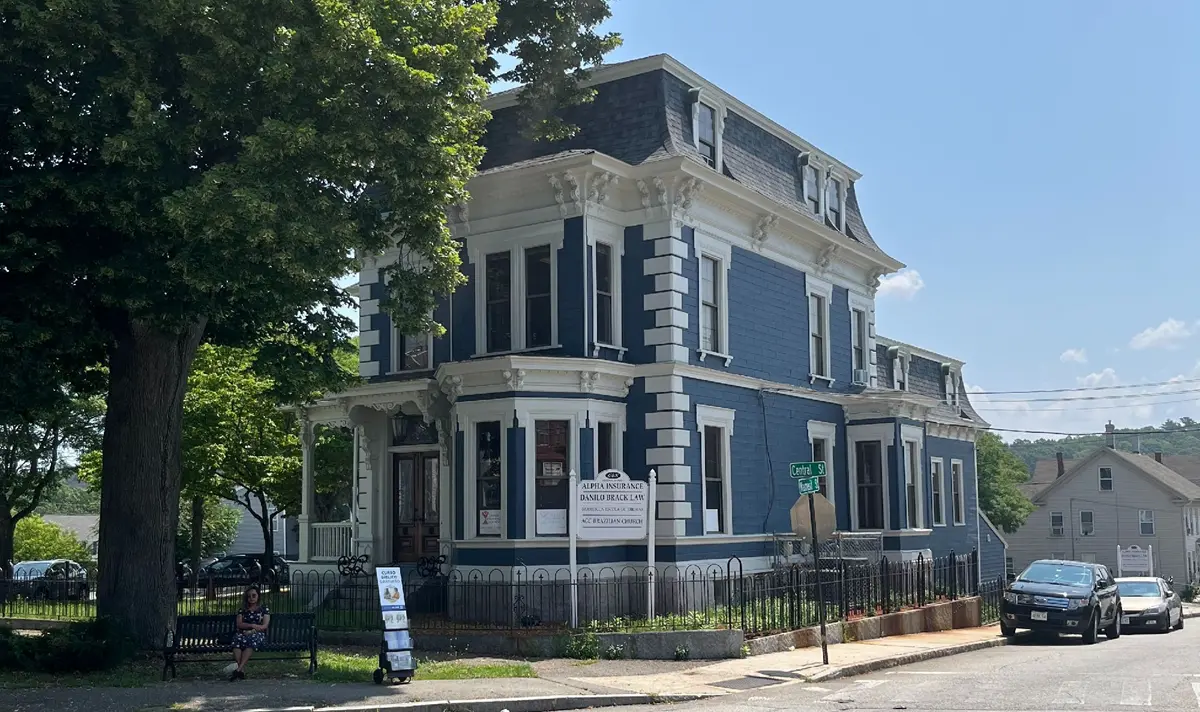
- Historic Name: Samuel Wood House/Children’s Home of Lowell
- Uses: Residential/commercial
- Date of Construction: Circa 1872
- Style/Form: French Second Empire
- Architect/Builder: Unknown
- Foundation: Granite
- Wall/Trim: Wood frame
- Roof: Mansard
- Major Alterations: Sympathetically restored in the 2000s
- Condition: Very good on exterior
- Included in Hengen survey? Yes
- Related oral interview? (Not Portuguese but a brief mention in Alice Stickney interview, CLH)
- Portuguese owned? Yes
- Recorded by: Gregory Gray Fitzsimons and Marie Frank
- Organization: UMass Lowell
- Date: July 2023
A remarkable example of Second Empire architecture in Lowell, similar to the Ayer Mansion (Franco-American School) on School Street. It occupies a commanding position at the crest of Central Street on Hosford Square, originally on a large lot that included five additional structures. By 1906 two drives—one from Mill and one from Wamesit, led to a carriage house. The house itself is asymmetrical in massing and consists of three stories (the third visible in the mansard roof). The north elevation (main entrance) has a bow window to the right and a double door entry on the left. A small porch extends off the east elevation and another bow window off the west. There is an extension off the back, south elevation—two stories with an additional floor in the mansard roof but because of the drop in terrain it only reaches the middle of the second story of the main block. The bow windows and eaves all have ornately carved paired brackets; the eaves also have a dentil molding in a substantial architrave. The corners of the main block have quoins. The windows have dog-ear lintels and small brackets under the sills. The wood siding is laid flush and scored to resemble stone.
History
Samuel Newall Wood (1821-1915) had this house built for his family and the quality of the design and construction again attests to Back Central’s allure for Lowell’s successful businessmen and merchants. He made his fortune first in the grocery and grain wholesale business, through real estate, and then as a director of the First National Bank and a trustee of the Central Savings Bank. Wood ran his business, Samuel N. Wood and Son, at 47 Market Street and lived at 9 Centre Street prior to the construction of this house (he purchased the house on Centre Street in 1847). Wood’s father, also named Samuel (1786-1874), or another family member named Henry, owned the lot at 648 Central since c. 1832. A structure on the lot shows up in the 1834, 1841, and 1850 maps but with a different footprint than the existing house (note: house number in 19th century is 304 Central). Samuel Wood the elder (originally of Tewkesbury) bought and sold numerous properties; when his wife died in 1830 leaving him with young Samuel, he moved to Lowell and started a wholesale grain business. Samuel Newall went to the public schools and then to Phillips Andover Academy, graduating in 1837. By 1845 Samuel started his own grocery business in partnership with Marshall Hemingway (see entry for 571-73 Central); but by 1850 he went into partnership with his father and when his father retired in 1851, he ran the business on his own. In 1868 he brought his own son, Edward, into partnership in the business, and then retired in 1882. However, he had inherited a number of his father’s real estate properties and he also acquired more on his own, so he spent the decades of the 80s-90s managing that side of his business (for example, he owned a number of the buildings on the southeast corner of Union and Chapel). He had three wives—Marcia Gray in 1843, Laura Hyde in 1845, and then Emma Dudley. He had two children, a daughter who moved to New London after her marriage and a son, Edward N. Wood. He attended the High Street Congregational Church. Samuel Newall liked to tell the story that his father brought the first bale of wool and cotton shipped to Lowell to the Hurd Mills.
After Wood died in 1915, his executors (his daughter’s children, the Chases) sold off the auxiliary buildings that faced Mill Street to Catherine and Patrick McGagh. In his will, Samuel left $1,000.00 to his church to aid the poor; perhaps in that spirit, his executors sold the main house to the Children’s Home of Lowell in 1918. The orphanage must have rented the house prior to 1918: in February of 1916, Ellen O’Leary, the matron of the children’s home, oversaw the move from their prior home at 60 Kirk Street where they had resided for 14 years (they were forced to move due to the construction of the new high school). The home provided for approximately 30 children; one of the draws of the Wood home was its large lot and the opportunity to let the children play outside. After acquiring the home, it was made “modern in every particular” with nine large sleeping rooms, a reception room, dining hall, and playroom. All rooms had electric outlets and heat. And the large stable was converted to another play area. The home existed successfully for the next forty years. By 1945, Sarah Watson served as matron; by 1956 Evelyn Kaczmarczyk served as matron. The house still maintained approximately 30 children from age 2-14. According to an oral interview with educator Alice Stickney, the wife of Herbert Ball (a professor of engineering at the university), became a staunch advocate for the home in its later years.
In 1962 however, the Children’s Home of Lowell closed. This may have been due to the increased use of foster homes for children or to increased fire regulations after the disastrous fire at Our Lady of the Angels in Chicago. (The Home continues to function as a non-profit that donates funds to children’s causes.) The house was sold to John and Anamay McGoohan in August of 1962. They sold the house to Joao Nunes in 1975. Both the McGoohans and Nunes separated the house into rental apartments. In this period, a number of Portuguese rented rooms. Maria Silveira Estacio of the Azores lived there for two years in the mid-60s and attended St. Anthony’s Church. The area certainly declined through the 60s and 70s as witnessed by the number of break-ins, arrests, and thefts that occurred at or around the site. In 1976, renter Angel Figueroa was tried in court for unarmed robbery and assault. Nunes sold to Duarte Bettencourt in 1980, who in turn sold it to Jorge Oslan in 1984. However, the house was vacant and deteriorated even by 1981. With funding provided by Lowell Institution for Savings, Oslan renovated the property and leased the first floor and basement to Lowell Institution for a Back Central neighborhood branch of the bank. However, by the summer of 1986, Oslan was experiencing financial difficulty and deeded the entire property to Lowell Institution which continued as the owner until 1991 when the bank became insolvent and was taken over by the FDIC. As the successor owner of 648 Central Street, the FDIC sold the property in 1992 to Attorney George Basbanes who used it for his law office; he sold it in 2013 to Alpha EML (an insurance company that currently occupies a portion of the building). Other current occupants include a law firm as well as the AGC Brazilian Church.
Particular thanks to Dick Howe and Nicole Tantum for information in this entry.
Sources
- U.A. Boyden, Plan of Lowell Village, 1834
- Beard and Hoar, Map of Lowell, 1841.
- Sidney and Neff Map of Lowell, 1850.
- Lowell atlases 1879, 1882, 1906, 1924 and 1936.
- Lowell city directories.
- Lowell Sun, Jan 17, 1911, p. 34, “Hale and Hearty: Samuel N. Wood Observes 90th Birthday”
- Lowell Sun, Feb. 29, 1916, p. 18 “O’Leary House Moving.”
- Lowell Sun, March 25, 1916, p. 20 “Children’s Home Opens.”
- Courier-Citizen, Illustrated History of Lowell, p. 454.
- Alice O. Stickney, interview by Robert Dugan, in Lowell, Massachusetts, February 6, 1974, interview 74.05b, transcript, Oral History Collection, Lowell Historical Society, Center for Lowell History, University of Massachusetts Lowell.
- The Children's Home of Lowell, Inc., Box 9, Folder 23, John A. Goodwin Collection, Lowell Historical Society, Center for Lowell History, University of Massachusetts Lowell.