
61 Chapel Street
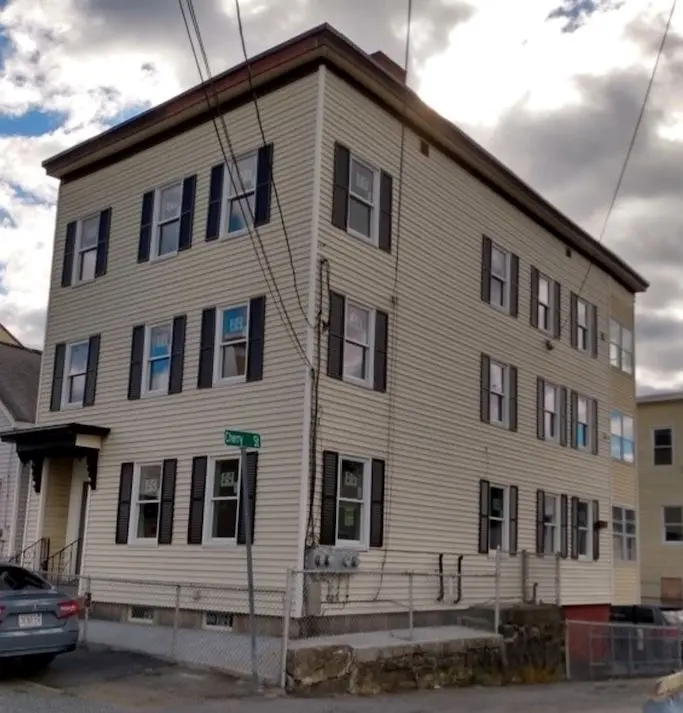
- Historic Name: None
- Uses: Apartment building
- Date of Construction: Circa 1830s (rebuilt circa 1900)
- Style/Form: Vernacular Italianate elements (now largely absent)
- Architect/Builder: Unknown
- Foundation: Rubble stone
- Wall/Trim: Vinyl siding
- Roof: Flat roof
- Major Alterations: Most notable are new vinyl windows and shutters; vinyl siding; new flat roof with original cornice removed
- Condition: Good
- Included in Hengen survey? No
- Related oral interview? No
- Portuguese owned? Yes (1915)
- Recorded by: Gregory Gray Fitzsimons and Marie Frank
- Organization: UMass Lowell
- Date: July 2023
Description
A dwelling appears at this location on the corner of Chapel Street and Cherry Street (originally called Merrill’s Court) on the 1841 map of Lowell. It was likely a wood-frame, single-family house built in the Greek Revival style. This three-story, wood-frame tenement with a flat room likely dates from the early 1900s and probably was built with Italianate elements. It has been greatly altered in recent years with the addition of vinyl siding, windows, and shutters, and a new flat roof with projecting ends and a vinyl, flat cornice belt, which likely replaced the more ornate wood dentils supporting the overhanging flat roof. The off-center main entrance is sheltered by a small flat roof supported by decorative wood brackets, which may date from the earlier single-family house.
History
Born in Billerica, Massachusetts, Levi Sprague (1810-1902), a contractor who moved with his family from Lawrence to Lowell in the mid-1850s, bought a house on the southwest corner of Chapel Street and Cherry Street (originally called Merrill’s Court), which was built by 1841. The dwelling was likely a Greek-Revival style building, wood-frame, and 2-1/2 stories in height with a gable roof. In 1858 Joseph S. Pollard (1811-1884), a dry goods dealer and one of the city’s wealthy residents, purchased the property from Sprague. Pollard, who lived in a large house on Ash Street at the corner of East Merrimack Street and owned real estate in Chapel Hill, rented the Chapel Street dwelling. One of the early (in 1861) renters was James Beggs, a mason born in Scotland, and his family. It was still a 2-1/2 story house in the early 1880s and the residents in this area of Chapel Street were increasingly Irish working-class families.
Arthur G. Pollard (1843-1930), who took over the dry goods business from his father and turned it into Lowell’s premier department store, inherited the house on Chapel Street. The Pollard estate where Arthur lived, until he moved to the wealthy Belvidere neighborhood, was only few blocks away on Elm and Linden streets. He continued to rent the Chapel Street house until 1896 when he sold it to Patrick McGuire. A newspaper ad in 1905 stated that “a sunny downstairs flat” with hot and cold water bath, was available “to let cheap,” indicating that 61 Chapel Street had been rebuilt into a tenement. Thus it is likely that by this time the building had been raised to three stories, with an apartment on each floor. Chapel Street residents were predominately Irish and one of the long-time tenants at 61 Chapel Street was Philip Devine (1828-1911) and his family. Born in Ireland, Devine immigrated to the United States in the 1850s, settled in Lowell, and married Irish immigrant Anna Marie Breen (1839-1909) in 1864. Devine worked many years as an iron moulder, a highly skilled position in a foundry.
McGuire died in 1910 and his married daughter, Mary A. McGuigan, inherited the Chapel Street property. In 1914, she and her husband, James J. McGuigan, a clerk in a clothing store on Central Street, sold the property to Antonio Pacheco an Azorean immigrant, born in 1883. By 1920, Pacheco had become an American citizen and operated a fish market in Back Central. He lived with his wife Maria, likely on the ground floor. They had no children. Residing upstairs in the tenement was Peter Marcotte, age 52, a French Canadian whose wife was deceased, and his son Frank, age 20. Both men worked for a local oil company. On the third floor was Frank Souza, 31, his wife Etta, 25, and cousin Maria Cunha, 33. All three were Portuguese immigrants and worked as weavers in a cotton mill.
Antonio Pacheco, a well-known figure in Lowell’s Portuguese community died in 1923 after a short illness. His wife, Maria, remarried in the late 1920s. Her husband, Joao Ribeiro, born in Madeira, moved with his parents, when he was quite young, to Brazil, before returning to Madeira and then immigrating to the United States in 1906, was a widower with a daughter, Maria. All three lived on the first floor of the tenement. They continued to rent the two flats above. By 1940 the tenants included Joseph and Eva Varanoski, a Lithuanian couple, and their two sons. Also living in the other apartment was Eusebio Merino, born in Spain, his Portuguese wife, Mariana, and son Manuel. Almost all of the adult tenants over the years were wage earners who worked in various Lowell factories. The property remained in the Ribeiro family until the 1980s.
Sources
- Beard and Hoar, Map of Lowell, 1841
- Sidney and Neff, Map of Lowell, 1850
- Lowell atlases, 1882, 1879, 1906, 1924 and 1936.
- Federal census, Lowell, Massachusetts, 1860, 1870, 1880, 1900, 1910, 1920 and 1940.
- Lowell city directories, 1870, 1875-76, 1894, 1906, 1916, 1926, and 1936.
- Classified ad, Lowell Sun, May 5, 1905.
- Obituary of Philip Devine, Lowell Sun, March 3, 1911.
- Obituary of Antonio Pacheco, Lowell Sun, September 12, 1923.
- “Mr. and Mrs. Joseph Varanoski,” Lowell Sun, September 16, 1948.
- Property deed, Sprague to Pollard, September 11, 1858, book 16, pages 285-286, Northern Middlesex Registry of Deeds.
- Property deed, Pollard to McGuire, June 1, 1896, book 275, pages 419-421, Northern Middlesex Registry of Deeds.
- Property deed, McGuigan to Pacheco, November 17, 1914, book 530, pages 161-162, Northern Middlesex Registry of Deeds.
- Commonwealth of Massachusetts, Department of Revenue, Estate Tax Release, Mary Ribeiro, March 1, 1986, Northern Middlesex Registry of Deeds.