
557-561 Central Street
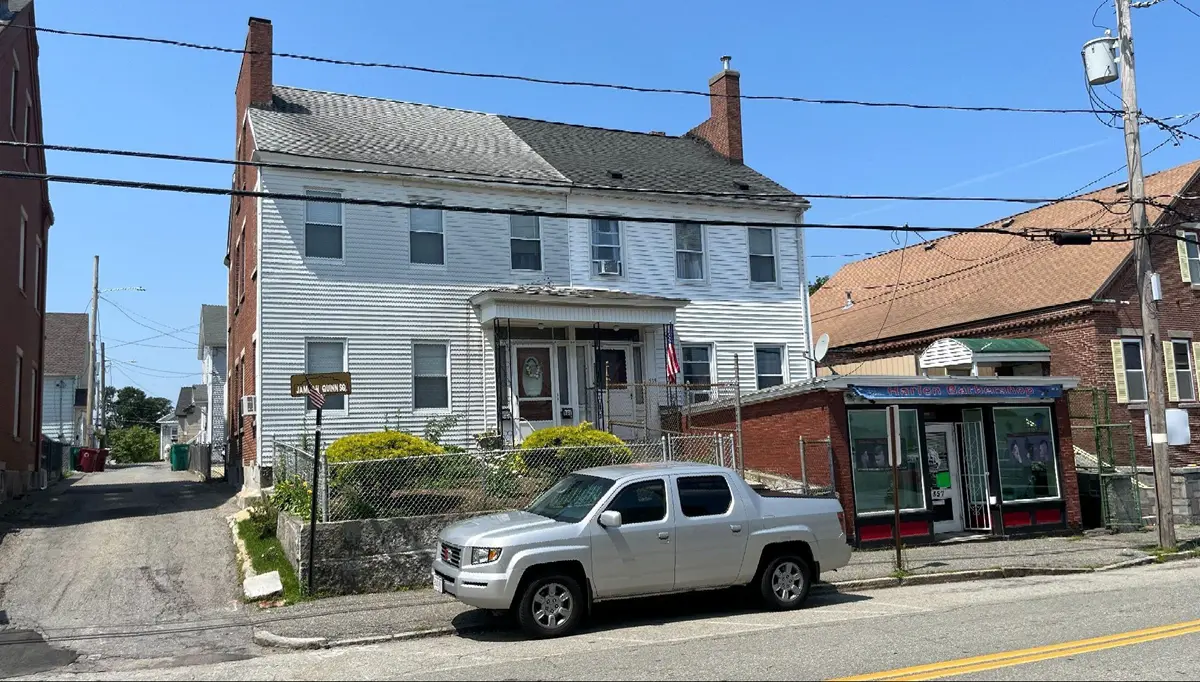
- Historic Name: Joseph Locke House
- Uses: Residential (#559-61) and Commercial (#557)
- Date of Construction: Circa 1833
- Style/Form: Federalist/Greek Revival
- Architect/Builder: Unknown
- Foundation: Granite
- Wall/Trim: Wood frame east and west elevations; brick north and south
- Roof: Gable
- Major Alterations: Commercial extension off front of #559; extensions off rear; vinyl siding on front elevation and extensions
- Condition: Good
- Included in Hengen survey? Yes
- Related oral interview? None
- Portuguese owned? Yes
- Recorded by: Gregory Gray Fitzsimons and Marie Frank
- Organization: UMass Lowell
- Date: August 2023
Description
This house, in its original condition, yet again underscores the refined architecture that once dotted the streets of Back Central. It is a “brickender”: constructed with brick walls on the side elevations and a wood frame for the front and rear elevations. It is also a double house (#561 and #559), it has the symmetry and regularity of the Federalist/Greek Revival styles. The entrances to each house are paired at the center, flanked by two windows on each side on the first story; the second story has six evenly spaced windows. The roof is a pitched gable; the side elevations are brick with impressive parapet chimneys. Windows on the side elevations, again symmetrically disposed, have granite lintels and sills. A wood frame addition added sometime after 1850 and two rooms deep, extends off the back. Aluminum siding added to the front façade in the 20th century either removed or obscures any Greek revival molding details at the corners of the building. The entry had a porch supported by three Doric columns (with matching engaged columns) but these were removed after 1981 and replaced with thin filagree metal supports. The doors have sidelights and transoms; #561 has a Queen Anne door. #557 is a one -story brick addition to the front of #559 and served as a commercial space throughout the 20th century (see below). It has a central entrance with two large plate glass windows on each side.
Note: prior to 1855 there were no house numbers; after 1855 the house numbers are 235 and 237 Central Street.
History
The Joseph Locke House is both architecturally and culturally significant for Back Central. Brickenders in New England are unusual, and in Lowell rare. The brick ends contain the fireplaces and chimneys for the house and mark a transition away from the increasingly unfashionable central-chimney layouts of the previous century. The house is also among the earliest in Back Central; its construction came shortly after Scripture’s Bakery on the adjacent lot to the north (see entry for #547 Central). Although called the Locke House, the initial land and house was jointly purchased by Joseph Locke and Zadok Howe in 1832 from Aaron Mansur. The lot originally extended all the way to Chapel Street. Howe was not a resident of Lowell; he earned a medical degree from Dartmouth and lived and worked in Billerica (he donated the funds for its high school). Locke, however, had a prominent position in Lowell. Born in New Hampshire, Locke attended Harvard College, entered the legal profession soon after his graduation, and embarked on a highly successful career. He practiced in Billerica from 1801-33 (where he and Howe no doubt became friends); his skills led to the position of representative to the General Court for eight years and he also presided over the Middlesex County court of sessions during his time in Billerica. In 1833 he moved to Lowell to preside as the first judge of the Lowell Police Court; the 1834 city directory lists his residence at this site. His court was located in Crosby’s Building, also on Central. Like several of his legal and legislative colleagues in the city, he also branched into banking, becoming an incorporator of City Bank in 1836. Locke lived in #561 until his death in 1853; in 1854, Howe’s heirs relinquished his half of the property to Locke’s heirs making them sole owners. Locke’s wife remained there until 1855. The heirs sold the house in 1856 to Charles Maynard who ran a lace shop at 76 Merrimack Street (19th century street address). Maynard died and David Gove, a grocer, purchased the house in 1861. (His grocery was just a few blocks down at 225 Central on the southwest corner of Charles and Central.) Gove lived in #561 with his family until 1889. By 1866, #559 was owned by Jonathan Kendall. Kendall initially worked as an overseer at the Suffolk Mill in the 1850s but by the 60s had opened his own paint store on Cabot Street. By the date of the 1879 atlas, the rear additions for both addresses are visible. Kendall’s heirs sell the property in 1884; it changed hands quickly until purchased by Anders Thomasson in 1889. Thomasson most likely added the commercial front (#557) to #559—it shows up, lightly pencilled in, on the 1882 atlas (which notably was not published until 1888). Thomasson (1844-1919) emigrated from Sweden and became a citizen in 1879. He was a trained druggist and active member of the Swedish community of Trinity Lutheran Church on Meadowcroft Street for which he served as a trustee. The Trinity Church website includes a photograph of Thomasson and his wife outside of the side elevation of their home at #559. The couple donated a mural to the church after they survived a transatlantic trip in which their ship struck an iceberg.
For decades, #557 served as a staple drugstore in Back Central. Thomasson’s inventory ranged from the product “Rejuvenine” (for women who suffered from hysteria and melancholia) to tickets for the Cunard Line; in 1915 he applied for a license to sell intoxicating liquors of the sixth class (druggist). Thomasson ran a successful business; in addition to trips back to Sweden, he and his wife vacationed at Onset near Cape Cod each summer for a few weeks, and in 1908 they purchased a home in the Highlands neighborhood at 452 Westford Street. Thomasson turned the business over to the Devno brothers, Frederick and Charles, of Belvidere, in 1914. They kept the Thomasson name on the business and ran the pharmacy successfully until 1924 when tragedy struck. In November, Fredrick accidentally shot himself after a hunting expedition outside of Hollis, NH. Frederick’s gun discharged when he attempted to stow it in his car and he was killed instantly. Charles continued the business, also listed as a grocery, and lived in #559 with a daughter, Ethel. By 1926 Catherine Hornbrook owned #561; Devno continued to own #557-9 through the 1930s although by 1936 he rented out the pharmacy to Francis Flanagan who changed the name to Flanagan Pharmacy. In 1942 Francis Flanagan purchased #557-9 (but did not reside in #559); then in 1957 Paul Bernard purchased it and changed the name to Bernard Pharmacy.
The neighborhood also had its share of crime by the mid-20th century. On January 17, 1944, right in front of the drugstore, a thief stole the purse of Mrs. Julia Andrews of 574 Central (the Hocum Hosford house, see entry). Mrs. Andrews struggled to keep her purse and the man hit her on the head with his fist to knock her down.
After almost a century of continuous use as a pharmacy, #557 changed function. Bernard sold the property in 1973 to Eurico and Gabriela Duarte. In 1972 the commercial space had been used by the St. Francis Cabrini Sodality for meetings but after the Duarte purchase it became the Casa Portugal Club retail store. Attention focused on this store when a major theft occurred on Christmas, December 25, 1975. According to the proprietor, Duarte Bettencourt, over $3,000 worth of valuables vanished, including a color television, three portable televisions, cassette radios and an expensive, $1,452 transoceanic radio. The thieves gained entry by removing the molding around the front window and reaching in to unlock the door. By 1985 the store is no longer listed in the city directories, but Maria Duarte retained ownership until she sold to Mateo and Filomena Fagundes in 1994 who remain the current owners. #557 is currently occupied by the Harlan Barbershop. #561 also had Portuguese owners. After Hornbrook owned the property in the 1920s, it was owned by two subsequent women, Mary Young and Julia Richardson, before Richardson sold it to Daniel Pacheco in 1969. Pacheco in turn sold it to Osvaldo Quadros in 1972. It is currently owned by Antonio Bettencourt.
A grateful thank you to Dick Howe for his help unraveling the deeds of this complex property, particularly the early years of Locke’s ownership.
Sources
- U.A. Boyden, Plan of Lowell Village, 1834
- Beard and Hoar, Map of Lowell, 1841.
- Sidney and Neff Map of Lowell, 1850.
- Lowell atlases 1879, 1882, 1906, 1924 and 1936.
- Lowell city directories.
- Registry of Deeds.
- Elizabeth Hengen, Lowell Cultural Resource Inventory.
- Lowell Sun, “$3,000 in Goods Taken in Central Street Break,” Dec. 26, 1975, p. 54
- Lowell Sun, “Death While on Hunting Trip: Frederick L. Devno Killed By Accidental Discharge of His Shotgun,” Nov. 21, 1924, p. 24.
- Lowell Sun, “Women Victim of Purse-Snatcher,” January 17, 1944, p. 28 for details on Anders Thomasson: Trinity Lutheran Church website and
- Fitzsimons, Gray, “Unheralded Building Linked to a “Swedish Pioneer” in Lowell,” Lowell Historical Society Spring Newsletter, v. 31 (April, 2010): 3-5.