
52 Auburn Street
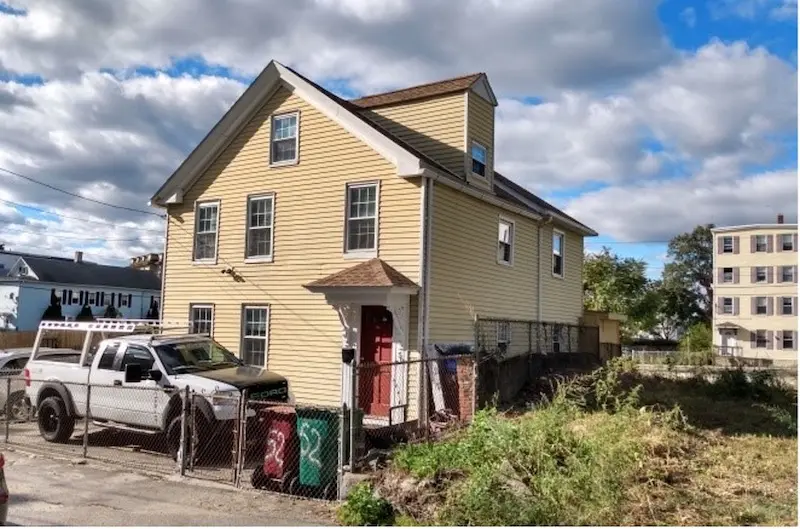
- Historic Name: None
- Uses: Single-family home
- Date of Construction: Circa 1848
- Style/Form: Greek Revival
- Architect/Builder: unknown
- Foundation: Stone
- Wall/Trim: Vinyl siding
- Roof: Gable roof with a single gable roof dormer
- Major Alterations: Most notable are new vinyl windows; the removal of windows on the west and east façades; and vinyl siding
- Condition: Good
- Included in Hengen survey? No
- Related oral interview? No
- Portuguese owned? Yes (1917)
- Recorded by: Gregory Gray Fitzsimons and Marie Frank
- Organization: UMass Lowell
- Date: July 2023
Description
This 2-1/2 story wood-frame house was constructed in the 1840s and is one of many Greek Revival-style dwellings in Back Central. It has been greatly altered with a number of windows removed, all others replaced with vinyl windows; and a rear 2-1/2 story addition with a gable roof (this addition likely dates from the early 20th century). A sole gable-roof dormer is on the east side of the original part of the house and this might date from the 19th century, although it appears altered. There was likely a matching gable-roof dormer on the west side as well. The lot contains an extensive array of grape arbors.
History
This house on Auburn Street appears on the Sidney & Neff map of Lowell from 1850. It was one of four houses built on this street in the 1840s. Auburn Street, from its inception in the 1840s, was narrow and alley-like. Other streets, like nearby Elm and Linden, which intersected with Auburn, were wider. Nevertheless, the population in this part of Chapel Hill grew as the neighborhood developed alongside the Middlesex County Courthouse.
Although not the first to inhabit the house that would, in time, have the address of 52 Auburn Street, Elisha Hall (1812-1895) was an early resident in this single-family Greek Revival house. Born in Vermont, Hall married and lived in a few towns in the Green Mountain State before moving to Lowell in the 1850s. He worked as an overseer at the Appleton Mills and lived with his wife and children in an Appleton Corporation boardinghouse. By 1864 he bought the Auburn Street property and obtained a job as an overseer in small woolen mill along the Concord River. In April, 1865, just as the Civil War was ending, Hall sold the house to Lucy Baker, who was about 50 years of age. Baker, a nurse, practicing in Lowell since the 1840s, was one of the few single (non-widowed) women to own property outright in the Spindle City. She lived in the house for only a few years, however, before selling it to John Burns, a mechanic, in 1869. Burns and his wife Mary, both born in Ireland, had five children by 1880. A tenement next door, as well as many of the other dwellings on Auburn Street, was home to nearly all Irish and Irish Americans. The Burns family would remain in their Auburn Street house for nearly 50 years.
In the early 1910s, Frank C. MacLeod, a carpenter who worked at the Massachusetts Mills, bought the Burns family house from the Butler Bank. MacLeod likely built a rear addition to the dwelling to create a two family-house for rental income. MacLeod lived in a wealthier part of the city (on Rogers Street) and rented the Auburn Street property until 1917 when he sold it to José Lopes. Born on the island of Madeira in 1885, Lopes immigrated to the United States in 1907 and settled in Lowell. He obtained a job in picking room at the Massachusetts Mills. He married and saved enough money with his wife to buy the Auburn Street property. Within three years, however, Lopes and his wife were unemployed with three children. They sold their house to Frank Porto, who had been living with his wife, Maria, in a small cottage he owned on nearby Court Avenue.
Porto was one of the few Lowellians from Spain. Born in 1881 in Coruna, in the Galicia region of Spain, Porto immigrated to the United States in 1916. His wife, Maria (Ares) Porto, appears to have had family in Lowell and the couple settled in the Back Central neighborhood where the Ares family resided. Frank Porto obtained a job as a blacksmith in a machine shop, an indication that he was a highly skilled worker before moving to the United States. In 1917 he bought a cottage on Court Avenue (see entry of 7 Court Ave.) residing there with his wife, his mother-in-law, Carmen Ares, a sister-in-law, and a cousin. All were born in Spain. Three years later Porto acquired the Auburn Street property, while selling the cottage to Richard C. Ares (who was likely his brother-in-law). Porto rented one part of the Auburn Street house to a Portuguese family. In 1925, Maria Porto placed an ad in the Lowell Sun, noting she was administrator of the Porto estate, with Frank Porto being deceased, and that the Auburn Street property was for sale. Mysteriously, it appears Frank Porto merely deserted his wife for, by 1940, he was living in a low-rent hotel, filled with men who were down on their heels, in the Bowery in Manhattan. His fate is unknown.
Acquiring the Porto property on Auburn Street in 1925 was Joao Gomes Jardin and his wife Stefini (also noted as Stephanie). From Madeira Island, Joao Jardin immigrated from his native land and settled in Lowell in 1920. He worked initially in the Appleton Mills and then as laborer in the Lowell Waste Company mill that recycled rags and various textile fabrics. The Jardins rented the apartment in the house to other Portuguese families. By the 1920s, however, a number of Italian families lived on Auburn Street. During the Great Depression many working-class families in Lowell lost their homes either to defaulting on mortgages or failure to pay municipal taxes, or often both. Joao and Stefini Jardin turned over their property to the Washington Trust Company in 1938. The house on Auburn Street has had various owners since the 1930s. The two families that have held the property for the longest stretches were Portuguese, including Antonio G. and Emma S. Sequeira, and Maria Cabral Goes. Antonio Sequeira, from Madeira Island, was a well-known figure and long-time resident in Lowell’s Portuguese community. Active in the Portuguese American Civic League and at St. Anthony’s Church, he lived with his wife and family for many years in a house on Clark’s Court before buying the Auburn Street property, apparently as a real estate investment.
Sources
- Sidney and Neff Map of Lowell, 1850.
- Lowell atlases, 1879, 1882, 1906 and 1924.
- Lowell city directories, 1853, 1858, 1864-65, 1875-76, 1906, 1917, 1926, 1936 and 1950.
- Federal census, Lowell, Massachusetts, 1880, 1900, 1910, 1920 and 1930.
- Federal census, New York City, Manhattan Borough, 1940.
- “Real Estate Dealers,” Lowell Sun, September 25, 1920.
- “Legal Notices,” Lowell Sun, September 23, 1925.
- Obituary of Antonio G. Sequeira, Lowell Sun, November 6, 1971.
- Property deed, Hall to Baker, April 11, 1865, book 41, pages 460-462, Northern Middlesex Registry of Deeds.
- Property deed, Baker to Burns, July 8, 1869, book 68, pages 450-452, Northern Middlesex Registry of Deeds.
- Property deed, Burns to Butler Bank, 1906, book 397, page 73, Northern Middlesex Registry of Deeds.
- Property deed, MacLeod to Lopes, July 16, 1917, book 618, pages 511-512, Northern Middlesex Registry of Deeds.
- Property deed, Lopes to Porto, September 17, 1920, book 633, page 180, Northern Middlesex Registry of Deeds.
- Possession, Jardin to Washington Trust, November 3, 1938, book 922, page 52, Northern Middlesex Registry of Deeds.
- Quitclaim Deed, Maria C. Goes, July 31, 2000, Northern Middlesex Registry of Deeds.