
512 Central Street
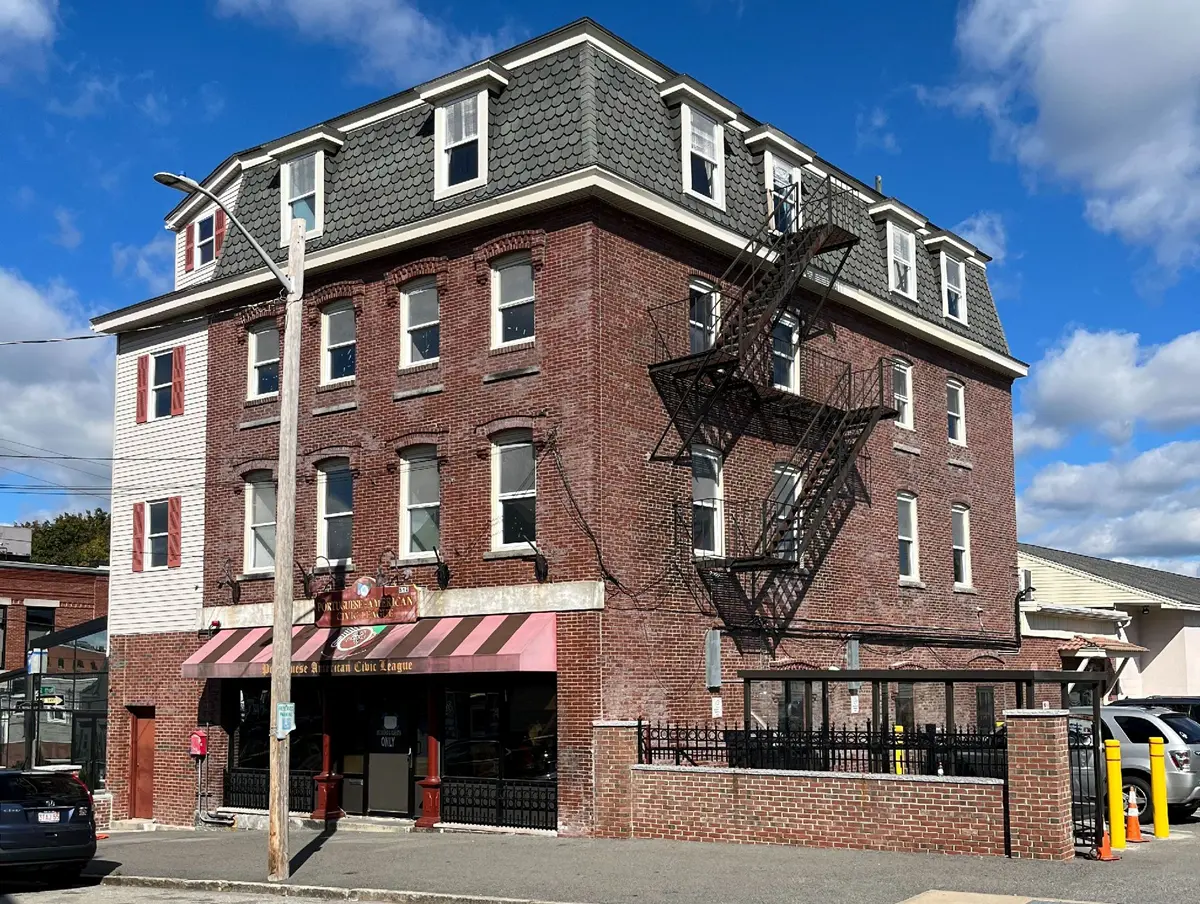
- Historic Name: Donovan Grocery; Portuguese American Civic League
- Uses: Social club and restaurant
- Date of Construction: 1873
- Style/Form: Second Empire
- Architect/Builder: Unknown
- Foundation: Granite stone
- Wall/Trim: Brick
- Roof: Mansard roof
- Major Alterations: Full-height glass walls on first floor of main façade; addition to the north façade; demolition of adjacent building for a parking lot
- Condition: Good
- Included in Hengen survey? No
- Related oral interview? No
- Portuguese owned? Yes
- Recorded by: Gregory Gray Fitzsimons and Marie Frank
- Organization: UMass Lowell
- Date: July 2023
Description
This four-story brick building with a stone foundation and a mansard roof was designed in the Second Empire style. The cast iron columns of the original storefront entrance survive; but the fixed glass panels along the first floor are a more recent addition. The ornate brick lintels of the upper story windows and the granite sills survive. An original granite belt extends across the top of the first floor of the main façade. There have been numerous alterations in recent years, including a four-story brick and wood-frame addition on the north façade. The neighboring lot to the south, which until recently had an 1840s dwelling, has been turned into a parking with the building demolished.
History
This building now owned and operated by the Portuguese-American Civic League, was constructed in 1873 by John J. Donovan, son of Irish immigrants who, in 1884, became Lowell’s first Irish-American, Roman Catholic mayor. Born in 1843, in Yonkers, New York, Donovan came to Lowell with his widowed mother when he was three years old. He was educated in the city’s public schools and entered high school at the age of 12. Before finishing high school he joined the grocery business of David Gove, who operated a store on the corner of Central and Charles streets. Born in New Hampshire, Gove had been an overseer of repairs at the Hamilton Mills before joining Marshall Hemenway, in the grocery business. (Hemenway operated a grocery store in the commercial space at 507 Central Street—see the survey form for this building).
In the 1860s Gove made Donovan a partner in his enterprise. Donovan eventually succeeded Gove upon his retirement. Looking to expand the business, Donovan acquired a property on the opposite side of Central Street and about two blocks to the south. In 1873 he had the building on the lot demolished, constructing in its place a four-story, brick building with a mansard roof and cast iron storefront, as well as granite trim. Its design, in the Second Empire style, was popular at this time. The first floor housed the Donovan grocery and the upper floors were apartments. Donovan proved to be skilled businessman and he invested in real estate, as well as a local paper mill. His ability to work within Protestant and Catholic business circles certainly enhanced his business and political successes. His brother-in-law John Seede continued to run the grocery until his death in 1899.
For the next 50 years the building had various owners and uses. By 1959, however, the Portuguese American Civic League, established in the 1930s, purchased the building for its social and civic activities. This historic building is still owned by the Civic League and is known locally as the “Red’s Club.”
Sources
- “Old Citizen [David Gove] Departed,” Lowell Daily Courier, October 9, 1882.
- “New Building,” Lowell Courier-Citizen, August 8, 1873.
- “John J. Donovan—Ex-Mayor of Lowell Died This Noon,” Lowell Sun, April 24, 1905.
- Property deed, Picanso to Portuguese American Civic League, February 17, 1959, book 1430, page 12, Northern Middlesex Registry of Deeds.