
46 Linden Street
- Historic Name: None
- Uses: Single-family home
- Date of Construction: Circa 1868
- Style/Form: Italianate
- Architect/Builder: Unknown
- Foundation: Concrete and stone
- Wall/Trim: Vinyl siding
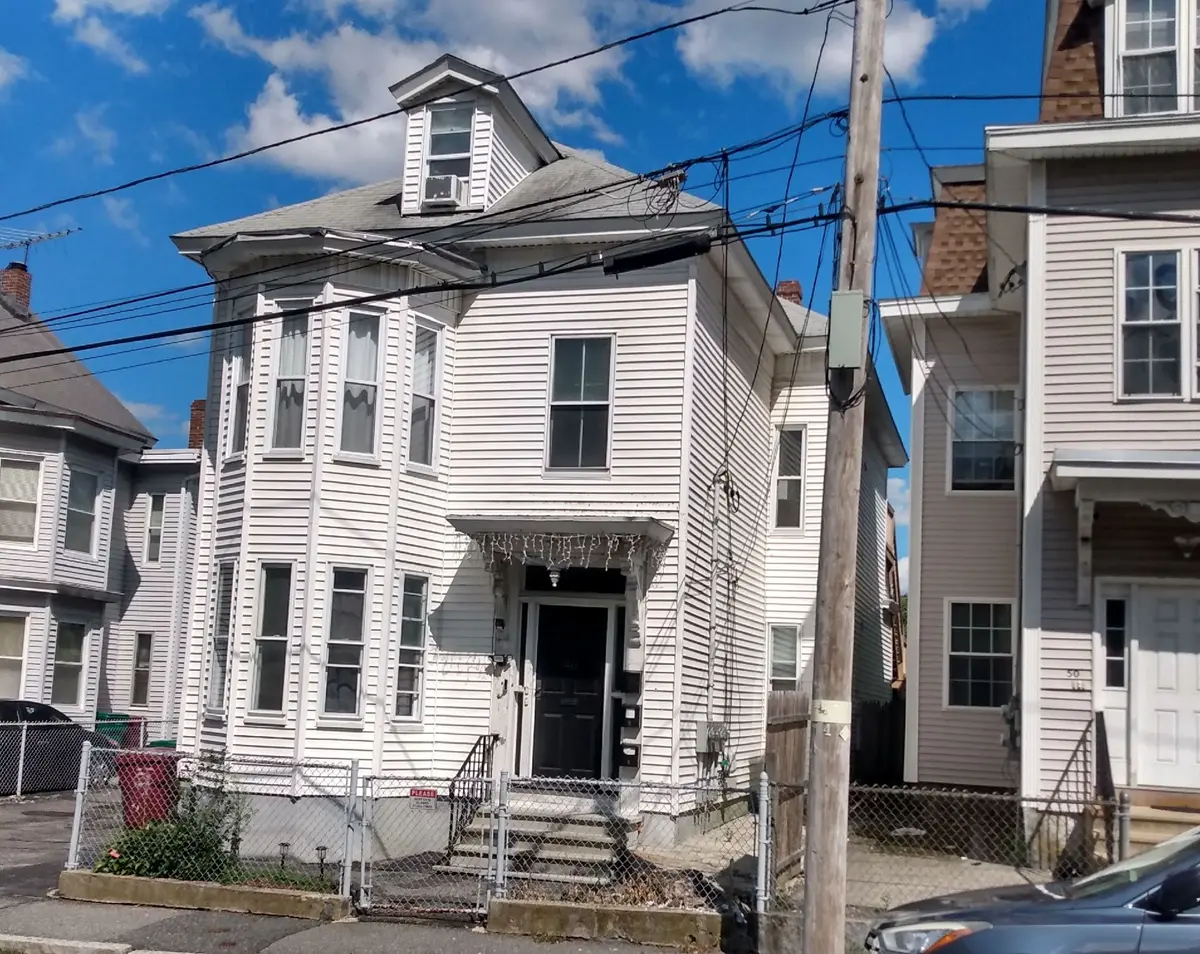
- Roof: Pyramidal roof with gable roof dormers
- Major Alterations: Most notable are new vinyl windows and vinyl siding
- Condition: Good
- Included in Hengen survey? No
- Related oral interview? No
- Portuguese owned? Yes (1919)
- Recorded by: Gregory Gray Fitzsimons and Marie Frank
- Organization: UMass Lowell
- Date: July 2023
Description
This 2-1/2 story wood-frame house was constructed ca. late 1860s and has Italianate elements, including a hexagonal projecting bay on the main façade, an off-center entrance, and a lightly decorative cornice below the projecting eaves of the pyramidal roof. It rests on a concrete and stone foundation. It also has a projecting bay along the north façade and a rear two-story, wood-frame addition with a flat roof.
History
This Italianate house first appears on the 1879 Lowell atlas, just two doors up Linden Street from the corner of Linden and Cherry streets, where the rectory for St. John’s Episcopal Church had been built. A deed dating from 1872 indicates that there was no building on the lot at this time. By 1875, however, Jonathan Rollins, a mason, who bought this lot in 1872, was living in this Italianate house. It is likely that Rollins built it. He lived there with his family until 1890, selling the property to Irish-American Peter H. Donohoe, a liquor dealer who owned several properties in Back Central. Donohoe lived with his family in the Linden Street house for only a few years because in 1893 Irish-born Margaret McVey (1839-1907), a widow, bought it. She lived in the house with a son, Edward D., a lawyer, one daughter, Emma, who worked in the Massachusetts Cotton Mills, another daughter, Lena B., a clerk, and a third daughter, Rose E. McVey (1856-1956), a principal at the Chapel Street Primary School and later at the Ames Street Primary School.
Rose McVey assumed ownership of the house after her mother’s death. But she sold the house in 1919 and moved to the Highlands neighborhood. The buyer was Francisco C. Avila, a carder in a hosiery mill who was living with his wife, Amelia, a weaver, and four children in a tenement nearby on Elm Street. Born on the Azorean island of Graciosa, in 1866, Avila immigrated to the United States in 1884, settling in Lowell by the 1890s. He and his wife were among the founders of St. Anthony’s Church and he was one of the organizers of the St. Anthony’s Benevolent Society, the Holy Name Society, and St. Vincent de Paul Society. One of his sons, John Avila, was also a well-known figure in Lowell’s Portuguese community and served in the U.S. Army in World War I. After Francisco’s death in 1941, John Avila owned the house and continued to live there with his family until he died in 1965.
Sources
- Sidney & Neff Map of Lowell, 1850.
- Lowell atlases, 1879, 1882, 1906 & 1924.
- Lowell city directories, 1875-76, 1883, 1892, 1894, 1906, 1916, 1926, 1936 &1950.
- Federal census, Lowell, Massachusetts, 1870, 1900, 1910, 1920 & 1930.
- Obituary of Rose E. McVey, Lowell Sun, May 1, 1956.
- Obituary of Francisco C. Avila, Lowell Sun, March 5, 1941.
- Obituary of John C. Avila, Lowell Sun, February 24, 1965.
- Property deed, Mitchell to Rollins, June 28, 1872, book 87, pages 341-342, Northern Middlesex Registry of Deeds.
- Property deed, Rollins to Donohoe, August 4, 1890, book 217, pages 443-444, Northern Middlesex Registry of Deeds.
- Property deed, French to McVey, June 9, 1893, book 245, pages 43-44, Northern Middlesex Registry of Deeds.
- Property deed, McVey to Avila, December 31, 1919, book 618, pages 179-181, Northern Middlesex Registry of Deeds.