
40 Chapel Street
- Historic Name: None
- Uses: Multi-family home (by 1870s)
- Date of Construction: Circa 1849
- Style/Form: Greek Revival
- Architect/Builder: Unknown
- Foundation: Rubble stone and concrete
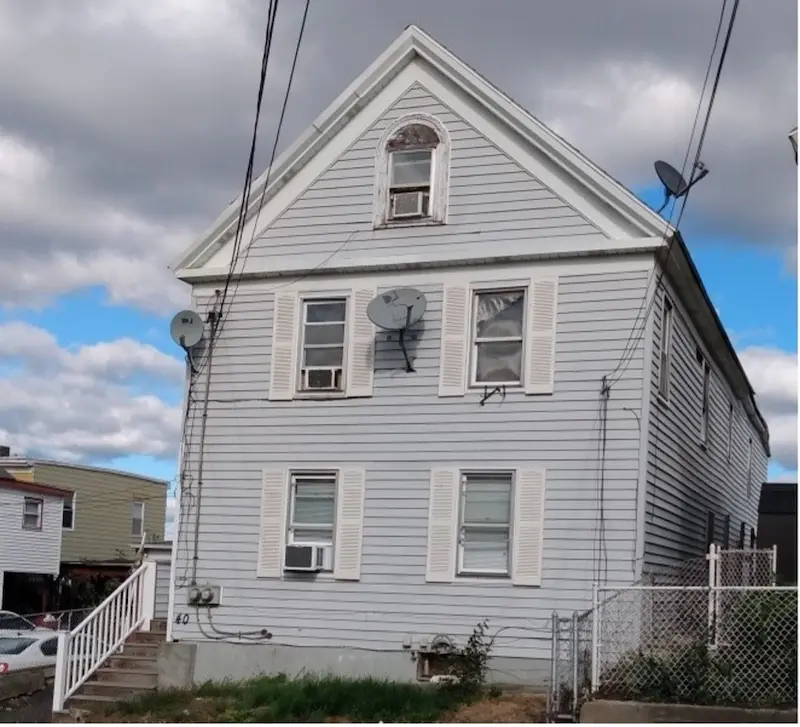
- Wall/Trim: Vinyl siding
- Roof: Gable roof with flat roof on rear addition
- Major Alterations: Most notable are new vinyl windows and shutters; and vinyl siding
- Condition: Good
- Included in Hengen survey? No
- Related oral interview? Yes (Interview with Patricia (Santos) Nickles; granddaughter of Charles Santos, Sr., interview Feb. 25, 2017, available in PADA)
- Portuguese owned? Yes (1919)
- Recorded by: Gregory Gray Fitzsimons and Marie Frank
- Organization: UMass Lowell
- Date: August 2023
Description
This 2-1/2 story wood-frame house with a two-story, wood-frame addition to the rear was constructed in the 1840s in the Greek Revival style. It is one of many similar antebellum Greek Revival dwellings built prior to the Civil War in the Chapel Hill neighborhood, although the main entrance is on the north side of the house and not along the street. The street (west) façade is the gable end, with two bays and windows on the first two floors, and an attic window under the gable peak. The rear addition appears to be built in the early 20th century. Although altered with vinyl siding and windows, the house retains much of its 19th century form and styling.
History
It appears that into the 1840s John Baldwin and Marshall Preston of Billerica, Massachusetts, owned a large parcel of land on the east side of Chapel Street, above Union Street. In 1848 they sold this lot to George Crosby, a co-owner of a small bedstead manufacturing concern and real estate speculator who lived on Central Street on Chapel Hill. Crosby was likely responsible for building the 2-1/2 story Greek Revival house, which originally had the address of 32 Chapel Street. It was likely a single-family house, although it had an ell extension to the rear (east) façade.
Those living here in the antebellum years included Benjamin F. Lesuer who had moved to Lowell from Uxbridge, Massachusetts, shortly after his marriage in that town in 1831. Lesuer operated a variety store on Jackson Street. He then entered the crockery business by the time he resided at 32 Chapel Street in the 1850s. (He subsequently moved to Chelsea, Massachusetts, and remained in crockery sales.) Following Lesuer another resident of the Chapel Street house was James Brooks, who worked at the Hamilton Mills, in the highly skilled job of block printer. Born in England, Brooks, his wife Mary, and their seven children, three of whom were born in Lowell, lived here into the 1860s. Brooks likely rented the house.
In 1864, Anson Bailey, a provision dealer with his shop on Central Street, purchased the Chapel Street property. He resided there with his family until around 1869 when he sold the house to Elizabeth Hartley Smith (ca. 1810-1877). For a number years until his death in 1882, Eben B. Sargent, who operated a fish market on Middlesex Street, near Summer Street, lived in the house. By the 1870s, it was a multi-family house. Sargent was born in Maine and moved to Lowell in 1846. His fish market proved financially successful. Also living in part of the house was Frank Wentworth, a machinist, his wife, and son. In addition Steven Scripture, who operated Scripture’s Bakery nearby on Central Street, resided here with his wife.
The property remained in the possession of the Elizabeth Smith estate into the early 20th century. Smith was from the textile manufacturing city of Preston, England, and had married George Crossley Smith (1807-1866) before immigrating with him to the United States and settling in Lowell in the 1840s. Her husband, a skilled machinist, founded a small manufacturing company that produced metal fasteners and bolts. Smith and his partner James Meadowcraft operated in a mill along Whipple’s Canal on the Concord River off Lawrence Street. (Smith reorganized the financially successful company in 1857 as the American Bolt Company and this firm was incorporated in 1881 after Smith’s death.) Before moving to Tewksbury in the 1850s, George and Elizabeth Smith, and their four children along with members of the Hartley family, lived on Floyd Street on Chapel Hill.
The heirs of Elizabeth Smith continued to rent the house at 40 Chapel Street. By 1910, only one family lived in the house, headed by Lawrence O’Dea (1856-1912), a laborer, and his wife Delia, both born in Ireland. One year earlier, the Smith heirs had an auctioneer sell the property for $300 (the equivalent of about $9,500 today), noting that the tenement, which could rent for $180 a month, contained eight rooms on the first two floors, and two finished attic rooms on the upper floor. John J. Hayden, an Irish immigrant who was a contractor and lived on nearby Union Street, bought the property. Hayden continued to rent the house until 1919, when he sold it to Rufino Silva.
From Funchal on Madeira Island, Silva immigrated to the United States and settled in Lowell in 1917. He obtained a job in the Sterling Mill on the Concord River and lodged in a two-family house on Swift Street in Back Central. His wife, Maria (Gonsalves), and five of their children, also from Madeira, joined him, followed by a married daughter and her husband. That Silva was able to buy the Chapel Street property within two years of immigrating while working in a woolen mill suggests that, unlike the majority of Portuguese immigrants, he held assets in his native land or possessed sufficient capital to become, in short order, a property owner. In addition to his family and son-in-law who resided at 40 Chapel Street, Silva rented attic rooms to an Italian-immigrant couple with two small children, and a Portuguese couple with one child.
The Silva family relocated to Brunswick, Georgia, in the late 1920s opening a grocery store there. Rufino sold the Chapel Street property to Edward J. Saunders, the son of the late John F. Saunders, who owned the popular Saunders Market on Gorham Street, and speculated in real estate, notably in the Back Central neighborhood. After a few years of renting the Chapel Street house, Edward Saunders sold the property to Joseph Rodrigues. Also from Funchal, Rodrigues immigrated to the United States in 1916 and settled in Lowell. Initially he worked in a cotton mill, married Mary Silva, from Graciosa, and started a family. For a few years He and Mary lived on Elm Street. But in the 1920s, Rodrigues left the factory and learned the butcher’s trade, obtaining a job at Charles Santos wholesale meat business on Gorham Street. It was Charles Santos who helped Joseph purchase the Chapel Street house by covering the mortgage in return for 6 percent interest on his loan to his employee. Rodrigues obtained some income by renting part of the house. For a few years his tenant was Manuel Santos, a brother of Charles, who worked in a woolen mill. Also living in this apartment was Manuel Santos’ wife Mary and their four children.
Rodrigues opened his own butcher’s shop on Gorham Street and named it “Joe’s Meat Market.” He operated the store for nearly 30 years retiring in 1956. Although his wife remained at 40 Chapel Street until she died in 1972, Joseph separated from her, living at 145 Charles Street until his death in 1971. Since the 1970s the house has had a few owners including the real estate firm Silva Brothers.
Sources
- Sidney and Neff Map of Lowell, 1850
- Lowell atlases, 1882, 1879, 1906, 1924 and 1936.
- Federal census, Lowell, Massachusetts, 1850, 1860, 1870, 1880, 1910, 1920 and 1930.
- Lowell city directories, 1835, 1841, 1853, 1861, 1864-65, 1875-76, 1894, 1906, 1916, 1926, 1936 and 1950.
- W. R. Wilbur, History of the Bolt and Nut Industry of America, (Cleveland, OH: Ward and Shaw, 1905), pp. 244-45.
- Obituary of Eben B. Sargent, Lowell Sun, August 5, 1882.
- Obituary of Joseph Rodrigues, Lowell Sun, April 25, 1971.
- Obituary of Mary Rodrigues, Lowell Sun, August 28, 1972.
- “Real Estate Transactions,” Lowell Sun, June 30, 1919.
- Property deed, Baldwin to Crosby, June 8, 1848, book 61, pages 542-543, Northern Middlesex Registry of Deeds.
- Property deed, Dyar to Smith, December 1, 1868, book 65, pages 90-91, Northern Middlesex Registry of Deeds.
- Property deed, Silva to Saunders, August 22, 1928, book 766, pages 398-399, Northern Middlesex Registry of Deeds.
- Property deed, Saunders to Rodrigues, June 9, 1933, book 825 pages 110-112, Northern Middlesex Registry of Deeds.