
22 Ames Street
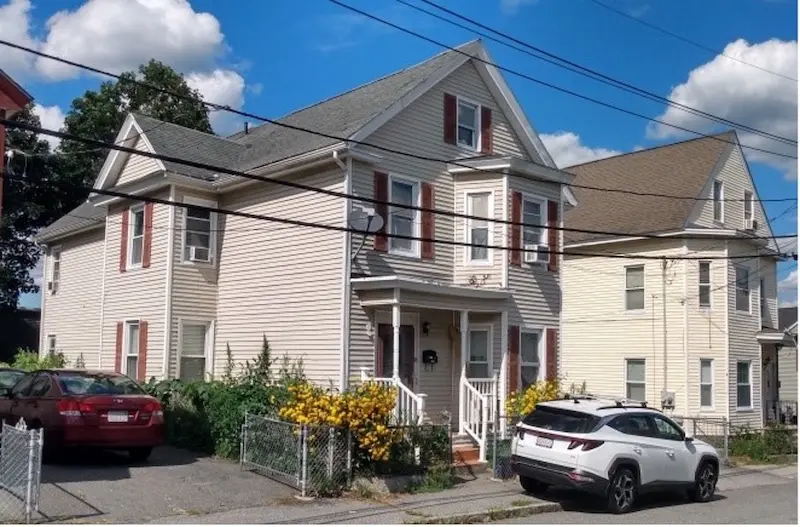
- Historic Name: None
- Uses: Single-family home with apartments
- Date of Construction: Circa 1872
- Style/Form: Greek Revival with Queen Anne elements
- Architect/Builder: Unknown
- Foundation: Rubble stone
- Wall/Trim: Vinyl siding
- Roof: Gable roof with an intersecting gable roof
- Major Alterations: Most notable are new vinyl windows and shutters; vinyl siding and a new front porch
- Condition: Good
- Included in Hengen survey? No
- Related oral interview? No
- Portuguese owned? Yes (1922)
- Recorded by: Gregory Gray Fitzsimons and Marie Frank
- Organization: UMass Lowell
- Date: July 2023
Description
This 2-1/2 story wood-frame house with a gable roof along with an intersecting gable roof, forming a T-shaped plan, was constructed around 1871. It contains Greek Revival and Queen Anne elements and features a two-story projecting bay on the main (south) façade. All of the houses on this (north) side of Ames Street were developed, beginning in the 1870s. Formerly at the corner of Ames and Lawrence streets was the Ames Street Primary School.
History
Unlike other blocks in antebellum Chapel Hill, Ames Street, between Lawrence and Central streets, had houses only on the south side of the street. In the 1840s the city built and operated a fire station on the north side of Ames. In the mid-1850s, Hocum Hosford (1825-1881), a prominent merchant who served as Lowell’s mayor during the Civil War, had his home constructed on Central Street. His estate included much of the land on the north side of Ames down to Lawrence Street. In 1871 he sold a large parcel of this land to Torrey E. Stratton (1836-1910), a machinist with a wife and three daughters. Born in Watertown, Massachusetts, Stratton, as young boy, moved to Lowell with his Quaker family. His father operated at fruit store on Merrimack Street. As a young man, Torrey Stratton worked for the Hamilton Mills, likely in the repair shop. Eventually he was hired by machinist F. S. Perkins. Stratton had his house built on Ames Street ca. 1871 and moved there from Appleton Street. A few years later, adjoining Stratton’s property to the east, the city of Lowell, with land from Hosford, built the Ames Street Primary School, on the corner of Ames and Lawrence streets.
Stratton’s dwelling appears to have been a two-family house. By 1880, machinist Benjamin Rushworth, lived at the same address (18 Ames) with his wife and three adult children. In 1887, Stratton sold the property and moved to Coral Street, in the Highlands neighborhood. The new owner of the Ames Street house, James F. Norton (1832-1912), born in Roxbury, Massachusetts, to Irish parents, was a well-known fireman who would become Lowell’s deputy fire chief by 1900. By 1896 a second residence, a wood-frame, two-family house, was erected on an adjoining lot to the east, next to the Ames Primary Street School. It appears that Norton had this two-family house built for rental property income. The address for this house was 24-26 Ames Street, while Norton’s address was 22 Ames Street.
Following Norton’s death, the family sold the properties to Irish-born John J. Honan, a machinist in the car shops of the Boston & Maine Railroad. Honan lived at 24-26 Ames Street and rented 22 Ames Street to another Irish family, headed by Thomas Meehan, a plumber. In 1922, Luis C. Silva (1882-1950) purchased the 22 Ames Street property. (At about this same time another Portuguese family, the Espinola family, bought the property next door at 24-26 Ames Street.) Born on the Azorean island of Graciosa, Luis Silva, immigrated to the United States in 1906, settled in Lowell, and married in 1910. He and his wife, Urania, had two sons and a daughter. Luis Silva worked in the carding room at the American Woolen Company’s Beaver Brook Mill in Dracut. Prior to buying their house, Luis and Urania Silva rented a house on Lawrence Street, about two blocks from Ames Street. By 1930, Luis Silva was still working at the Beaver Brook Mill, Urania Silva, was employed at the Lowell Silk Mill, and the eldest son, Manuel, 19, joined his father at the Beaver Brook Mill. The Silva family belonged to St. Anthony’s Church and Luis was active in the Portuguese American Civic League. He died in 1950, having only recently left mill work because of ill health. The property remained in the Silva family (Urania Silva died in 1990) until 1994, when John M. and Claire M. Silva sold the property to Cambodian Americans Sophorn Duong and Neung Theum.
Sources
- Beard and Hoar, Map of Lowell, 1841
- Sidney and Neff, Map of Lowell, 1850
- Lowell atlases, 1882, 1879, 1906, 1924 and 1936.
- Federal census, Lowell, Massachusetts, 1920 and 1930.
- Lowell city directories, 1870, 1875-76, 1894, 1906, 1916, 1926, 1936 and 1950.
- Obituary of Torrey E. Stratton, Lowell Sun, May 4, 1910.
- Obituary of James F. Norton, Lowell Sun, February 26, 1912.
- Obituary of Luis C. Silva, Lowell Sun, April 30, 1950.
- Property deed, Hosford to Stratton, December 14, 1871, book 83, pages 518-519, Northern Middlesex Registry of Deeds.
- Property deed, Stratton to Norton, May 8, 1887, book 188, pages 94-95, Northern Middlesex Registry of Deeds.
- Property deed, Carmody to Silva, August 28, 1922, book 667, page 302, Northern Middlesex Registry of Deeds.
- Property deed, Silva to Duong and Theum, September 9, 1994, Northern Middlesex Registry of Deeds.