
17 Elm Street
- Historic Name: None
- Uses: Single-family home
- Date of Construction: Unknown
- Style/Form: Greek Revival
- Architect/Builder: Unknown
- Foundation: Rubble stone
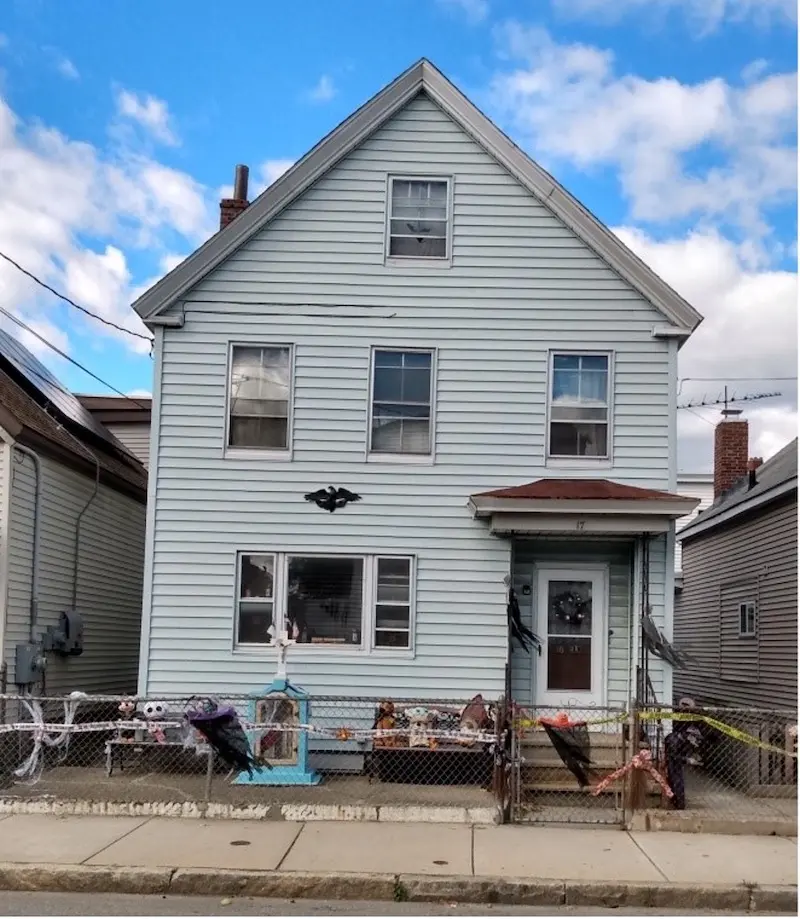
- Wall/Trim: Vinyl siding
- Roof: Gable roof
- Major Alterations: Most notable are new vinyl windows and shutters; and vinyl siding; an addition to the rear dates from 1915
- Condition: Good
- Included in Hengen survey? No
- Related oral interview? No
- Portuguese owned? Yes (1915)
- Recorded by: Gregory Gray Fitzsimons and Marie Frank
- Organization: UMass Lowell
- Date: July 2023
Description
This 2-1/2 story wood-frame house was constructed in the late 1850s in the Greek Revival style. It is one of many similar antebellum Greek Revival dwellings built prior to the Civil War in the Chapel Hill neighborhood. A one-story L-section in the rear was rebuilt in 1915, raising it to two stories with a flat roof. As with many homes in the neighborhood it now has vinyl siding, windows, and shutters. A chain-link fence extends around the property.
History
The presence of the Middlesex County Courthouse on Gorham Street, following its completion in 1850, enhanced Lowell’s importance as a major city in Massachusetts and also sparked development on Chapel Street. Into the 1840s, Elm Street was just one-block long and ran only between Central and Chapel streets. But following the opening of the courthouse Elm Street was extended to Gorham Street and a number of houses were along Elm and neighboring streets. One was this 2-1/2 story wood-frame dwelling, erected in the late 1850s in the Greek Revival style. The builder was likely Elbridge Kimball, a carpenter who, during most of the 1850s, lived on Chapel Street near the corner of Charles Street. But after building the house, Kimball and his wife Abigail held the property for only a year or two before selling it in 1859 to another carpenter, Dudley L. Watson. Born on a farm in Exeter, New Hampshire, Watson (1836-1918), like many young men, moved to Lowell in search of job and social opportunities. He found work as a carpenter at the Hamilton Mills. He married and lived with his wife, Lydia, in a Hamilton Corporation boardinghouse, before purchasing and moving to the house on Elm Street. It appears that Lydia died in the 1860s after which Watson decided to move to California. In 1864 he sold the Elm Street property to James G. Morrison for $2,000 (about $39,000 today) and departed for Santa Clara.
Also born in New Hampshire, Morrison (1822-1888), a superintendent for the Middlesex (Woolen) Mills was in charge of all of the mechanical operations of the water-powered mill. He, his wife Mary, and their daughter moved from a dwelling on Church Street to the Elm Street house. James Morrison lived there until his death. His wife and daughter continued to reside on Elm Street for another 20 years. In 1908, they sold the property to Dennis J. Cooney (1864-1938), who owned a liquor store on Central Street.
Born in Ireland, Cooney immigrated to the United States as a teenager and settled in Lowell by the 1880s. Initially he worked in a tannery and married at age 24 to Mary Whalen, an Irish-American cotton mill worker. Cooney obtained a job in a cotton mill in the highly skilled position of roll coverer (the fitting of leather belts around pulleys that operated almost all machinery in a mill). He eventually saved up enough money to leave the mill and operate a liquor store business. He and Mary had four daughters (and later a son, James L. Cooney) and lived on Linden Street, near Elm, before buying the house in 1908. They remained on Elm Street for only four years. Having made sufficient money in the liquor store, Cooney and his wife decided to move to the more affluent Highlands neighborhood.
In 1912 the property on Elm Street fell under the auctioneer’s block. An ad described the house as having ten rooms, with a bath, pantry, and “cemented cellar.” Like many homes in the city there was no electricity, but piped-in gas and gas fixtures throughout the interior. The ad also noted that the lot was 2,850 square feet and the yard was fully fenced. It was not until 1915, however, when the property finally passed from Cooney to Manuel M. Correira and his wife Maria. Listed as a textile mill operative in the city directories, it appears from various property transactions in Lowell that Manuel Correira also dealt in real estate. Soon after purchasing the Elm Street house he renovated it, adding an extra floor to the rear L-extension, which served as an apartment. He then rented it to fellow Portuguese immigrants who were cotton mill workers.
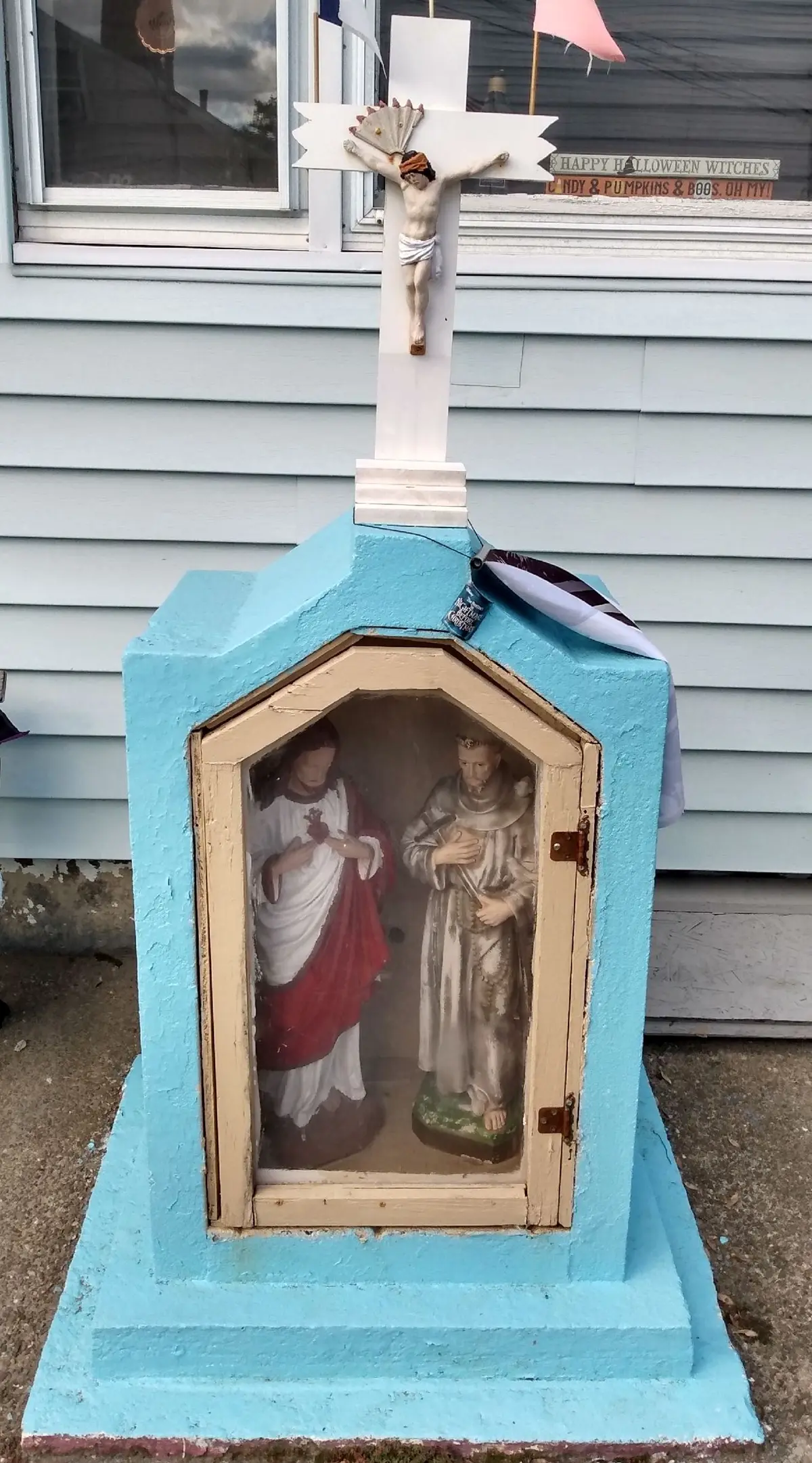
In the summer of 1919, Correira sold the Elm Street property to Manuel F. Pereira. Born in 1879, Pereira immigrated to the United States in 1910 and settled in Lowell. Like many Portuguese in Back Central, he obtained a job in the Appleton Cotton Mills. Pereira married a Portuguese immigrant, who was born around 1890, and had three daughters. Pereira continued to rent the apartment. In 1923, however, he sold the house to Stanley Kasper, a Lithuanian immigrant. Kasper had left his native Vilna in 1907 and joined Lowell’s growing Lithuanian community. By 1930, Kasper, age 53, his wife, Josephine, age 47, and his three sons, along with a daughter-in-law and an adopted daughter from Lithuania, lived at 55 Elm Street. In the apartment was a Polish immigrant, who worked with Stanley Kasper in a corduroy mill in South Lowell. The Kasper family owned the Elm Street property until 1990 when Juvenal and Vera Mello bought it. Likely dating from the 1990s, a religious shrine is situated prominently in the small front yard, near the sidewalk. Resting on a concrete pedestal is an alcove with a glass door, inside of which are figures of Jesus Christ and St. Francis, on top of which is a depiction of the crucifixion, although the element representing the crown of thorns has been slightly damaged.
Sources
- Beard & Hoar, Map of Lowell, 1841.
- Sidney & Neff Map of Lowell, 1850.
- Lowell atlases, 1882, 1879, 1906, 1924 & 1936.
- Lowell city directories, 1858, 1864-65, 1875-76, 1894, 1906, 1916, 1926, 1936 &1950.
- Federal census, Lowell, Massachusetts, 1870, 1880, 1900, 1910, 1920 & 1930.
- “Sales Conducted by Keyes on Saturday,” Lowell Sun, October 19, 1903.
- Obituary of Manuel A. Bettencourt, Lowell Sun, December 30, 1951.
- “Building News,” Lowell Sun, October 3, 1908.
- “C.F. Keyes, Auctioneer,” Lowell Sun, November 30, 1912.
- Property deed, Kimball to Watson, April 26, 1859, book 19, pages 92-93, Northern Middlesex Registry of Deeds.
- Property deed, Watson to Morrison. August 17, 1864, book 40, pages 99-100, Northern Middlesex Registry of Deeds.
- Property deed, Cichowski to Correira, November 23, 1915, book 547, pages 236-237, Northern Middlesex Registry of Deeds.
- Property deed, Correira to Pereira, July 30, 1919, book 605, page 170, Northern Middlesex Registry of Deeds.
- Property deed, Pereira to Kasper, August 23, 1923, book 690, page 115, Northern Middlesex Registry of Deeds.
- Property deed, Kasper to Mello, September 16, 1990, Northern Middlesex Registry of Deeds.