
16 Kinsman Street
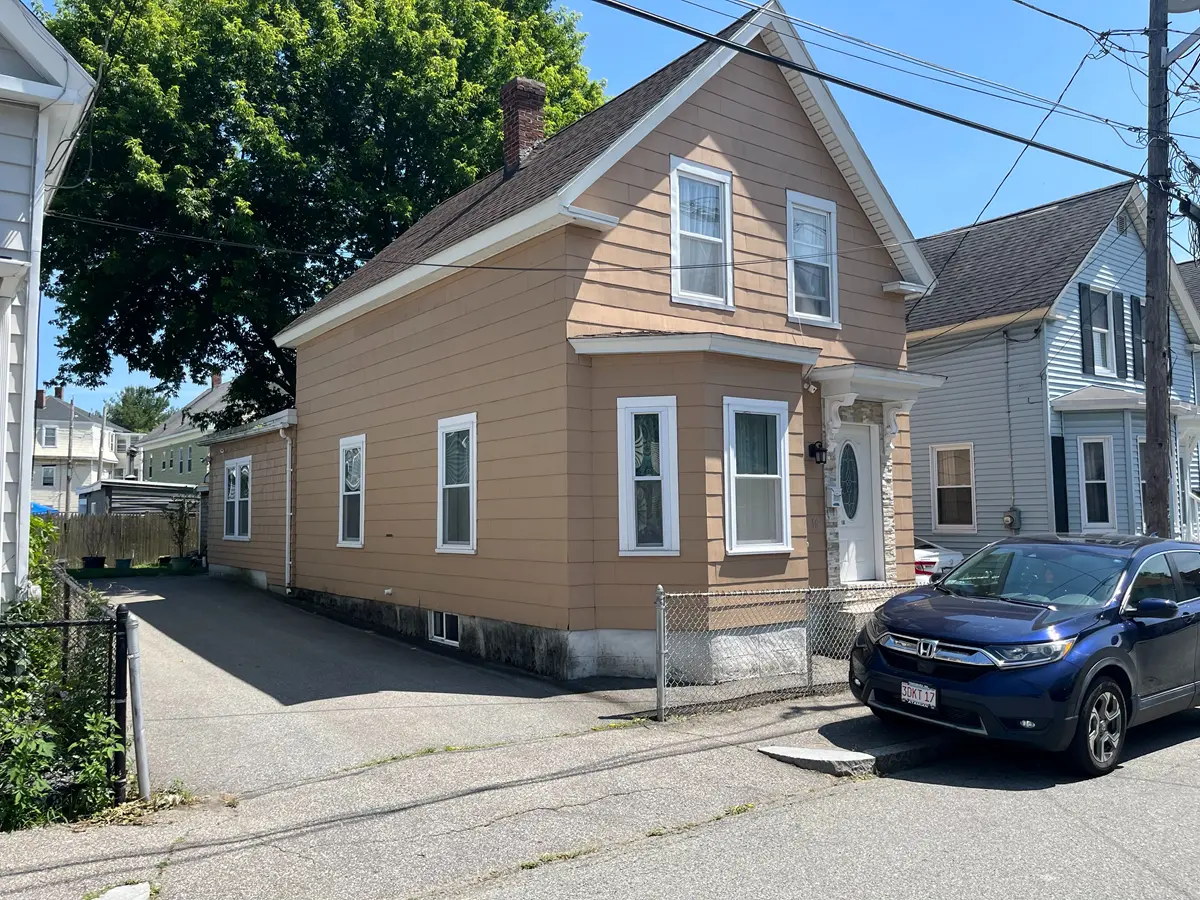
- Historic Name: None
- Uses: Single- and multi-family home
- Date of Construction: Circa 1880
- Style/Form: Vernacular with Queen Anne elements
- Architect/Builder: Jesse Bassett (possibly)
- Foundation: Rubble stone and concrete
- Wall/Trim: Vinyl siding
- Roof: Gable roof
- Major Alterations: Most notable are new vinyl windows and shutters; and asbestos siding; and a new front door
- Condition: Good
- Included in Hengen survey? No
- Related oral interview? No
- Portuguese owned? Yes (1921)
- Recorded by: Gregory Gray Fitzsimons and Marie Frank
- Organization: UMass Lowell
- Date: July 2023
Description
This 1-1/2 story wood-frame cottage with a gable roof features a projecting bay on the first floor and an off-center (sidehall) entrance. To the rear is a one-story wood-frame addition with a flat roof. The original house rests on a stone foundation. The front entrance retains the original ornate woodwork that supports the shingled hood. Alterations include asbestos siding and windows, a new front door with oval-shaped window, and a form-stone veneer surrounding the front door. Across the street there are several identical cottages, which were included in the neighborhood street survey completed by Elizabeth Durfee Hengen in 1981, as part of the city of Lowell Department of Planning and Development’s architectural survey.
History
Among the major builders of homes in Back Central in the two decades after the Civil War were the Bassett brothers, Gershom C. and Jesse N. Bassett, who were born in Maine and, by the 1870s, had become well-known contractors and real estate speculators in Lowell. Jesse Bassett owned several lots on Kinsman Street and was likely responsible for the cottage at 16 Kinsman, which was erected in the early 1880s. Bassett also likely constructed a number of other cottages, nearly identical in design, on Kinsman as well as a series of similar-looking cottages on nearby Hudson Street.
In 1881, Bridget Gray purchased the cottage at 16 Kinsman, along with four other adjacent properties extending up to and along Whipple Street. Born in Ireland, Bridget (Redmond) Gray (1837-1917) immigrated at the age of 20 with some of her siblings, including her older brother Martin Redmond, to the United States in 1857. Martin Redmond initially worked in a foundry by 1860 he obtained a highly skilled job as a dyer and printer in a small factory at Whipple’s Mills along the Concord River. Bridget worked with one of her sisters in a textile factory, very likely the Middlesex Mills. The Redmond siblings lived in a multi-family house on Central Street, before Martin bought a house in late 1860 on Kidder Street (now Butler Avenue) in Back Central near Whipple’s Mills. In 1863, Bridget married Michael Gray (1825-1874), also an Irish immigrant who worked at the Middlesex Mills. For a few years they lived on Appleton Street near the corner of Gorham Street.
While Bridget Gray became a homemaker, her husband continued working at the Middlesex Mills and by 1864 they had saved enough money to purchase a property on the corner of Whipple and Kinsman streets, that was part of a large parcel of land owned by Oliver Whipple. E.B. Patch, an agent of Whipple who handled Whipple’s large real estate holdings auctioned dozens of lots in Back Central in 1864, including the lot bought by Gray. Michael Gray then had a house built with the main entrance facing Whipple Street. Gray lived only about 10 more years dying in 1874 and leaving behind his widow Bridget, three sons and a daughter, the youngest who was just months old and eldest, John Gray, age 11. By 1880 Bridget Gray had expanded her Whipple Street (No. 45) residence to take in boarders. There were six males, all born in Ireland and all wage earners, boarding there in 1880. (As shown on the 1882 Lowell atlas, updated to 1888, the Whipple Street property is noted as a tenement with a saloon on the ground floor; it appears that in the 1880s, the former single-family dwelling was expanded to include rooms for tenants and a commercial space for a saloon.)
Evidently Gray’s income was sufficient to purchase additional properties on Kinsman Street, including the cottage at 16 Kinsman, which she bought in 1881 and, which at this time, had the address of 10 Kinsman. She also owned 6 and 8 Kinsman (two cottages identical to 10 Kinsman) and a cottage at 47 Whipple Street. When her oldest son John Gray attained his majority he became a real estate agent, handling his mother’s properties.
By 1900 Bridget and two of her unmarried sons, including John Gray, age 35, still working in real estate, and Michael, age 24, employed in a grocery store, moved into one of her Kinsman Street cottages. She rented 16 Kinsman to James Gilligan, age 43, a widower born in Ireland and working as a currier in one of the city’s tanneries. Living with Gilligan were his seven children, ranging in age from seven to 18. Like the Gilligan family, the heads of households among residents on Kinsman Street were born in Ireland and the children were born in Massachusetts. Virtually all of those employed, worked in factories.
Ten years later, Kinsman Street had scarcely changed nor had the ethnic composition of this section of Back Central. Renting the cottage at 16 Kinsman, however, was Alexander and Maria Semple, a married couple in their forties, along with a niece, all born in Scotland, and their three children, ages 14 to 19. While Maria was a homemaker, the three teenage children worked, including the youngest, Andrew, an office boy for the U.S. Cartridge Company. Alexander worked in a cotton mill as an elevator operator.
Over the next decade, Back Central, in and around Kinsman, was still heavily Irish, but a few families of other nationalities, including Armenian and Italian, resided here. Bridget Gray died in 1917 in the home of her son Peter, who lived nearby on Whipple Street. But at the time of her death her properties were heavily mortgaged to Lowell’s City Institution for Savings. The bank assumed ownership of Gray’s real estate, including 16 Kinsman. In short time the Institution for Savings sold all of Gray’s property on Whipple and Kinsman streets to Edmund Fairburn, an English immigrant who was the proprietor of a Lowell butcher shop. Fairburn then rented the cottages and tenement. His first tenant at 16 Kinsman was Michael J. Feeney, a teamster born in Ireland. Feeney and his wife Maria, also born in Ireland, lived in this small cottage with their seven children.
One of Feeney’s fellow teamsters was Manuel S. Costa (ca. 1882-ca. 1937), a Portuguese immigrant from Madeira. Costa had married Maria Jesus (ca. 1882-1946) in Madeira and their first two (of seven) children were born on the island prior to their move to Lowell in 1908. Upon settling in Lowell, Manuel initially worked as an operative in the Tremont-Suffolk Mill, before obtaining a job as a blacksmith, a trade he likely learned in his native Madeira. He was likely employed in the small repair shop of the Tremont-Suffolk Mill and he and his family resided in one of the company’s boardinghouses on Bradford Street, in the shadow of the mill. This section of Lowell was home to nearly 200 Madeirans, many of whom worked at the Tremont-Suffolk Mill. But by about 1920 Costa saved enough money to leave the employ of Tremont-Suffolk, purchase a freight wagon, and become a teamster. Along with a larger group of teamsters, Costa operated out of a Green Street depot next to the Boston & Maine Railroad Station.
In the 1920s the Irish dominated Lowell’s teamsters; Costa was the only Portuguese teamster listed in the city directory. He and Feeney began working together and they specialized in furniture and piano moving, typically in the service of the city’s middle and wealthier classes. Feeney purchased a house on Kinsman Street (No. 19) and likely informed Costa that Fairburn was willing to sell 16 Kinsman. In 1921 he bought the property from Fairburn and moved his family, which included his wife and all seven of his children, from the Tremont-Suffolk boardinghouse to the cottage in Back Central. Various members of the Costa family resided here for over 90 years.
By the mid-1920s Manuel Costa shifted his business from moving furniture to selling it. He was one of the first Portuguese to enter this enterprise although he dealt exclusively with second-hand furniture. He operated his business out his Kinsman Street house, constructing an out-building in the back yard. It appears he relied on Feeney to deliver the furniture that he sold and since it was used furniture his customers were likely from working-class families. In 1927 a neighboring Irish homeowner leveled a complaint before the city’s license commission charging that Costa’s business was a nuisance (Costa had received a license to operate a “junk yard” at his residence). The complainant maintained that young men were congregating day and night at Costa’s junk yard and disturbing the peace. The commission instructed Costa to prohibit this activity or else his license would be revoked. Evidently Costa resolved this problem and he continued in the furniture business.
A year or two before he died, however, Manuel Costa stopped selling furniture and resumed work as a furniture mover. After his death ca. 1937 his wife, Maria, assumed ownership of the house. For many years, several of her adult, unmarried children continued to live with her. When she died in 1946, her youngest child, Florence T. Costa (1922-2015), owned the house. Florence was born at 16 Kinsman, attended public schools, finishing at the Butler Junior High School, before entering the workforce as a teenager. She worked at the U.S Bunting Company, part of the Ames Textile Company plant along nearby River Meadow Brook. After the bunting manufacturer closed in 1950 she went to work for Ames Textiles where two of her sisters, Emily and Ambelina, were employed. The three sisters and a brother lived together at 16 Kinsman. Florence later worked for two electronics manufacturers, as well as at Prince Engineering, connected to the Pellegrino family’s Prince Pasta Company in South Lowell. She remained at 16 Kinsman Street until 2014. The property was subsequently purchased by Sambath Keo, a Cambodian-American dentist in Lowell, presumably for rental income.
Sources
- Lowell atlases, 1879, 1882 (updated to 1889), 1906, 1924 & 1936.
- Lowell city directories, 1883, 1894, 1916, 1926, 1936, 1939, 1946, 1956, 1966 & 1975.
- Federal census, Lowell, Massachusetts, 1880, 1900, 1910, 1920, 1930, 1940 & 1950.
- Obituary of Bridget Gray, Lowell Sun, April 11, 1917.
- Obituary of Mary Costa Farrell,” Lowell Sun, January 2, 1932.
- Obituary of Edmund Fairburn, Lowell Sun, June 25, 1942.
- Obituary of John V. Costa,” Lowell Sun, October 28, 1966.
- Obituary of Florence T. Costa,” Lowell Sun, June 5, 2015.
- Property deed, Patch to Gray, July 18, 1864, book 39, pages 503-505, Northern Middlesex Registry of Deeds.
- Property deed, Bramhall to Gray, August 29, 1881, book 147, pages 502-503, Northern Middlesex Registry of Deeds.
- Property deed, Gray to Fairburn, June 1, 1918, book 591, page 539, Northern Middlesex Registry of Deeds.
- Property deed, Fairburn to Costa, June 4, 1921, book 644, page 547, Northern Middlesex Registry of Deeds.
- Property deed, Costa to Favotto, April 25, 2014, Northern Middlesex Registry of Deeds.