
 Image by courtesy
Associate Professor Joris Roos was recently awarded a $217,000 National Science Foundation grant to support his research on harmonic analysis, a branch of mathematics with applications in signal processing, medical imaging, fluid dynamics, data analysis and other fields.
The National Science Foundation (NSF) has awarded Associate Professor Joris Roos of the Department of Mathematics and Statistics a three-year grant totaling more than $217,000 for work on harmonic analysis. The award follows a similar NSF grant to Roos with a term that ended this year.
Harmonic analysis is a branch of mathematics that includes Fourier analysis, with applications in signal processing, medical imaging, fluid mechanics, data analysis, number theory and other fields. It’s a centuries-old field of study that somehow continues to be on the cutting edge of scientific and mathematical research despite its antique origins.
Roos first became interested in harmonic analysis as an undergraduate in Germany when he learned about the work of 19th-century French mathematician Joseph Fourier, whose investigations into the diffusion of heat led to the development of Fourier analysis, which is now part of the field of harmonic analysis.
“The work was so revolutionary that some of its ideas were not fully accepted or understood by Fourier’s contemporaries,” Roos says. “Two hundred years later, Fourier analysis is still an active area of research.”
Fourier analysis is important in signal processing and is also familiar to physicists and engineers, but Roos’s interest is in pure mathematics. “In basic research, we push the frontier of understanding as far as we can,” he says. “We look at mathematical merit, because experience has shown that the practical applications lag behind by decades.”
Roos explains harmonic analysis through an analogy. A piece of music is complex, but it can be broken up into individual notes, each with their own frequency, time and duration. “This is called a wave packet decomposition,” he says. “Harmonic analysis is about decomposing complicated mathematical functions or signals into more elementary components, so that they can be better understood.”
One of the topics Roos explores with harmonic analysis is finding the hidden mathematical patterns that occur in spherical averages taken over highly irregular scales. Instead of considering spheres of every possible radius, the radii are restricted to a fractal set. “There are some interesting, unexpected connections,” he says.
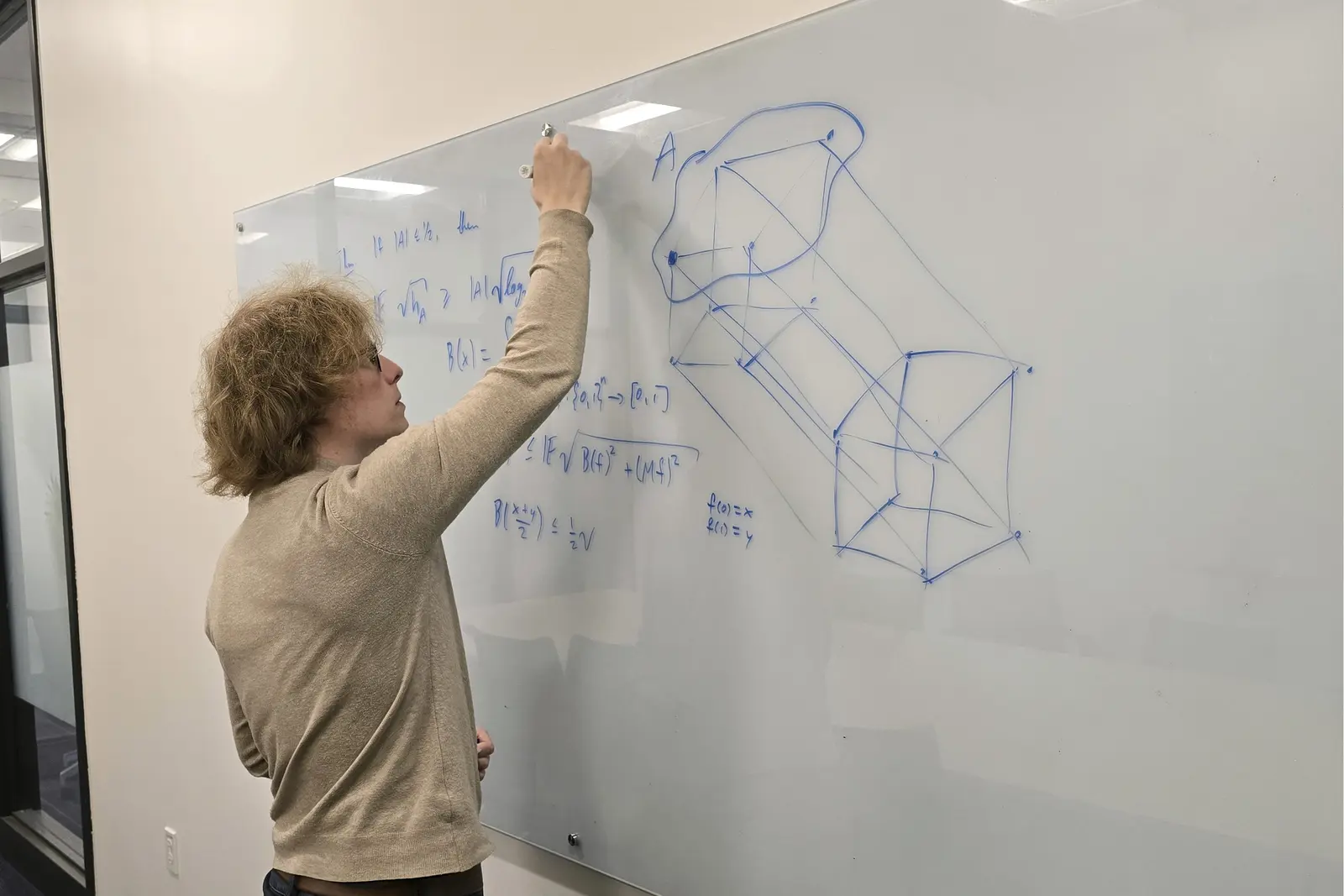
Another aspect of his work addresses the geometry of spaces consisting of long sequences of zeros and ones, he says. Given a collection of a fixed number of points in this space, one can ask how large its boundary must be, a fundamental question with direct connections to theoretical computer science.
One of the challenges this work faces is that it requires doing calculations on a computer, but computers and calculators round off numbers, which can invalidate the final result, Roos says. Instead, he uses rigorous numerics or interval arithmetic. This technique gives him two numbers and guarantees that his result is found between them.
“Interval arithmetic has been around for a long time, but this is the first time it's been applied to this circle of problems,” he says.
The NSF funding allows Roos and the postdoctoral researcher who works with him to travel to conferences, meet with collaborators and engage with the global academic community.
The grant also helps support students assisting in the research, especially in formalization, which is a way to translate mathematical proofs into a computer language such as Lean so that the proofs can be checked for correctness. This gives students the opportunity to learn skills that can be applied in the growing field of software verification.