
 Image by Ed Brennen
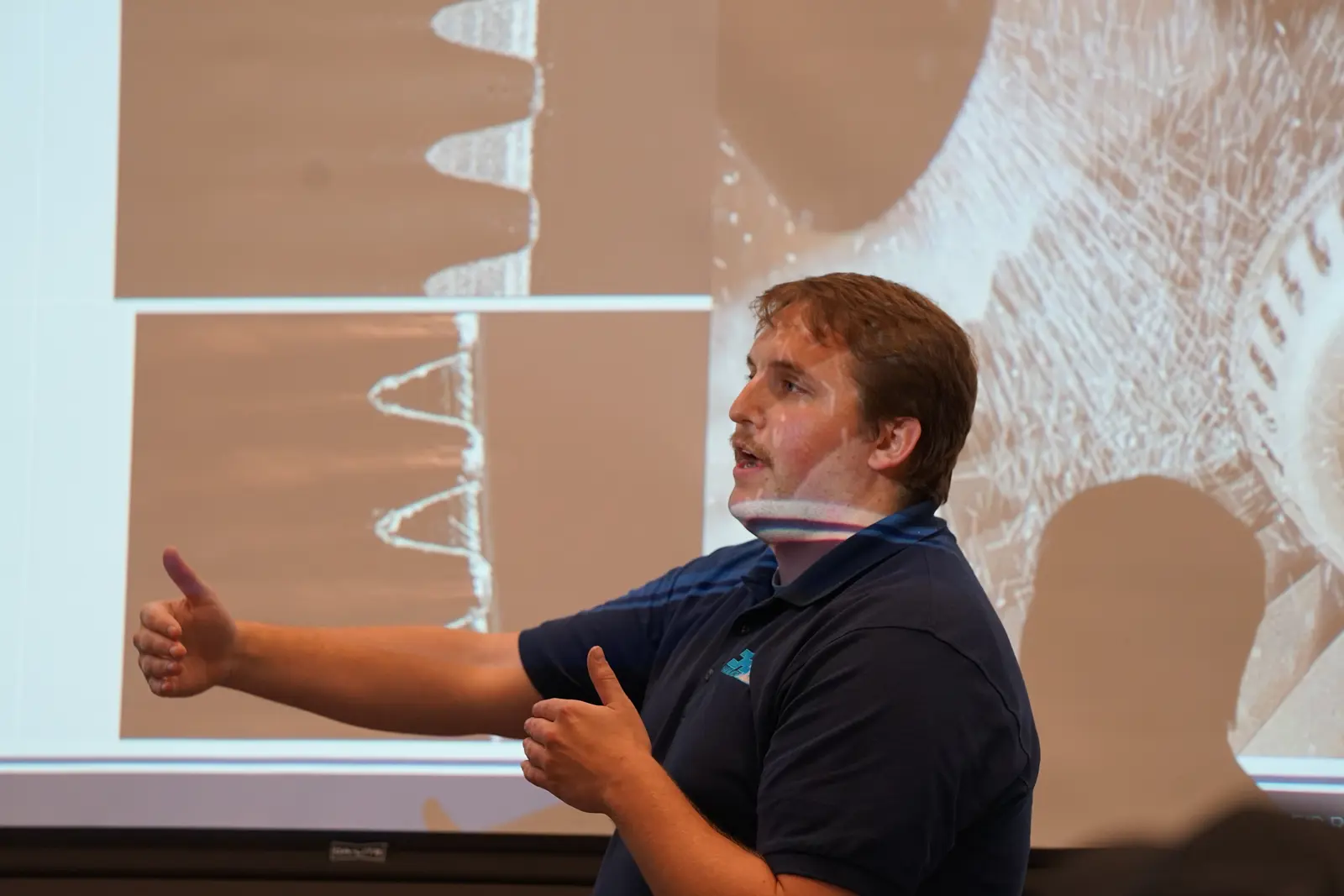
 TechAMP participant Joe Hegarty, a manufacturing engineering technician at Harmonic Drive in Beverly, presents his capstone project at Alumni Hall.
Four years ago, Joe Hegarty started working in the shipping department at Harmonic Drive, a Beverly-based manufacturer of precision motion control components. He moved into manufacturing, learned to run a computer numerical control (CNC) machine and eventually became a manufacturing engineering technician.
Now, after completing UMass Lowell’s Technologist Advanced Manufacturing Program (TechAMP), Hegarty has found a way to improve a manufacturing process that he says could save his company more than $250,000 at full production capacity.
And Hegarty, who has never attended college, is considering taking another step: enrolling at UMass Lowell to work toward an engineering degree.
“I thought this would be a great first step, kind of working my way back into getting that degree,” Hegarty says. “That’s definitely the goal.”
Hegarty was one of 10 members of UMass Lowell’s inaugural TechAMP cohort who recently presented their capstone projects and celebrated their graduation at Alumni Hall.
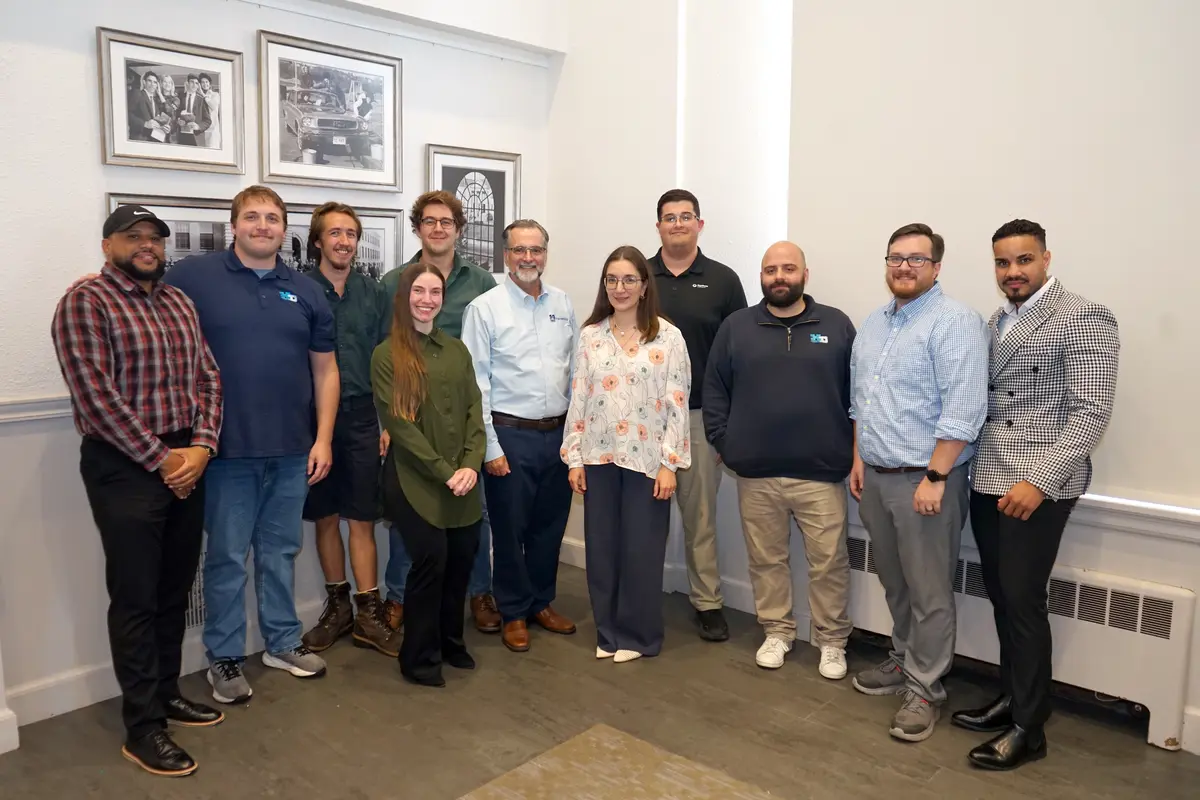 Image by Ed Brennen
 The first TechAMP cohort, led by Program Manager Gary Ainsworth '87, center, celebrated the completion of the yearlong program at Alumni Hall.
UML collaborated with MIT and industry partners to develop TechAMP, which includes eight courses over two semesters followed by a 10-week capstone project — all while participants continue working for their employers.
While TechAMP is a noncredit certificate program offered at several sites, UML is developing a unique pathway that will allow participants to complete additional coursework and earn 12 transferable academic credits beginning in fall 2027.
Gary Ainsworth ’87, TechAMP’s program manager and educational site coordinator at UML, says manufacturers face a growing challenge as experienced technicians retire and production environments require workers with broader technical skills.
“Technicians make the world go ’round,” says Ainsworth, who is also vice president of operations at clean-technology company BLU NXT. “They’re also at the front line of production support and technical support.”
UML launched the first cohort as a prototype to test the educational model and determine whether it could eventually become self-sustaining, Ainsworth says.
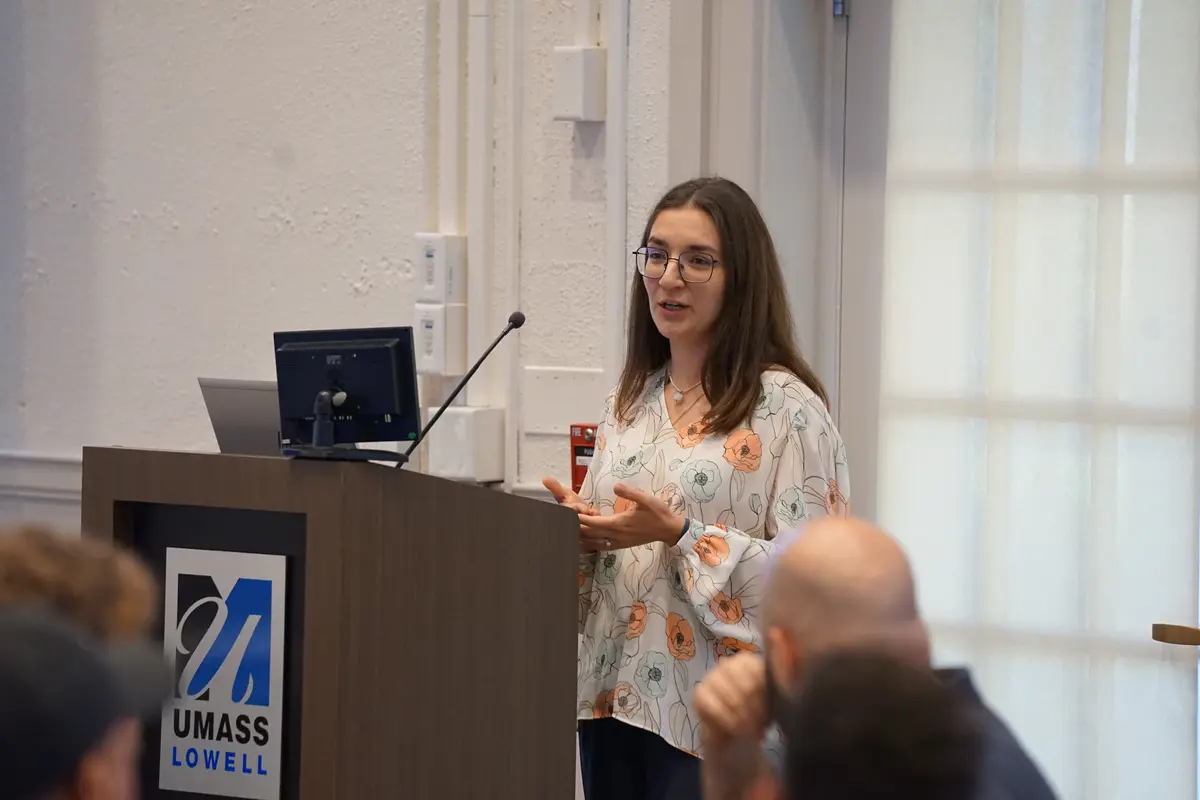 Image by Ed Brennen
 Alla Manukyan, an engineering and industrial technology lab specialist at North Shore Community College, presents her TechAMP capstone project on improving lab capacity and student success in an engineering technology course.
For his Harmonic Drive capstone, Hegarty changed the way a machine cuts precision metal components, eliminating a step in which workers had to manually remove excess material. At full cell capacity, he says the change could save the company more than $250,000.
“A huge success,” Hegarty says.
Fellow TechAMP graduate Zakery Dion also saw the program as an opportunity to build a foundation for his career.
Dion, a calibration lab coordinator at Raytheon, joined the company two years ago with no previous engineering experience. Like Hegarty, he has not attended college.
“I saw this as a great way to get some experience under my belt,” he says. “I think it’s really beneficial for people just starting out in their careers.”
Dion’s capstone focused on improving vendor turnaround time for equipment sent out for calibration. He says the redesigned workflow could cut the amount of time it takes to get equipment calibrated in half.
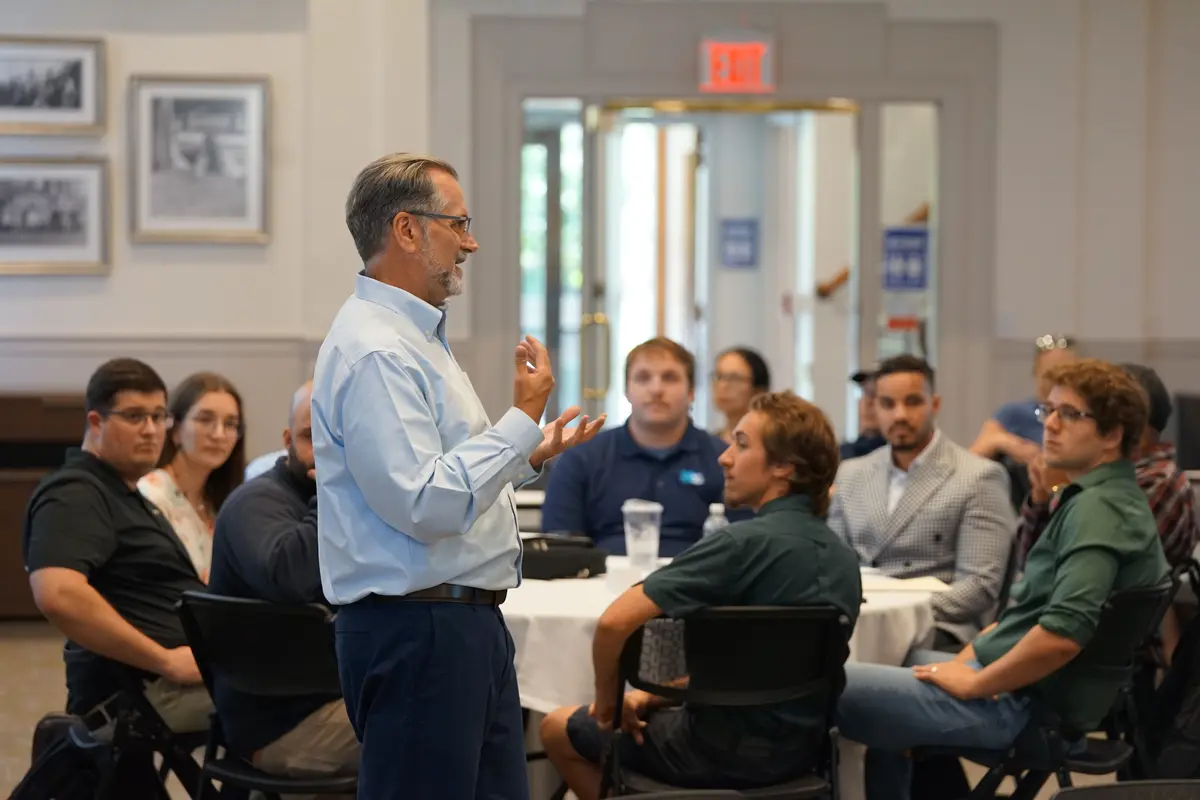 Image by Ed Brennen
 TechAMP Program Manager Gary Ainsworth '87 addresses the inaugural cohort at Alumni Hall.
Like Hegarty, Dion is also considering continuing his education at UML, possibly in electrical or mechanical engineering.
Sarah Murphy, a manufacturing technician at Mide Technology in Woburn, used her capstone to improve the testing process for piezoelectric strain sensors, devices that convert mechanical deformation into electrical signals. She developed a new test fixture that more closely reflects how customers use the product while producing reliable data to support future product improvements.
The program helped Murphy gain new skills and greater confidence in using tools such as Excel; Arduino, an electronics platform made of easy-to-use hardware and software; computer-aided design (CAD); and data analysis.
“Some of the subjects I’d never even heard of before,” she says.
UML’s second cohort, which begins this fall, is expected to more than double in size, Ainsworth says. The incoming group includes 10 employees from Analog Devices and five from Raytheon.
The federal funding that supported the launch made TechAMP free for the inaugural participants, but a longer-term objective is to demonstrate enough value that employers will ultimately pay to enroll their workers.
Ainsworth hopes the connections formed by the inaugural cohort will continue long after graduation.
“We want them to be able to benefit from this experience beyond the year they’ve been involved with it,” he says.