
 Image by Ed Brennen
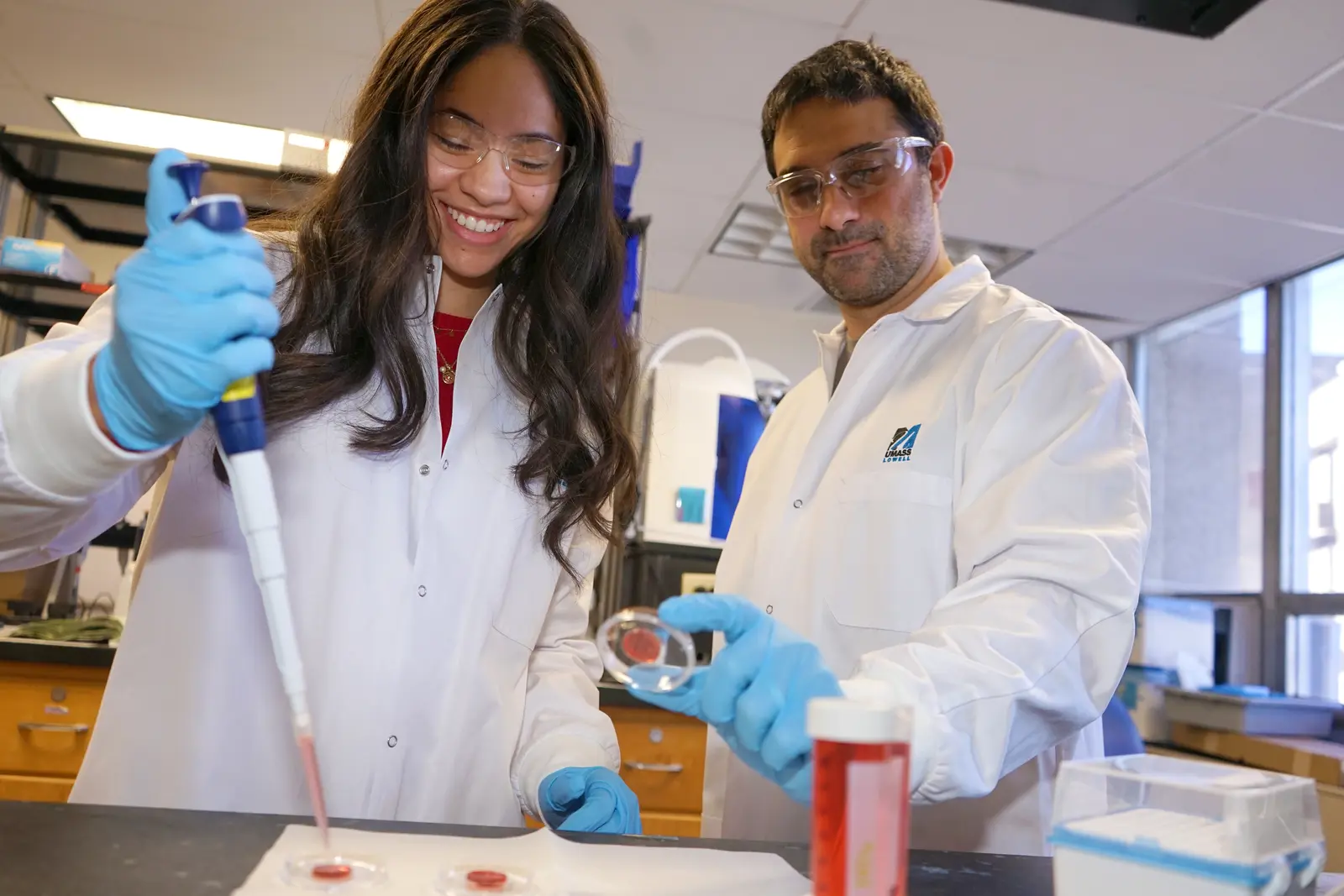
 Medical materials chemistry graduate student Stephanie Ceballos '25, left, was able to continue her nanoparticle research with Associate Professor Michael Ross, right, thanks to the KCS Science Masters program, which provides paid summer research positions for master's students.
Stephanie Ceballos ’25 spent her summers conducting research in campus laboratories while pursuing a bachelor’s degree in biochemistry from the Kennedy College of Sciences (KCS) — first as an Immersive Scholar and then through the KCS Science Scholars program.
But after graduation, she found herself in limbo. Ceballos was continuing for a master’s degree in medical materials chemistry at UMass Lowell in the fall, and she wanted to spend the summer gaining even more intensive research experience.
Enter the new KCS Science Masters program, which provides paid summer research positions for master’s students across the college.
“I wanted to use that time wisely,” says Ceballos, who was accepted into the program and able to continue her nanoparticle research with Chemistry Associate Professor Michael Ross, working 20 hours a week in his lab. “The summer gave me extra time to work on the project and transition into my master’s program.”
Launched last year by Interim Dean Paul Bryce with financial support from alum John Kennedy ’70, ’16 (H), KCS Science Masters is part of the college’s broader “Summer of Science” program, which includes KCS Science Scholars, an initiative that provides stipends to undergraduates to work alongside faculty researchers, and KCS Science Discoveries, a program that provides stipends to undergraduate students for research projects that they initiate.
“There is nothing more career-connected than our students working in labs that are at the forefront of our cutting-edge research in sciences,” says Bryce, who notes that the summer is an ideal time for students to conduct research.
“The campus looks quiet, but our labs are humming,” he says.
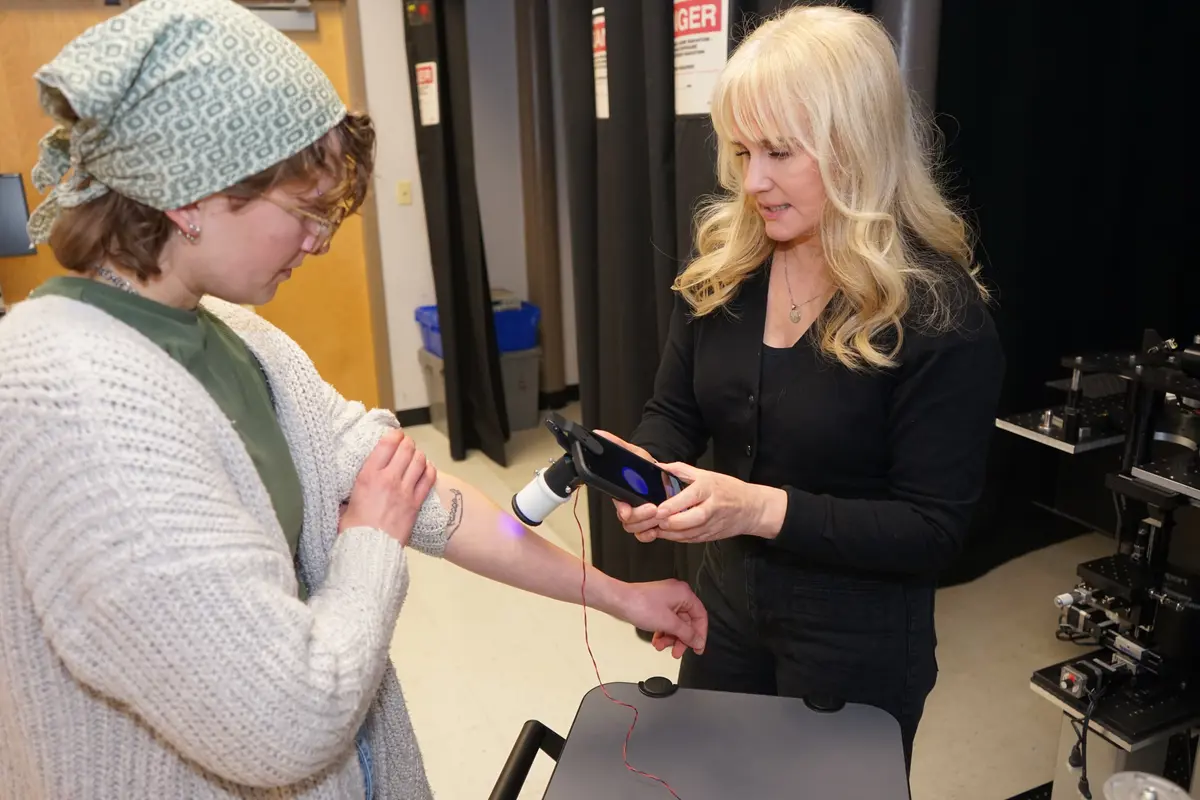 Image by Ed Brennen
 Medical physics graduate student Kate Mallory, left, demonstrates an optical polarization imaging system that she has helped Professor Anna Yaroslavsky, right, through the KCS Science Masters program.
Kate Mallory, a master’s student in medical physics working with Professor Anna Yaroslavsky, spent the summer advancing optical polarization imaging, a patented technology that uses light to visualize collagen beneath the skin. The system allows clinicians to detect tissue changes that aren’t visible to the naked eye, better identifying the margins of skin cancers and monitoring how tumors respond to radiation therapy. Mallory helped test and refine a portable version of the technology that attaches to a smartphone, making the system easier to use in a range of rural or low-income clinical settings where access to advanced imaging is not always possible.
“This project incorporates so many different things, which is exciting,” says Mallory, who attended UMass Amherst as an undergrad. “There’s the clinical aspect, which is new to me coming into graduate school, and there’s also the engineering with the prototype and the physics with optics.”
Science Masters students are paid at a rate comparable to graduate research assistants, or roughly $8,000 over the summer.
“The funding was really helpful,” Mallory says. “I could focus more on the research instead of having to get a job on the side.”
Yaroslavsky says that kind of support is especially important for students pursuing a master’s degree.
“Master’s students usually pay their way, so programs like this give them a break,” she says.
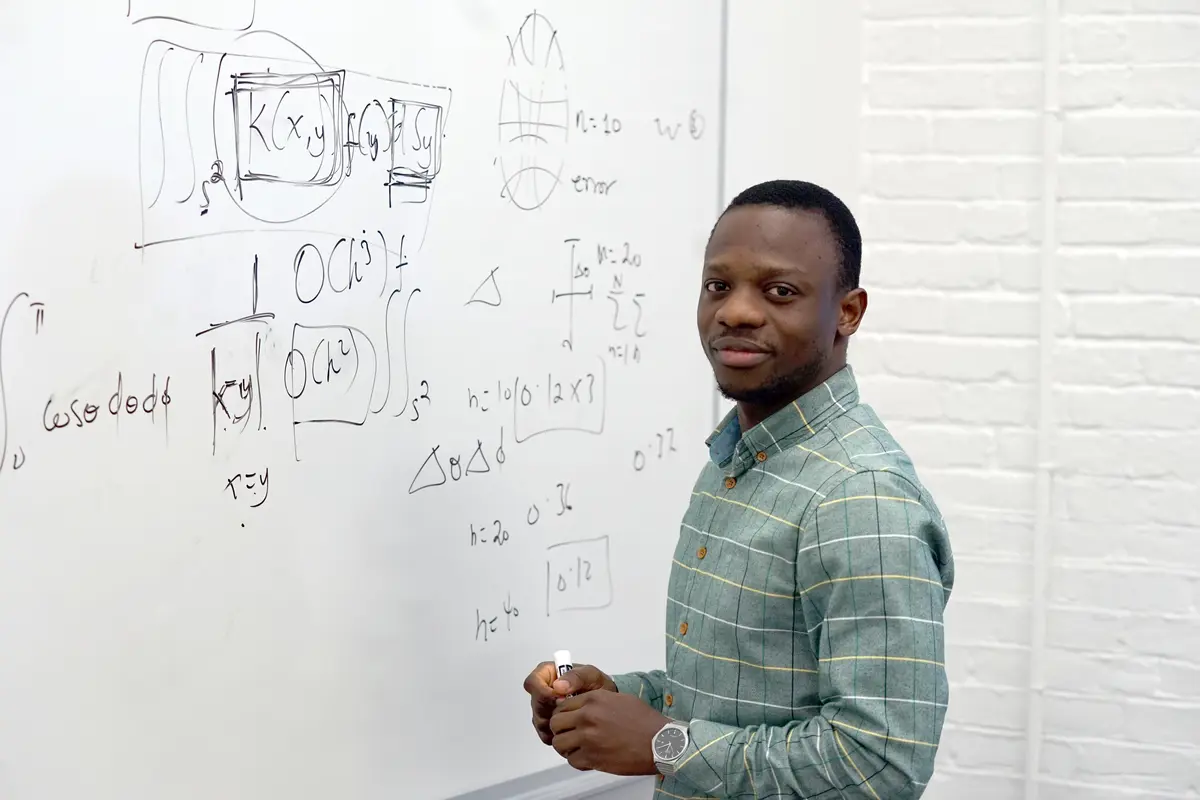 Image by Ed Brennen
 "It gave me the opportunity to learn new things and challenge myself," Clement Tayie, a master's student in applied mathematics, says of the KCS Science Masters program.
Clement Tayie, a master’s student in applied mathematics, experienced that firsthand. Originally from Ghana, Tayie spent the summer working with Assistant Professor Bowei Wu on developing numerical algorithms to solve complex problems known as singular integrals. The work focuses on designing faster, more accurate computational methods for equations that can become unstable at certain points — calculations used in scientific models, including partial differential equations used in physics and engineering.
“It’s all about trying, trying, failing, trying again — and then you finally get it,” Tayie says of his approach to mathematics. “As long as you stay consistent, you should get it.”
The paid position allowed him to concentrate on refining his models and extending the work into applications involving partial differential equations. The research is ongoing, with plans to submit results for publication.
“It was really powerful,” Tayie says of the KCS Science Masters program. “It gave me the opportunity to learn new things and challenge myself.”
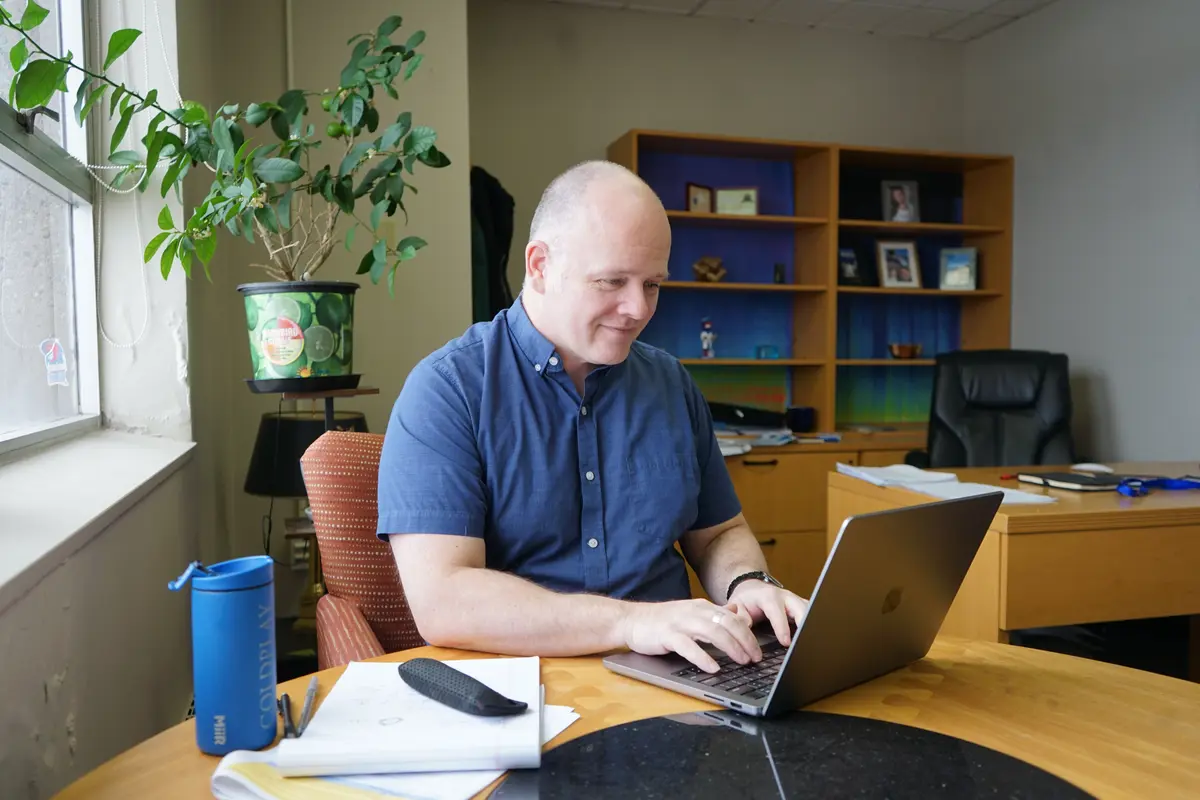 Image by Ed Brennen
 Paul Bryce, interim dean of the Kennedy College of Sciences, launched the KCS Science Masters program last year as an extension of the college's broader "Summer of Science" program.
Ross says the uninterrupted summer research accelerated the work significantly.
“It let her continue full-time as a graduate student and really build on what she started — and turn it into research, a provisional patent and, soon, a publication,” he says.
Ceballos, who is pursuing her medical materials chemistry master’s degree through the UMass Biomedical Engineering and Biotechnology Program, presented the research this spring at the American Chemical Society’s national meeting in Atlanta.
“I’m really grateful,” Ceballos says. “There are so many opportunities to keep building on your research, connect with other scientists and share your work. The Kennedy College of Sciences has really supported me every step of the way.”