
 Image by Courtesy
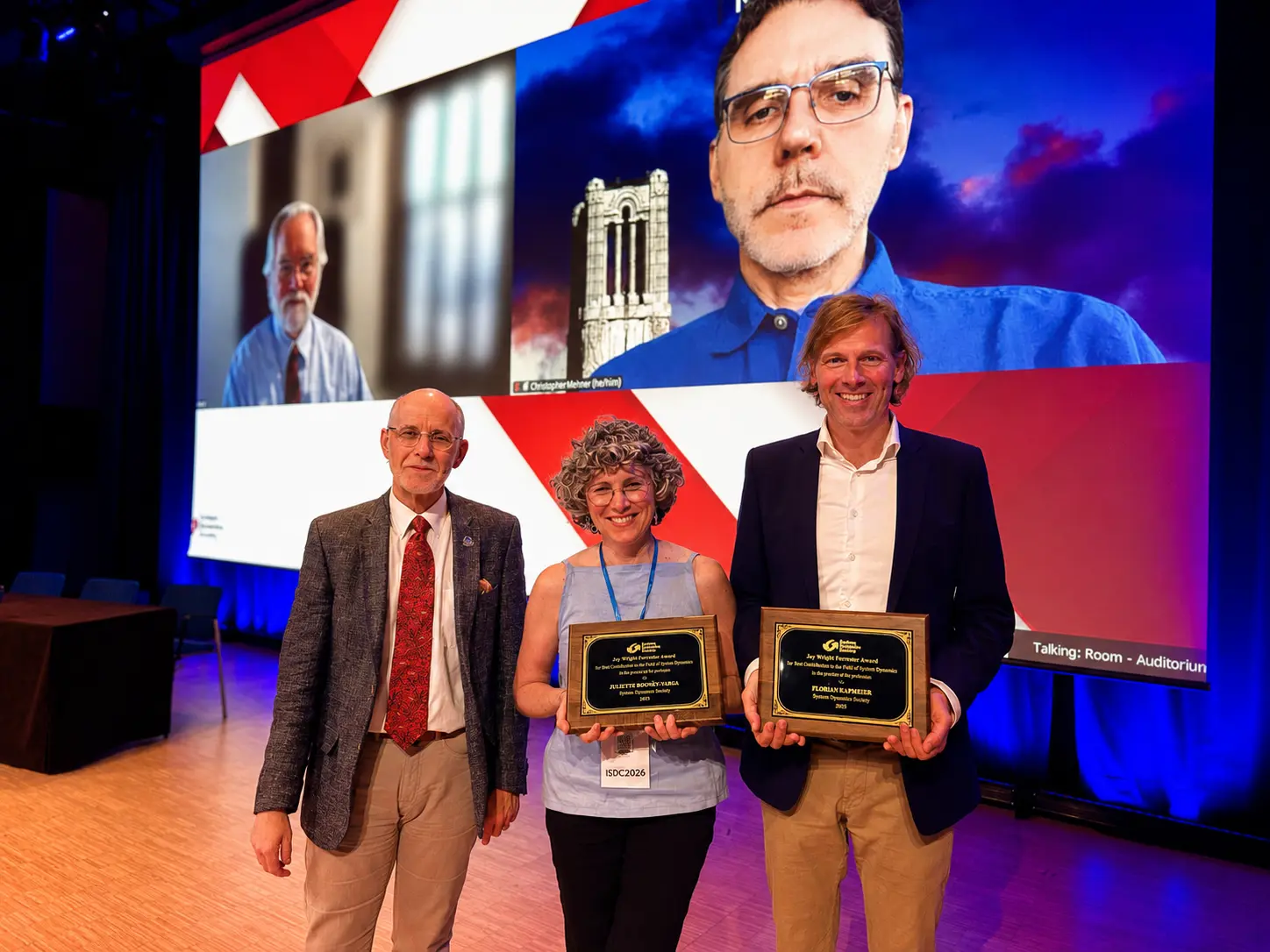
 Professor Juliette Rooney-Varga, center, received the Jay Wright Forrester Award in system dynamics. The award honors a 2024 paper in Nature Sustainability co-authored by Rooney-Varga, Florian Kapmeier (ESB Business School, Reutlingen University, Germany), right, Charles Henderson (North Carolina State University), top right, and David Ford (Virginia Tech), top left. Forrester Award Committee Chair David Lane, left, presented the award.
Environmental, Earth and Atmospheric Sciences Professor Juliette Rooney-Varga has won the Jay Wright Forrester Award, which recognizes the best contribution to the field of system dynamics over the past five years.
The System Dynamics Society presents the Forrester Award as often as once a year. The award is named for Jay Wright Forrester, who founded system dynamics — a discipline that uses computer simulation and feedback-loop modeling to understand how complex systems change over time. The approach has informed real-world decision-making in fields ranging from change management to business strategy and policy for environmental, climate and energy systems.
Rooney-Varga received the award at the International System Dynamics Conference in Delft, Netherlands, from July 20–24, 2026. She directs UMass Lowell's Climate Change Initiative and co-directs the Rist Institute for Sustainability and Energy.
The award honors a 2024 paper in Nature Sustainability titled "Community-Based Propagation to Scale Up Educational Innovations in Sustainability." Rooney-Varga co-authored the paper with Florian Kapmeier (ESB Business School, Reutlingen University, Germany), Charles Henderson (North Carolina State University), and David Ford (Virginia Tech).
The paper addresses a problem familiar to anyone who develops an innovation: how do you get it to scale? The team built a system dynamics model to study how educational innovations spread — or fail to spread — among university instructors. Their finding was counterintuitive. Word-of-mouth alone rarely works. Outreach campaigns help only a little. Instead, building a community of "ambassadors" who are committed adopters and actively mentor and recruit others can achieve rapid scaling. That structure creates reinforcing feedback loops capable of driving meaningful, sustained growth.
"This question kept coming up in our work: we have great sustainability solutions, but how do we scale them in time to make a difference?" Rooney-Varga said. "That's the question that motivated this paper. I'm deeply honored by this award, and grateful to be a part of the system dynamics community."
David Lane, chair of the Forrester Award committee, described the paper's rigor and reach when announcing the award. He noted that the model builds on a long lineage of system dynamics research, tracing back to classic diffusion and contagion models used in earlier Forrester Award-winning work. He also pointed out that the paper's core insight extends well beyond sustainability education, to any effort to spread an idea from a small group of specialists to a much larger population. Lane connected the work to Jay Forrester's founding vision for the field: that system dynamics has the greatest impact not when confined to a few decision-makers, but when it is practiced widely, by many, for the benefit of society.
The paper's insight is already shaping work closer to home. Rooney-Varga's group is applying the same model to a clean energy program in Lowell. Rooney-Varga and Lucia Cheney, program associate for the UMass Lowell Climate Change Initiative, are working with the city's Cambodian American community to build a cohort of "ambassadors" who serve as trusted messengers in the local community. Together with Manning School of Business Associate Professor José Godinez Gonzalez, they are studying whether this community-based scaling approach can boost participation in Massachusetts's clean energy incentives — programs that are underused by the households who would benefit from them most.