
 Image by Ed Brennen
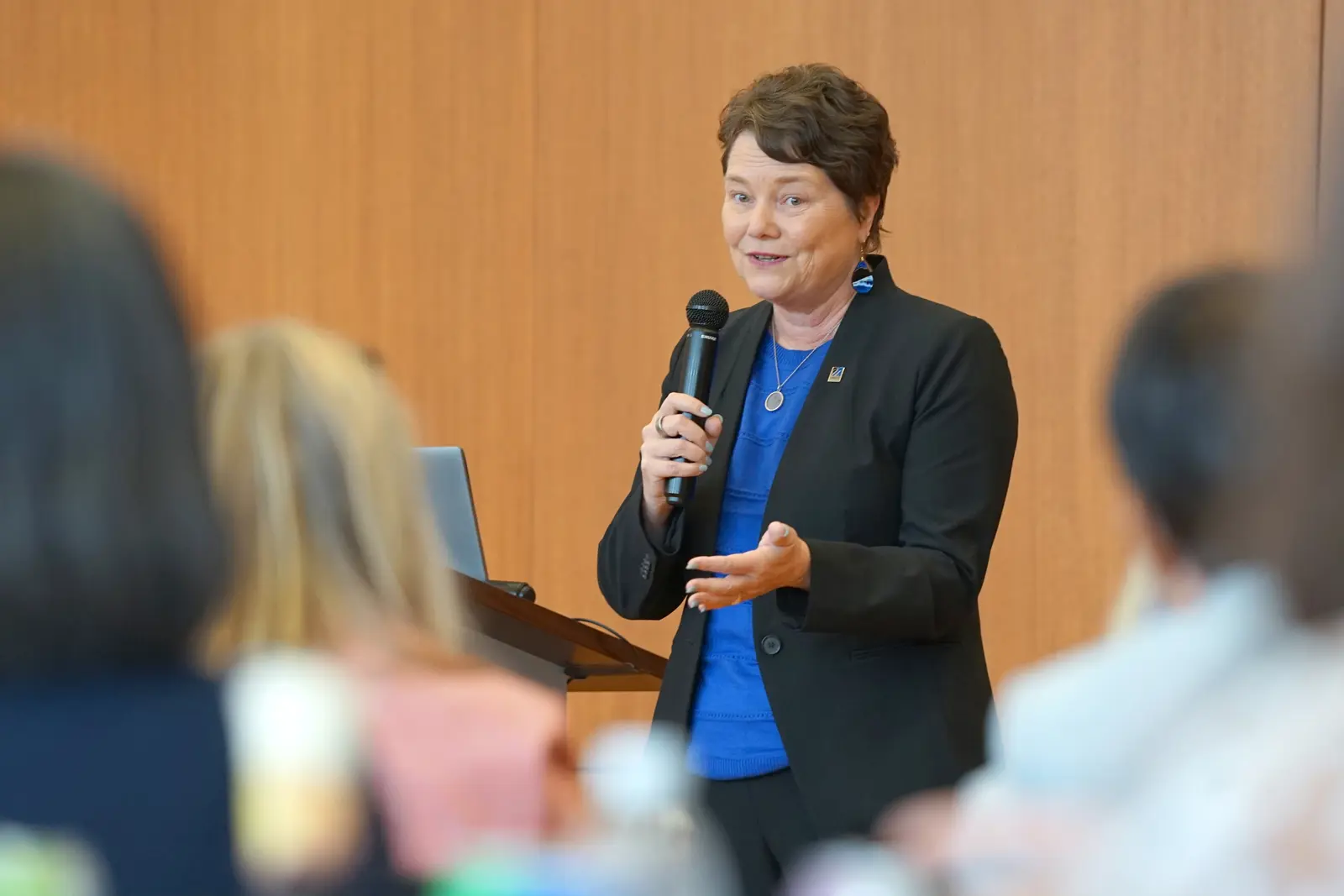
 Provost Lynne Cossman, who joined UMass Lowell this summer, introduces herself during new faculty orientation at Coburn Hall.
Lynne Cossman arrived at UMass Lowell this summer with a career spent at public research universities, a commitment to serving first-generation students and a desire to help shape higher education for a rapidly changing future.
Cossman, who began as provost and vice chancellor for academic and student affairs in August, came to UML from the University of Texas at San Antonio, where she was founding dean of the College for Health, Community and Policy — the university’s largest college, with more than 6,000 students.
A medical sociologist and demographer who earned bachelor’s, master’s and doctoral degrees from Florida State University, Cossman has held faculty and leadership positions at West Virginia University, Mississippi State University, the University of Central Arkansas and Miami University.
The Florida native has also seen plenty of the country along the way. Cossman set a goal of visiting all 50 states before turning 50 — and accomplished it.
Cossman recently sat down to discuss the path that led her to UML, her approach to leadership, the university’s Carnegie Research 1 (R1) status and how artificial intelligence is reshaping higher education.
What drew you to UMass Lowell and made this feel like the right next step for you?
When I started thinking about whether I wanted to be a provost and, if so, where, I knew I wanted to be at an institution committed to serving first-generation students, underrepresented minorities and Pell Grant-eligible populations, while also being R1 with top-notch researchers and superb teachers. I also wanted an institution that is community-engaged.
There aren’t a lot of schools that tick all of those boxes. When I started looking at UMass Lowell, I was impressed with the student demographics, which are very similar to the places I’ve worked. I want to work with students who really need us to help prepare them for their careers and their lives.
And then you look at the leadership and the amazing upward trajectory that the university is on, and who doesn’t want to be part of a winning team?
You built UT San Antonio’s College for Health, Community and Policy as its founding dean. How did that experience prepare you for the provost role at UMass Lowell?
I started as dean in the heart of the pandemic. I interviewed just before the world shut down, and my first day on the job was May 11, 2020. I launched a college with people I’d barely met during the interview when we were 100% remote for almost the first 18 months that I was there.
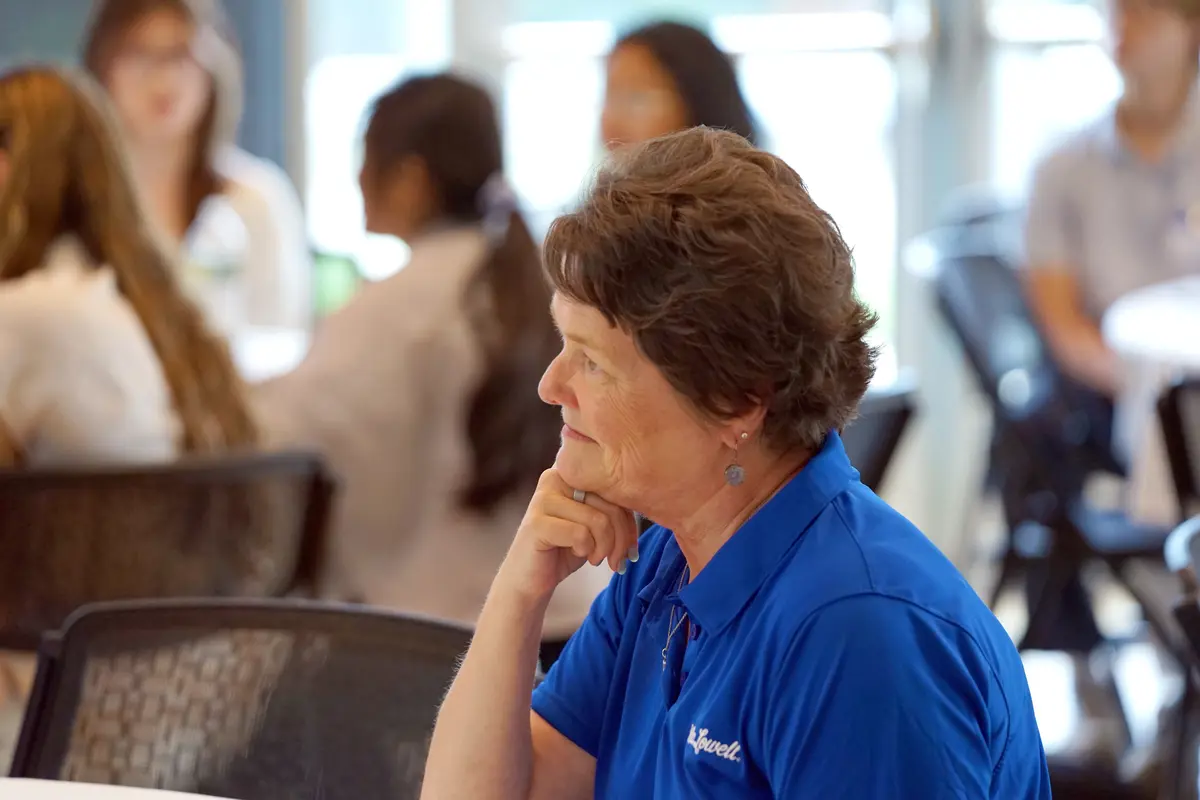 Image by Ed Brennen
 Provost Lynne Cossman, seen here watching final student presentations at this summer's Research, Academics and Mentoring Pathways (RAMP) program, says she wanted to be part of a community-engaged university with top-notch research and teaching.
I used that process in our strategic planning as well. I think the only way you’re going to collaborate is if you’re transparent and communicative from the start. I like to make sure that the trains run on time. Building those processes is something that I really enjoyed, and I think I can be helpful here with that as well.
How can UMass Lowell’s R1 status enhance the undergraduate experience and student success?
They absolutely have to work hand in hand. In my opinion, teaching, research and community engagement are a three-legged stool, and they serve one another.
The reason students want to study at an R1 institution is because you have some of the best researchers in the world teaching you the cutting-edge things. It’s like why you want to get health care at a teaching hospital: You have people at the forefront of their fields taking care of you.
To me, that’s what makes higher education interesting and exciting.
What role should AI play in a UMass Lowell education, and how should the university prepare students and faculty for the changing technology landscape?
The toothpaste is out of the tube; AI is here. I think we’re doing our students a disfavor if we’re not integrating applied AI into nearly everything we do. We have to teach them how to use AI ethically and responsibly.
In my time at San Antonio, I continued to teach in the area of leadership, and I integrated the use of AI into that. I had students draft in their own words, edit with ChatGPT, turn in that draft, grade that draft, critique that draft and then turn in their final draft, which was again back to their words.
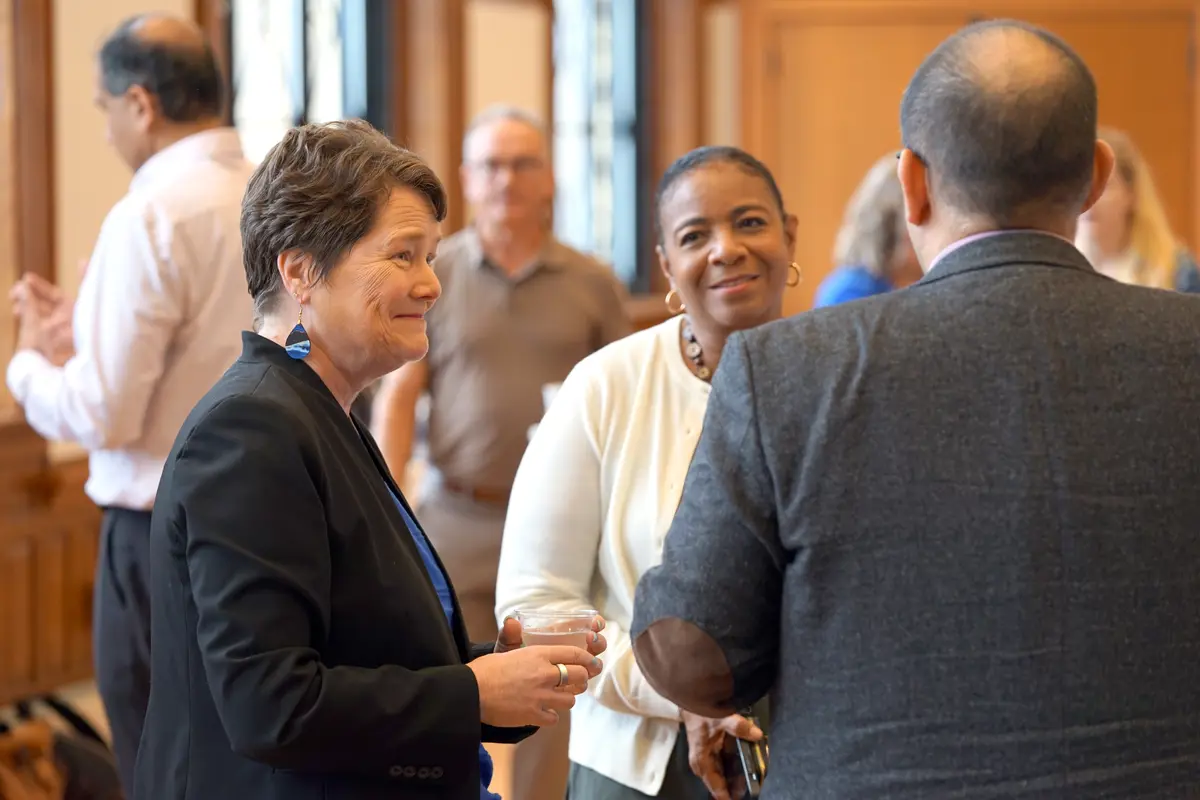 Image by Ed Brennen
 Provost Lynne Cossman, who plans to spend the fall semester absorbing as much as she can about UML, chats with Manning School of Business Dean Bertie Greer, center, and other faculty members at Coburn Hall.
I also think we need to seriously consider applied AI. How does AI matter for sociology, my home discipline? How does it matter for public health or marketing? That’s where we really need to be focused right now — understanding how AI applies across disciplines and preparing students to use it in their careers.
How did you find your way into sociology and demography, and eventually into studying health disparities?
When I started at Florida State, I wanted to be an actuary, but Florida State didn’t have an actuarial science program, so I decided I would be an accountant, which is what my father was. I had too much fun my freshman year and missed getting into the business school by one-hundredth of a point on my GPA. I took Intro to Sociology that summer to increase my GPA, and then the business school raised its requirements and I missed it again.
But I just fell in love with sociology. I thought, “This is the way I think about the world, and this is why I’m so curious.” I wanted to understand how structural factors influence things that seem very personal.
In graduate school, I was hired by a demographer to work on an NIH grant studying children’s knowledge, attitudes and beliefs about AIDS. After a year of working with demographers and learning what demography was, I became really interested in health and how something that seems very personal — your health and health behaviors — is driven by the structure around you.
I ultimately spent most of my career studying spatial disparities in mortality in the United States: Why do you have really high mortality rates in some counties and much lower rates in others? What’s causing that?
What has stood out to you as you’ve gotten to know UML and the Lowell community?
The thing that has pleasantly surprised me is that everybody here is not just welcoming, but they all have a can-do attitude. A problem comes up, and they’re like, “Oh, we’ll make it work.” Everybody’s been incredibly helpful as I figure out processes and how things work.
I’m looking forward to a time when I can answer more questions than I’m asking. But I think I’ll be asking a lot of questions for some time to come.
And in Lowell, I love how walkable everything is downtown. The Riverwalk, which I didn’t even know existed when I interviewed, has been a great discovery. I walked into work along the river this morning, and it’s just beautiful and peaceful.
How would you define a successful first year as provost?
I feel like my first semester here, success will be listening and learning just as much as I can about every aspect of the university — the students, the staff and the faculty.
One of the biggest priorities for me, not just in the short term but in the long term, is guiding the faculty and developing a curriculum for the next generation of our leaders. We need to figure out how our curriculum can be nimble and how we can adjust as AI changes the pace at which change occurs.
We have to make sure that, as Wayne Gretzky said, we can skate to where the puck is going to be and have the programs students will want in five or 10 years ready when they need them.
By the end of my first year, I’d like to have a really good sense of the culture and the people of UMass Lowell and Lowell, and have a plan for the rest of my tenure as provost.