
 Image by courtesy
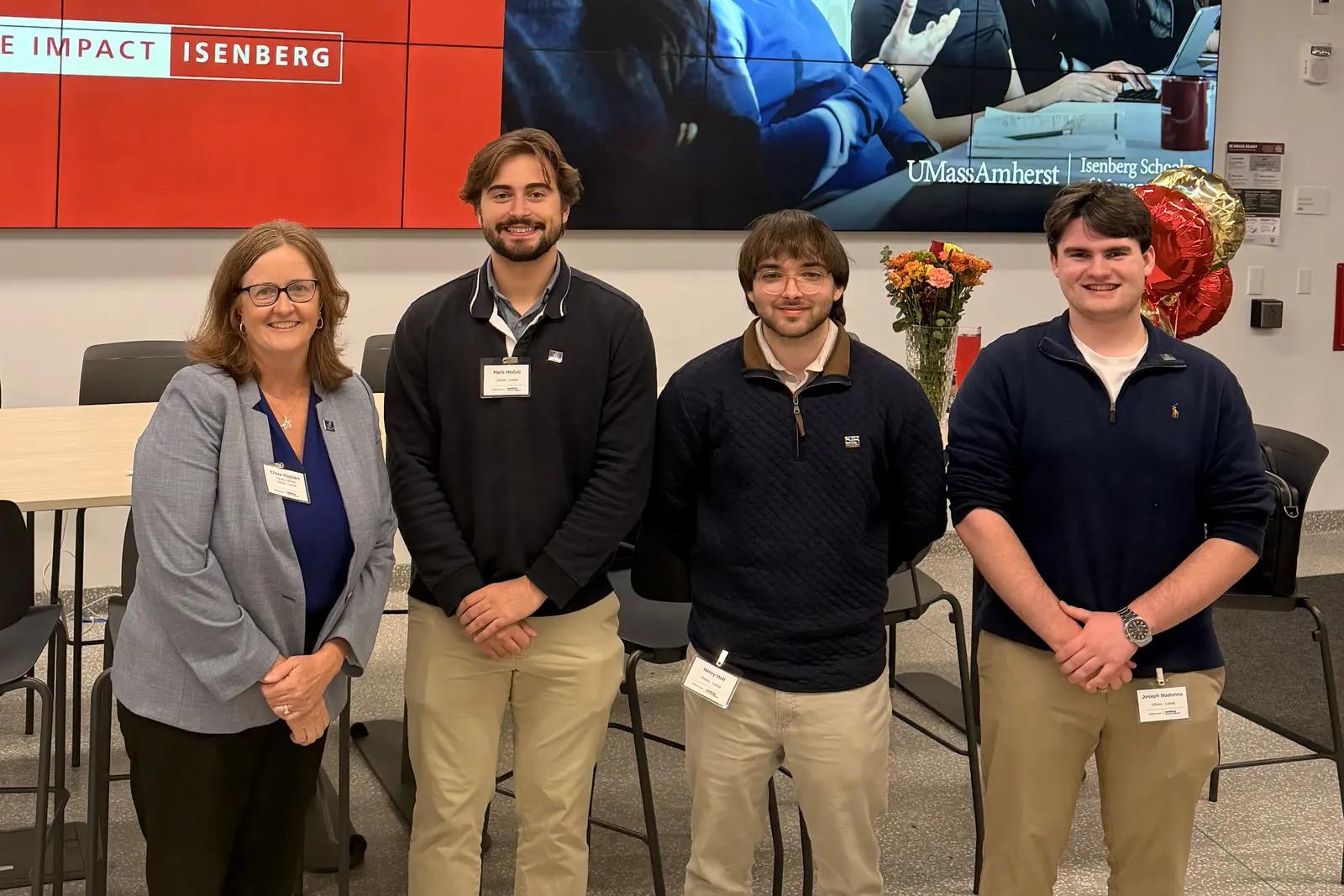
Associate Teaching Professor Elissa Magnant, left, faculty director of the Donahue Center for Business Ethics and Social Responsibility, accompanied students, from left, Harry Hodzic, Henry Holt and Joe Madonna to the recent Isenberg Ethics Case Competition at UMass Amherst, where they won their division.
Online sports betting and prediction-market apps have become increasingly common on college campuses, giving students easy access to wagers through their phones.
At the recent Isenberg Ethics Case Competition at UMass Amherst, three Manning School of Business students were asked to advise DraftKings, a sports betting and daily fantasy sports company, on how to grow its business while protecting vulnerable customers.
Senior business majors Joe Madonna, Henry Holt and Harry Hodzic won the Open/Invitational Division after presenting recommendations that balanced DraftKings’ legal, ethical and financial interests.
“It was great to win,” says Hodzic, a Wakefield native with concentrations in finance and marketing. “I was very proud of us.”
The students learned about the competition in their Business Ethics course with Associate Teaching Professor Elissa Magnant, faculty director of the Donahue Center for Business Ethics and Social Responsibility.
The team received the case, which asked them to consider DraftKings’ future as prediction-market platforms such as Polymarket and Kalshi continue to grow, one week before the competition.
Madonna handled the financial portion of the presentation, Holt focused on the legal issues, and Hodzic addressed the ethical considerations. The team met for about 45 minutes each day during the week before the competition, while also conducting individual research, preparing slides and rehearsing.
In Amherst, they had 20 minutes to present their proposal, followed by 10 minutes of questions from the panel of Isenberg alumni judges.
“The judges said they were having a difficult time coming up with questions because of how thorough we were with our presentation,” says Madonna, a finance student from Topsfield. “We were able to communicate our thoughts pretty clearly.”
The students recommended that DraftKings strengthen its systems for identifying risky gambling behavior and give customers more information about the potential harms of sports betting. They also recommended that the company work with lawmakers on consistent regulations, including a minimum age of 21 for prediction-market platforms such as Polymarket, which is available to users as young as 18.
The students’ recommendations come at a time of rising concerns about the growth in digital wagering by college students. A recent survey by Inside Higher Ed and Generation Lab found that 15% of undergraduates had participated in online sports betting, prediction-market trading or another form of digital wagering since enrolling in college. The figure rose to 25% among men.
Hodzic says he has friends who have lost more money than they could afford through sports betting. Although he enjoys sports and sees a place for casual betting, he worries that constant advertising makes gambling seem unavoidable.
“It shouldn’t be advertised as much as it is, because now it seems forced onto you,” Hodzic says.
Holt, who plans to attend law school, was drawn to the case’s legal questions, including potential lawsuits, product liability and gambling addiction. He says the competition also helped him overcome his nerves about public speaking.
“I went in feeling very nervous, but as soon as the official presentation started, I was calm and clear-headed,” Holt says.
Madonna says he joined the competition to step outside his comfort zone and apply what he was learning in business ethics.
“It was something interesting that I hadn’t done before,” he says.
The competition also provided an opportunity for the students to build professional connections and introduced them to consulting — a career path that Hodzic had not previously considered.
“I realized, ‘Oh, I am capable of this, and this is pretty interesting,’” Hodzic says.