
 Image by courtesy
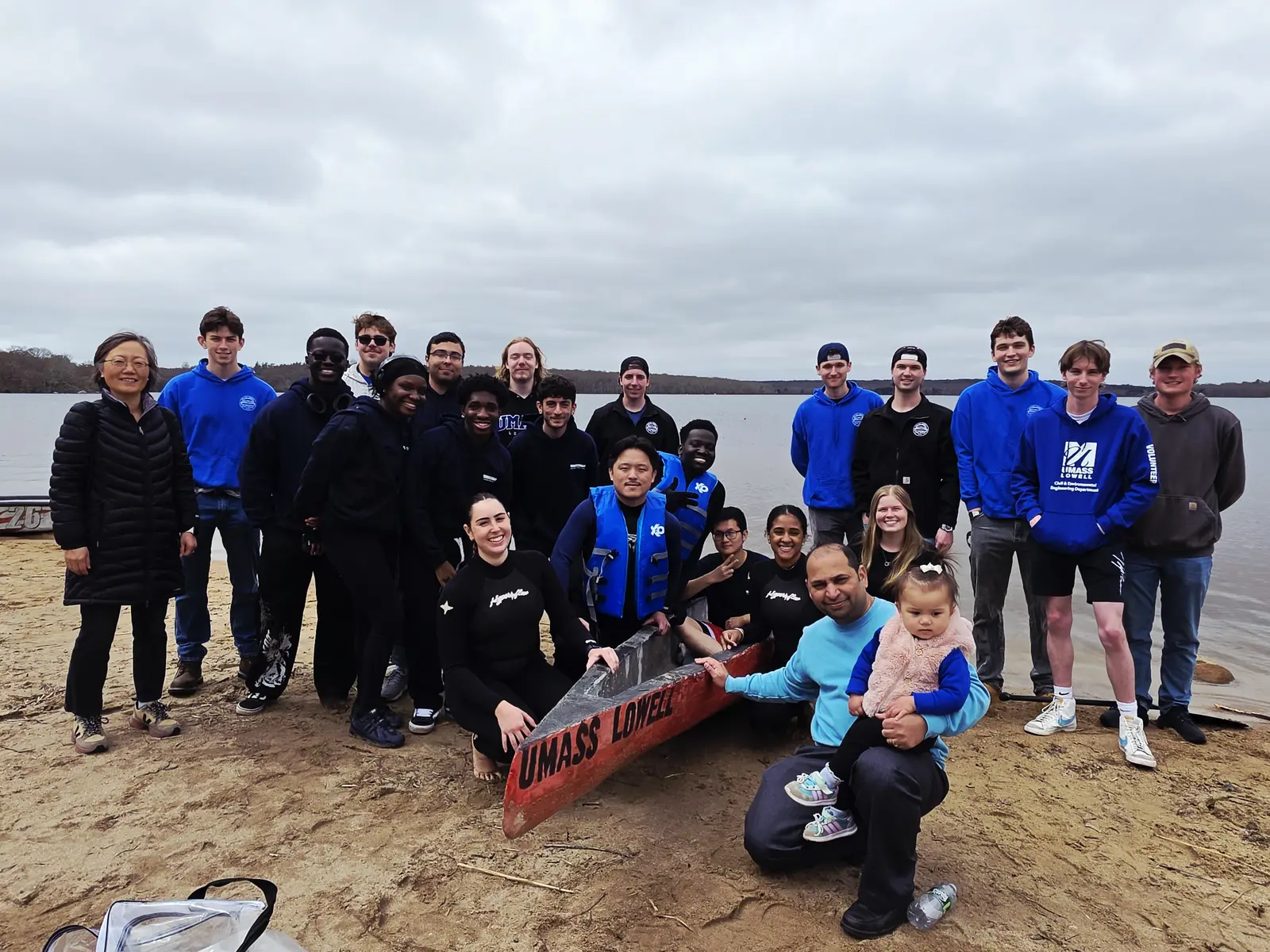
 Members of the Steel Bridge and Concrete Canoe teams pose for a photo with the Merrimack Monarch during the American Society of Civil Engineers' recent Northeast Student Symposium in Rhode Island. Both teams finished seventh.
The American Society of Civil Engineers’ Northeast Student Symposium was just 24 hours away, and the Falmouth Annex on North Campus was buzzing with activity.
Inside one of the garage bays, members of UMass Lowell’s Concrete Canoe Team were applying final coats of blue and red stain to the “Merrimack Monarch,” the boat they hoped would float to victory at the regional competition.
Meanwhile, outside the garage, members of the university’s Steel Bridge Team were practicing their choreographed construction one last time, quickly tightening bolts in a race against the clock.
By the end of the weekend in Rhode Island, both teams had delivered — each placing seventh overall against fields of more than a dozen teams from across the Northeast, including entrants from UMass Amherst and UConn.
Canadian teams dominated both competitions, with Université Laval winning the Steel Bridge event and École de Technologie Supérieure (ETS-Montreal) taking first in Concrete Canoe.
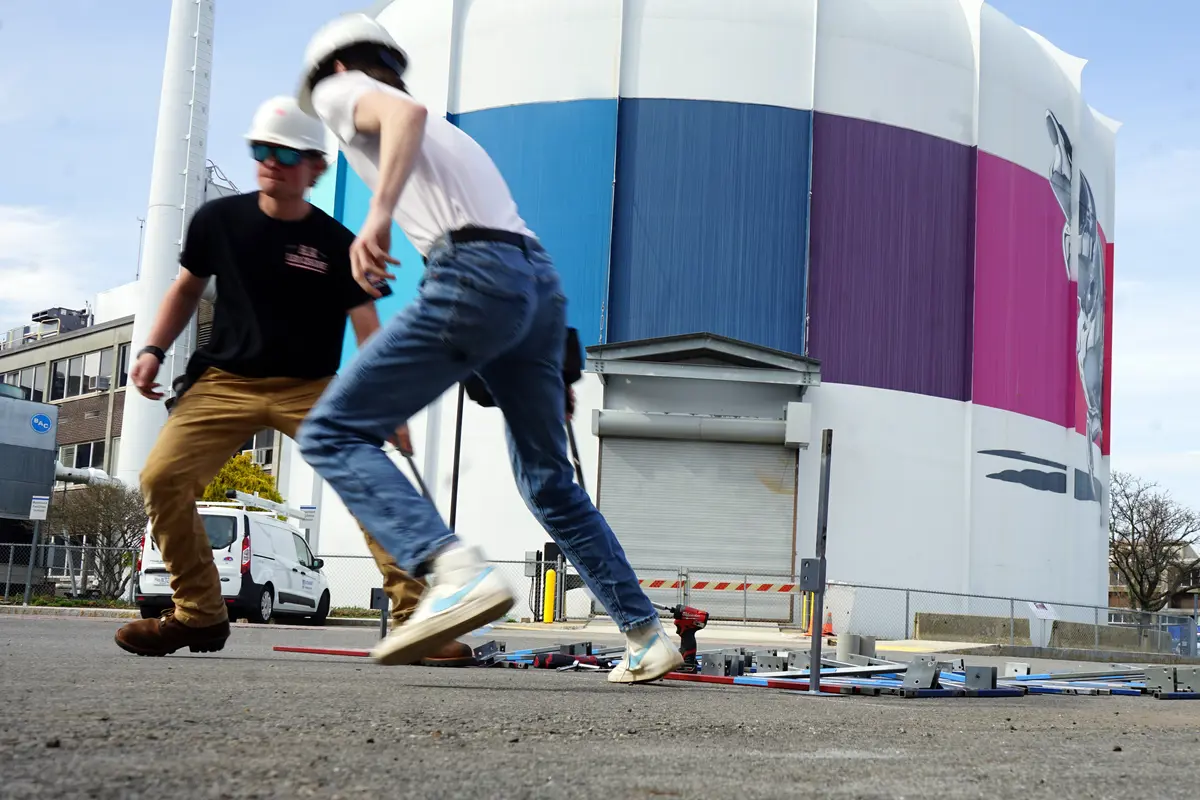 Image by Ed Brennen
 On the eve of the regional competition, Steel Bridge Team members get one final practice build in outside the Falmouth Annex, racing to complete their structure in less than 30 minutes.
“It was great to present our work, see other teams’ designs and learn different approaches to mix design, construction and teamwork,” says Alves. “It was rewarding to represent our university and present all of our hard work and dedication throughout the year.”
Junior civil engineering major Matt Paxton, who helped revive the Steel Bridge Team after the pandemic, was pleased with the performance and says they had “an amazing time” at the competition.
The annual symposium, hosted this year by Roger Williams University in Bristol, Rhode Island, brings together civil engineering students for hands-on competitions that combine design, construction and performance under real-world constraints. Each UML team sent around 10 students to the event.
“It’s a good way to take what you learn in class and apply it outside,” says Luiza Sette, a junior from Yarmouth who joined the Concrete Canoe team last semester.
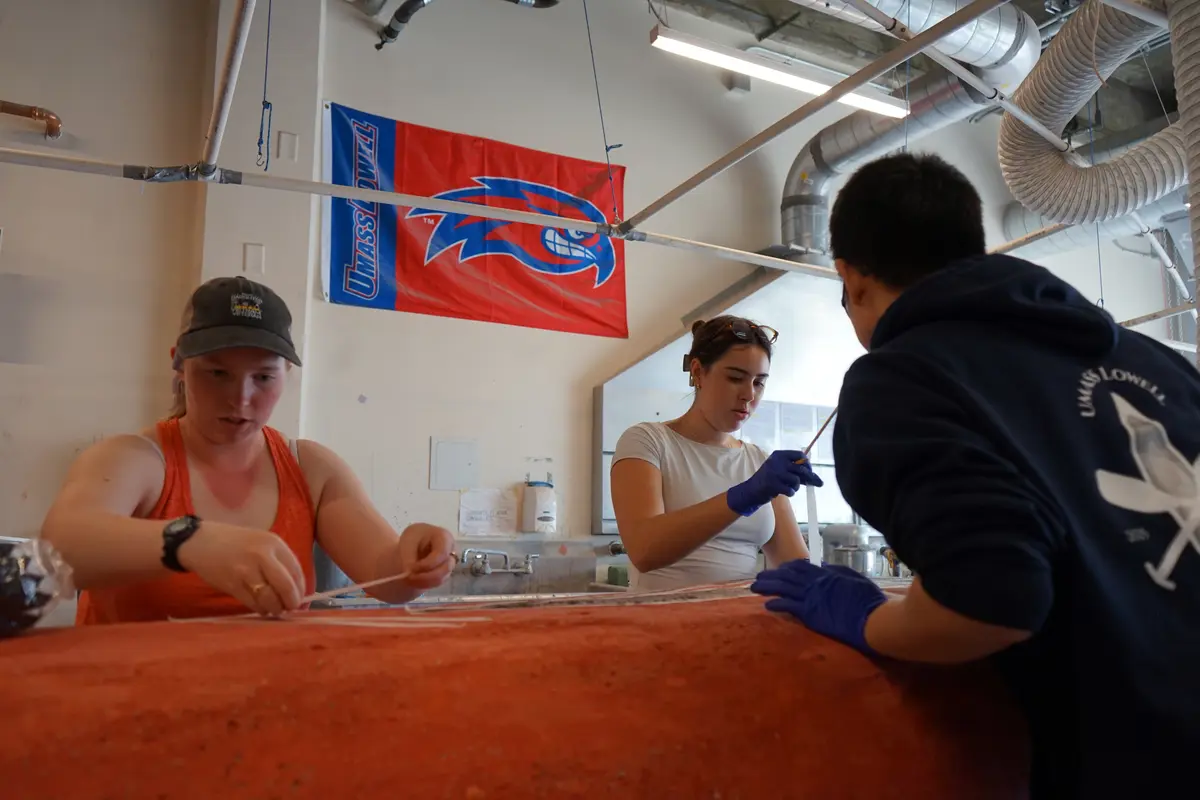 Image by Ed Brennen
 Concrete Canoe Team members apply the final decorative touches to the Merrimack Monarch inside the Falmouth Annex garage.
Both teams are largely student-driven, with support from faculty and staff who help coordinate logistics and funding.
“It teaches them leadership and how to work through problems,” says Michelle Riccio, department coordinator for Civil and Environmental Engineering.
The Concrete Canoe Team’s challenge is more complex than simply making concrete float. Teams must develop a lightweight concrete mix that can support multiple paddlers while meeting strict competition requirements for buoyancy, durability and safety.
In preparation for the event, adjunct instructor John Fitzgerald ’79, ’87 arranged for the team to practice paddling on Peters Pond in Sandwich. Because exposure to water can shorten a canoe’s lifespan, the team practiced with a canoe from a previous year — saving the Merrimack Monarch’s maiden voyage for the competition.
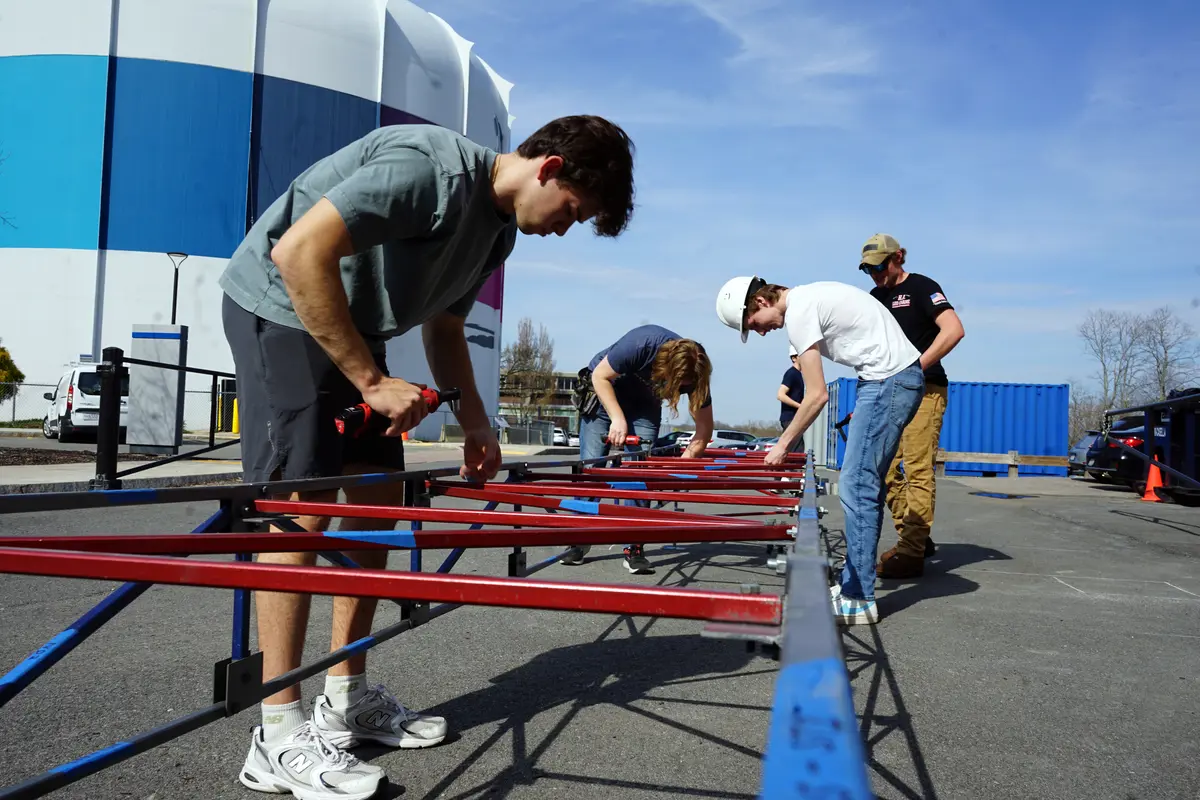 Image by Ed Brennen
 Steel Bridge Team members work on their structure on North Campus.
The Merrimack Monarch performed well in sprint events, including a fourth-place finish in the women’s race and a fifth-place finish in the coed race.
For the Steel Bridge competition, teams must design and fabricate a scale-model steel bridge capable of spanning about 20 feet and supporting 2,500 pounds, all while meeting strict competition rules for weight, speed and assembly. Bridges are also judged on stiffness, efficiency and aesthetics.
“The competition limits us to 30 minutes of build time, so our first goal was to construct under 30 minutes to avoid getting penalized,” Paxton says.
The team assembled its bridge in 25 minutes, 55 seconds. After penalties (which can be for infractions such as stepping outside of the construction zone or dropping a tool), its official time was 29 minutes, 55 seconds, ranking fifth in construction speed.
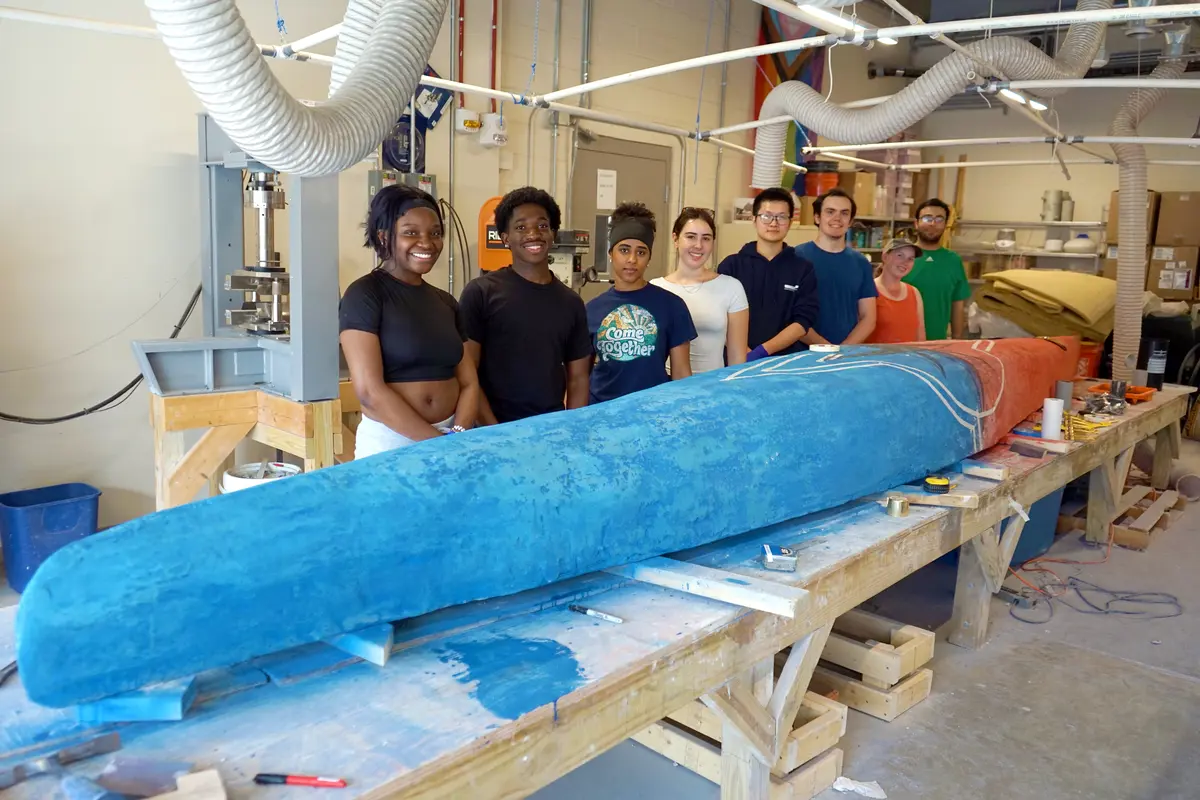 Image by Ed Brennen
 Concrete Canoe Team President Estefania Alves, third from left, says it was rewarding to represent UMass Lowell at the Northeast regional competition.
“Our bridge had virtually zero lateral displacement,” Paxton says.
For both teams, the symposium provided a chance to connect with peers, exchange ideas and see how other universities approached similar challenges.
“Overall, we were all inspired,” Alves says. “I think we would all do it again.”
Next year, they won’t have to travel far. UMass Lowell is set to host the 2027 ASCE Northeast Student Symposium, Paxton says, giving both teams a chance to build on this year’s momentum on their home turf.
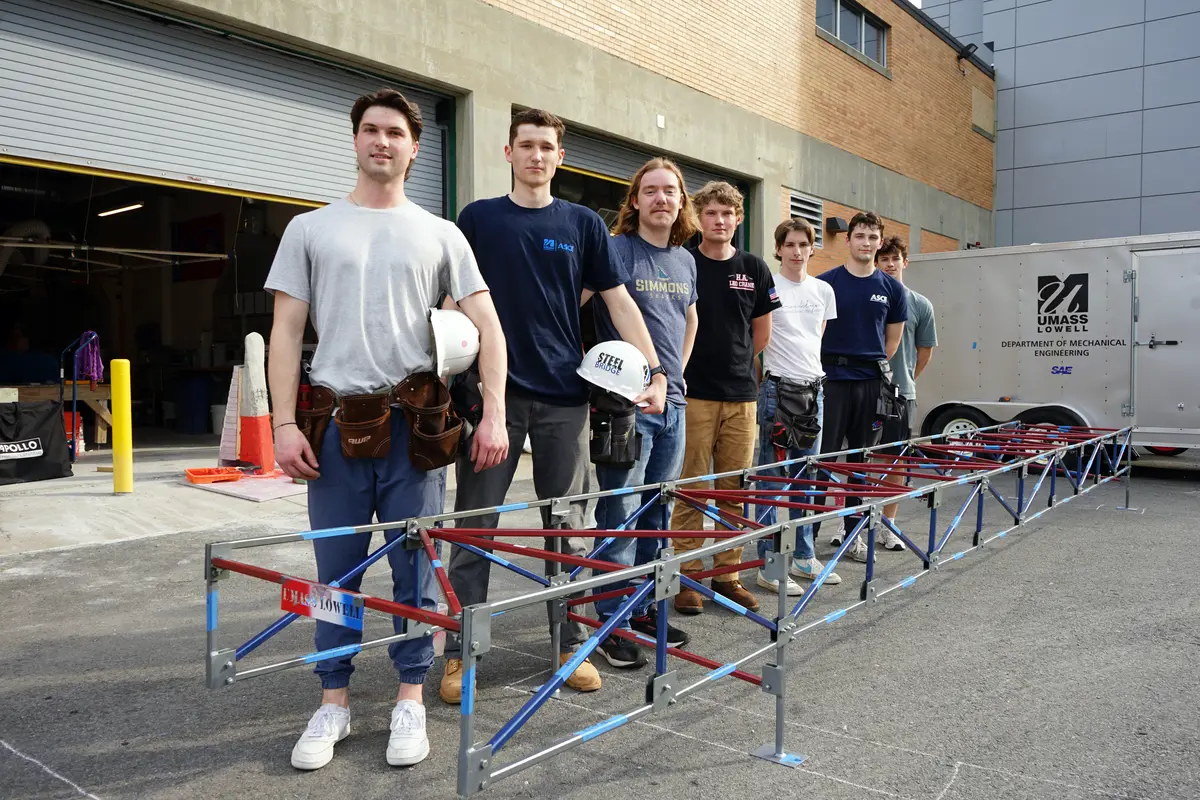 Image by Ed Brennen
 Steel Bridge Team President Matt Paxton, left, was pleased with the team's performance at the Northeast regional.