
Dogtor Booty-Ham sniffed out the treats tucked away in a wooden box.
The 1-year-old pit bull mix walked around the wooden container before biting a handle protruding from its side. Having no luck getting it open, he moved to a sliding door on top of the box. He pushed the door open with his snout, revealing the hidden treats. Within seconds, Dogtor devoured his findings.
The enrichment toy provided mental stimulation for Dogtor, who has been living at the Lowell Humane Society for the past month while waiting to be adopted. The toy is not one you could buy in stores; instead, it was made by students taking the course Introduction to Engineering Design.
“Being able to come here and see the dog play with the toys is the best experience in the world,” said Aaron Berube, a first-year industrial engineering major enrolled in the course.
As a final project for Introduction to Engineering Design, Assistant Professor Jasmina Burek and Assistant Teaching Professor Carter Keough in the Department of Mechanical and Industrial Engineering tasked their 90 students with making enrichment toys for animals at nearby shelters and rescues, including the Lowell Humane Society, Newhouse Wildlife Rescue in Chelmsford and the Guinea Pig Sanctuary in Salisbury.
“We were really excited when UMass Lowell reached out to us for this partnership,” says Crystal Arnott, executive director of the Lowell Humane Society. “It’s really important to have these types of enrichment tools at the shelter, because the animals are very intelligent and clever, and when left in a kennel or cage for almost 24 hours a day – they get a few short walks, but it’s not like being in a home – it’s really important for them to have ways to work their brain.”
Split into groups, the students had to find ways to engage the instinctual behaviors of their assigned animals: foraging and sniffing for dogs, chewing and hiding for rabbits, and gnawing and building for beavers.
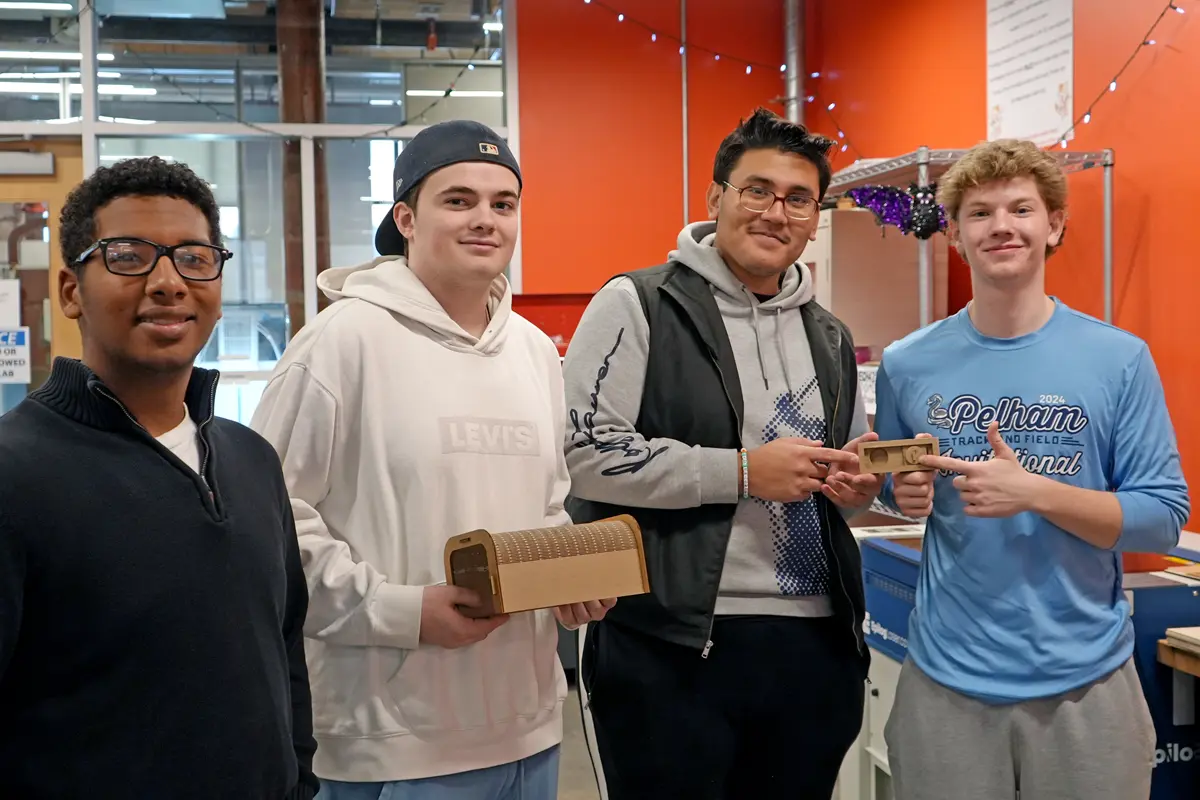 Image by Brooke Coupal
 Mechanical engineering students Jeremia Rosario, James Ducie, Alejandro Sanchez and Tibor Ivanyi show off their guinea pig toy at the Lawrence Lin MakerSpace.
The students used SolidWorks, a computer-aided design software package, to design their toys, which had to be durable, reusable and made with sustainable materials such as wood and cardboard. In the Lawrence Lin MakerSpace, they used laser cutting machines and 3D printers to construct their inventions.
“We know that our project is going toward a good cause, which gives us a greater purpose behind wanting to put in our best work and design something effective,” says Tibor Ivanyi, a first-year mechanical engineering student, whose guinea pig toy encouraged the instinctual behaviors of foraging for food and hiding.
Keough and Burek saw the value in creating a final project that tested their students' engineering design skills while also making a positive impact in the community.
“As engineers, we are problem-solvers,” Keough says. “We are here to better the world in one way or another, and this is a great opportunity to show that to the younger generation of engineers.”
Overall, the students made 11 toys for the Lowell Humane Society, seven for the Newhouse Wildlife Rescue and two for the guinea pig sanctuary. Some of those toys are already being put to good use, as seen with Dogtor Booty-Ham.
“I was absolutely happy to contribute to my community,” Berube says. “That’s a very important thing that UMass Lowell teaches their students.”