
Football-field-size Helium Balloon Lifts Instrument to Outer Edge of Atmosphere
10/03/2025
Media Contacts: David Joyner, senior director, communications and digital media, David_Joyner@uml.edu or Nancy Cicco, assistant director of media relations, Nancy_Cicco@um.ledu
LOWELL, Massachusetts – NASA on Oct. 1 launched a telescope designed and built by UMass Lowell and the space agency that seeks to identify planets beyond the solar system and other objects in space that would otherwise go unnoticed because they are hidden by the glare of nearby stars.
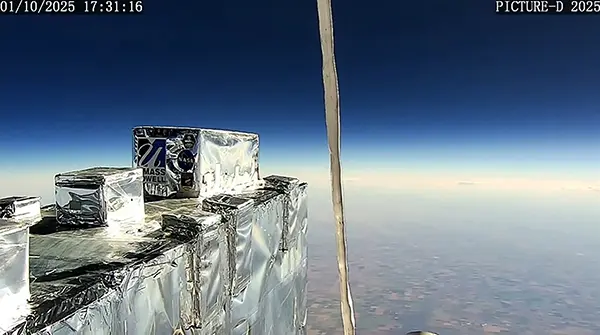
Tethered to a gigantic helium balloon inflated to about 39 million cubic feet – about the size of a football field – the telescope lifted off at 11:40 a.m. ET on Wednesday, Oct. 1 from the NASA Columbia Scientific Balloon Facility in Fort Sumner, New Mexico. The balloon carried the device to the edge of the atmosphere, to a height of about 120,000 feet, where it remained for into the night, collecting images of the cosmos for researchers to analyze back in Lowell.
Known as “PICTURE-D,” the instrument weighs 1,500 pounds and measures 14 feet long by 4 feet wide. It includes the fourth iteration of a specialized imaging and optical control system built by a research team in the university’s Lowell Center for Space Science and Technology (LoCCST) and the NASA Wallops Flight Facility in Virginia. Equipped with specialized technology that helps produce stable still images, the device, known as a coronagraph, blocks light to better take pictures of objects close to stars.
The research aims to advance scientific knowledge and develop several key imaging technologies capable of viewing planets beyond the solar system for future large-scale NASA space flights, according to UMass Lowell’s Christopher Mendillo, an electrical and computer engineering associate professor who is the lead investigator and scientist on the mission.
“We hope to capture images of planetary systems beyond the solar system, specifically large rings of dust, rock and ice that fill the space between planets. These objects are extremely faint and require a coronagraph to detect them against the bright glare of a star,” Mendillo said. “What we’re hoping to see are signposts of planets, evidence of planets. Eventually, in future missions with more powerful instruments, we hope to image planets themselves.”
Once the mission was completed, NASA controllers on the ground released the cable that tethered the balloon to the telescope, allowing the device to parachute safely to Earth. Controllers also punctured the balloon so that it dropped separately for a soft landing.
Members of the UMass Lowell team include Research Scientist Kuravi Hewawasam and Research Associate Sunip Mukherjee, both alumni; Lead Mechanical Engineer Jason Martel; and dozens of students who are gaining career-connected experience while working on the project.
“We involve undergraduate and graduate students in most, if not all our projects,” said UMass Lowell Physics Professor Supriya Chakrabarti, who directs LoCCST. “Two graduate students studying physics and several engineering undergraduate students participated in the design and development of PICTURE-D. Once the instrument returns scientific data, students will participate in data analyses and physics-based modeling that corrects for any distortions in the images so we can get a more accurate understanding of what the any shown objects look like.”
The project is funded by a $7 million, five-year grant from NASA’s Astrophysics Research and Analysis Program to UMass Lowell. The space agency initiative supports emerging science and technology that advance space missions and the study of the universe.