
Boston Women’s Workforce Council Forum at UMass Lowell Unites Employers, Policy Officials
10/31/2025
Media Contacts: David Joyner, executive director of communications and digital media, David_Joyer@uml.edu and Nancy Cicco, associate director of media relations, Nancy_Cicco@uml.edu
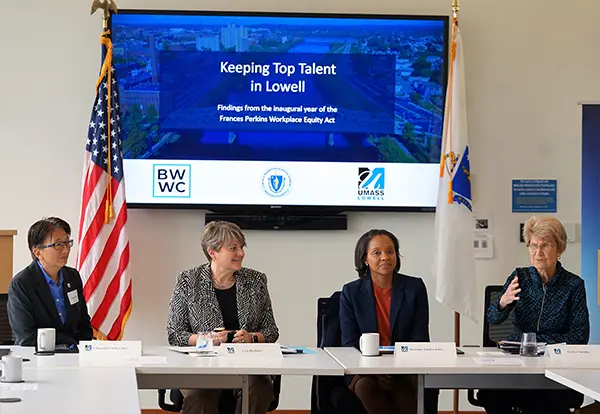
LOWELL, Massachusetts – Employers looking to learn how the state’s new wage transparency law can help them strengthen their workforce gathered at UMass Lowell on Wednesday for a forum presented by the Boston Women’s Workforce Council (BWWC) and attended by state Secretary of Labor and Workforce Development Lauren Jones.
Signed into law last year by Gov. Maura Healey, the 2024 Frances Perkins Workplace Equity Act seeks to promote wage parity and transparency by establishing new requirements for reporting for Massachusetts employers. The law’s namesake was a former U.S. labor secretary who was the first woman to serve in the presidential cabinet.
The law is the first in the nation that seeks out information from employers to proactively build a more diverse and robust workforce, according to former lieutenant governor Evelyn Murphy, co-chair of the BWWC and a longtime pay equity advocate. “This is the data and the database we need to build good public policy,” she said.
The session drew lawmakers and nearly 40 business, nonprofit, education and municipal leaders from throughout the Bay State. In addition to Jones, the panel included UMass Lowell Chancellor Julie Chen and BWWC member Lisa Brothers, principal and chair of Nitsch Engineering of Boston and a UMass Lowell graduate.
Under the act, employers with 100 or more employees must submit federally required equal employment opportunity wage data to the state. A second facet of the law, which took effect Wednesday, requires employers with 25 or more employees to disclose the pay range for all job positions. Under the new law, the state aggregates this information as a tool for employers to use as they recruit employees and determine wages, benefits and career pathways.
Presenting the information gathered through the law’s first year was Neha Gondal, associate professor of sociology and member in the Faculty of Computing and Data Sciences at Boston University, a partner in the project. The data can be found in the state’s 2025 Workforce Data Report and Dashboard.
While Massachusetts has made progress in diversifying its workforce, minorities remain overrepresented in service occupations and underrepresented in management. While women have made gains, according to Gondal, larger organizations in the state have a greater representation of employees who are women and people of color. This opens up an opportunity for smaller organizations to further diversify, she said.
“This wage data can be an available resource for employers to leverage as a workforce strategy to drive equity and affordability, and in turn, competitiveness for companies across Massachusetts,” Secretary Jones said.
Brothers reiterated that point when she spoke about her own professional trajectory as a woman in the engineering field and her company’s commitment to helping employees to grow their careers. She noted how an organization’s website and branding materials can attract or deter potential job candidates based on whether they can see themselves joining a given work environment. Now, with benchmark data in hand and new figures to be collected annually, she’s excited to see “what moves the needle over the years,” she said.
The effort to support and diversify the state’s workforce complements UMass Lowell’s mission, which includes providing each student with paid career-connected experiences. For the second time, The Wall Street Journal has named the university the No. 1 public institution in Massachusetts. This year, the media outlet also named UMass Lowell the state’s No. 1 best value public university and No. 1 among all colleges and universities in fostering social mobility among students. Past rankings from other institutions also cite UMass Lowell as tops in sustainability and return on investment.
Those rankings matter for all students but particularly for the estimated 50% of the student body who identify as people of color, as the workforce continues to welcome talented employees in all sectors, Chen noted. “If you want the best team, you don’t leave half the team on the sidelines. We want to maximize our talent in the commonwealth,” she said.
The BWWC will host more forums for employers about the new law in the coming weeks.