
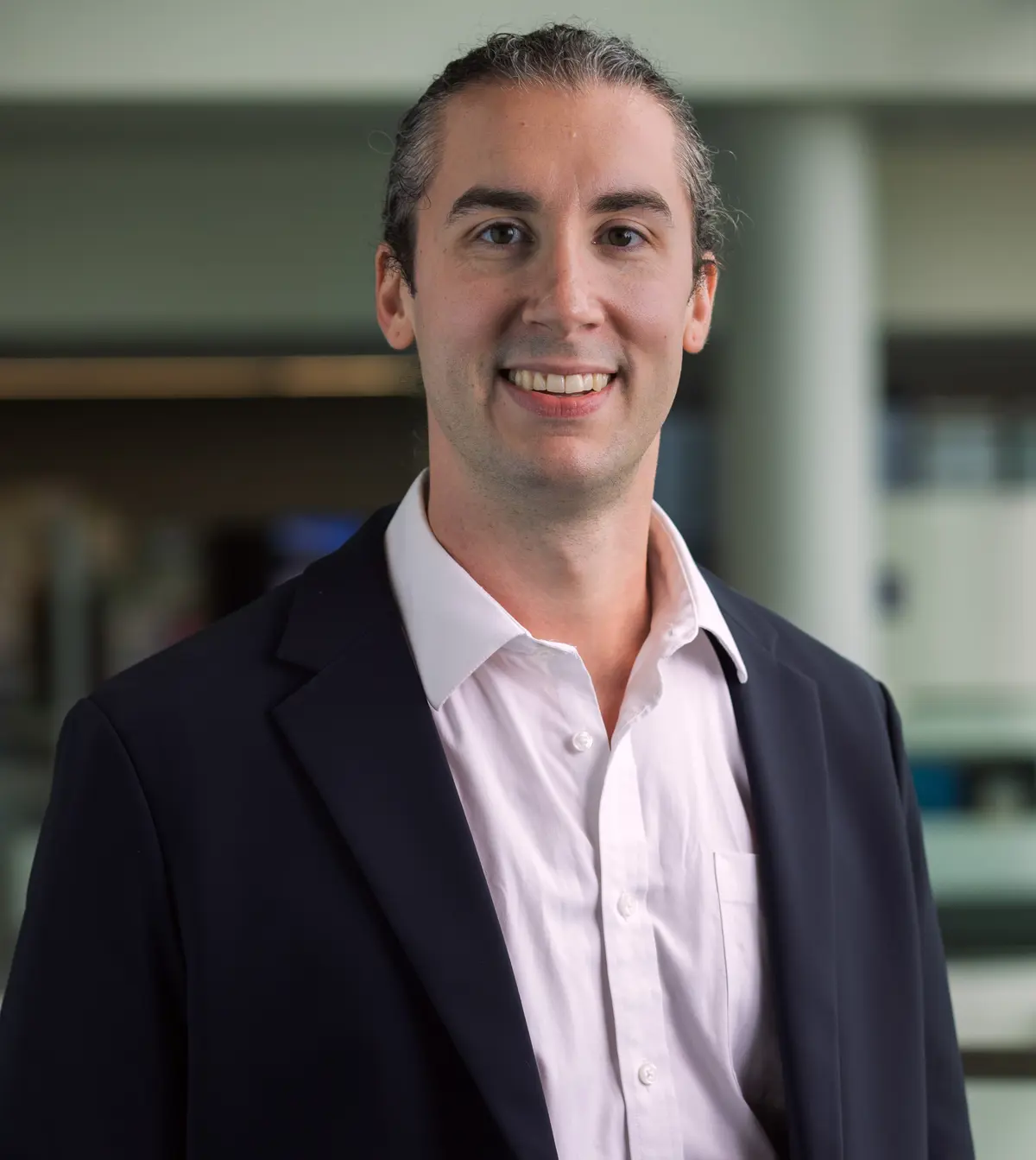
Brett Gelino, Ph.D.,
09/24/2026
By Jamie Trottier
Gelino studies something we all do every day: make decisions. His research looks at how and why people make the choices they do, how those choices change over time, and how the world around us can influence them.
Drawing on behavioral economics and quantitative modeling, Gelino applies those questions to a wide range of real-world issues. His research interests include health and addiction, climate change adaptation, natural hazard preparedness and community resilience. He is particularly interested in understanding how environmental and policy changes can influence behavior and help people and communities make different choices.
Before joining the Psychology Department, Gelino completed a postdoctoral fellowship at Johns Hopkins School of Medicine and held a faculty appointment at Rutgers Robert Wood Johnson Medical School. He earned his Ph.D. in Behavioral Psychology and a Professional Science Master’s degree in Environmental Assessment from the University of Kansas in 2022. He also earned a master’s degree in Applied Behavioral Science from the University of Kansas and a bachelor’s degree in Psychology from Eastern Connecticut State University.
Gelino’s work has taken him into some fascinating and practical areas of psychology. His research has explored decision making among adolescents, how people value rewards that are delayed or uncertain, pro-environmental behavior and even how people respond to tornado warnings. More recently, he has examined how behavioral economics can help identify barriers to natural hazard preparedness and strengthen community resilience.
His interest in using behavioral science to address environmental challenges extends beyond his own research. Gelino is a member of the American Psychological Association’s Climate Change Psychology Advisory Group and has contributed to the Association for Behavior Analysis International’s Climate Change Task Force.
The Psychology Department is excited to have Gelino bring this mix of interests and experience to his research and teaching. His work opens up new opportunities for students and faculty to explore how psychological science can be applied to some very practical questions — from the everyday choices people make to the larger challenges facing communities.
We’re happy to have Brett joining Psychology and look forward to seeing the new ideas, research and collaborations he brings to the department.