
10/01/2026
By By Richard Juknavorian
Rist DifferenceMaker
Plastic waste was everywhere — on streets, in gutters and waterways, and eventually making its way to the ocean. Ghana generates roughly 1 million tons of plastic waste each year, but only a small portion is recycled.
Joanita Amoah asked a simple question: Could that waste become an opportunity?
The question led to Plastoss, a recycling venture designed to recover plastic waste and eventually turn collected plastic into raw material for manufacturers in Ghana, while creating economic opportunities for local workers,
In spring 2026, Amoah and her teammates Brendan Viarella and Amber AbuZahra won the $4,000 Commitment to a Sustainable Environment Award, sponsored by UMass Lowell Chancellor Emerita Jacqueline Moloney and her husband, Ed, at the Rist DifferenceMaker Institute’s $50,000 Idea Challenge.
Amoah then won the $3,000 Student Sustainability Innovation Award at the Rist Institute for Sustainability and Energy’s inaugural Sustainable Innovation Showcase and Challenge.
Those awards gave her something more valuable than recognition: the opportunity to find out whether Plastoss could actually work.
Taking the Idea to Ghana
On June 10, 2026, Amoah traveled to Ghana to begin a 100-day Plastoss pilot.
The plan looked good on paper. The reality was much harder.
There were unexpected costs. Finding reliable workers was difficult. Some parts of the original model did not work as planned. At times, Amoah questioned whether the venture could work at all.
But that was exactly the point.
“A pilot isn’t supposed to prove that your original plan was perfect. A pilot is supposed to show you the truth,” Amoah said
Instead of abandoning the idea when things went wrong, Amoah adjusted the model and kept testing.
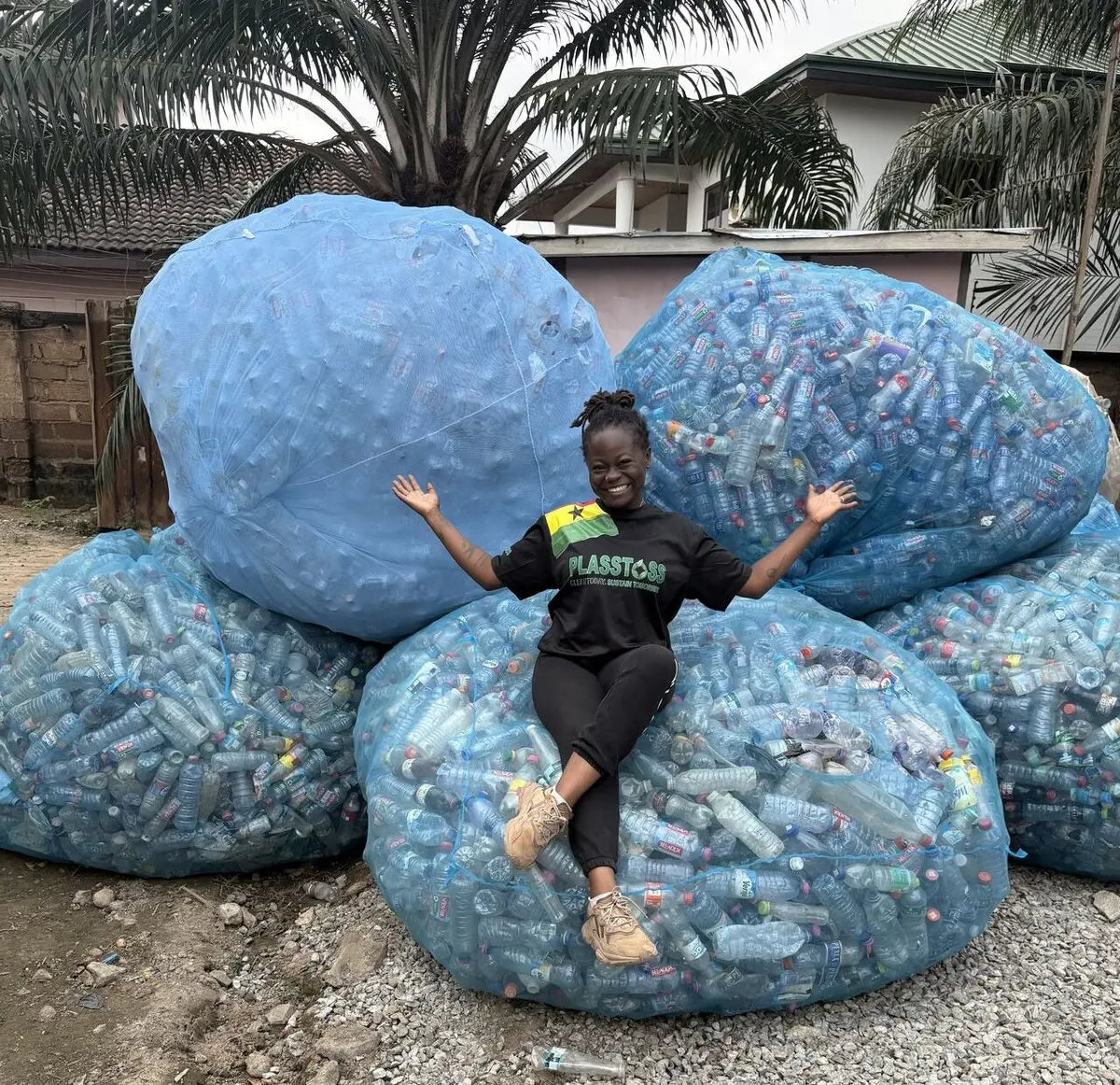
By day 60, Plastoss had built a network of 35 collectors and provided workers with personal protective equipment and collection nets to make their work safer.
Together, the team recovered more than 2,000 kilograms (more than 4,400 pounds) of PET bottles, along with HDPE and polypropylene plastics that might otherwise have remained in streets, waterways or landfills.
The pilot also taught Amoah where the model still needed work.
One of the original goals was to provide workers with access to Ghana’s National Health Insurance Scheme. Unexpected pilot costs made it impossible to offer that benefit at the scale Amoah had planned.
For her, that became another important lesson: social impact must also be financially sustainable to last.
Starting with the Next Generation
Plastoss is not only focused on collecting plastic.
During the pilot, Amoah introduced a recycling education program at two schools in Ghana. Starting this fall, students may join the Plastoss Eco Leaders Club.
The program will teach students about plastic pollution, recycling, waste separation, environmental health and green careers. Students will also take part in reuse projects, innovation challenges and community cleanups, and identify pollution problems in their own neighborhoods.
The goal is to help young people see themselves as part of the solution.
Learning by Doing
For Amoah, the pilot transformed Plastoss from an idea into something much more tangible.
The Rist DifferenceMaker Institute and Rist Institute for Sustainability and Energy provided funding, mentorship, connections and support that allowed her to test the venture in the real world.
“I arrived in Ghana with an idea,” Amoah said. “I am returning with something much more valuable: evidence, experience, relationships, mistakes, lessons, and a clearer understanding of what Plastoss can become.”
The numbers tell part of the story: 35 collectors, more than 2,000 kilograms of recovered PET plastic and two participating schools.
But Amoah says the impact is also visible in the people involved — workers earning income from discarded materials, communities becoming cleaner and students beginning to see plastic waste differently.
Sixty days into a planned 100-day pilot, there is still more to learn.
But Plastoss has already moved well beyond the idea stage.
“Sixty days ago, Plastoss was a hypothesis," she said. "Today, 35 collectors, thousands of kilograms of recovered plastic, two schools and countless lessons later, we know there is something here worth building.”
For Amoah, that is what the pilot was ultimately about: not proving that every assumption was right but learning enough to build something better. And Plastoss is just getting started.
This item initially appeared on the Rist DifferenceMaker Substack.