
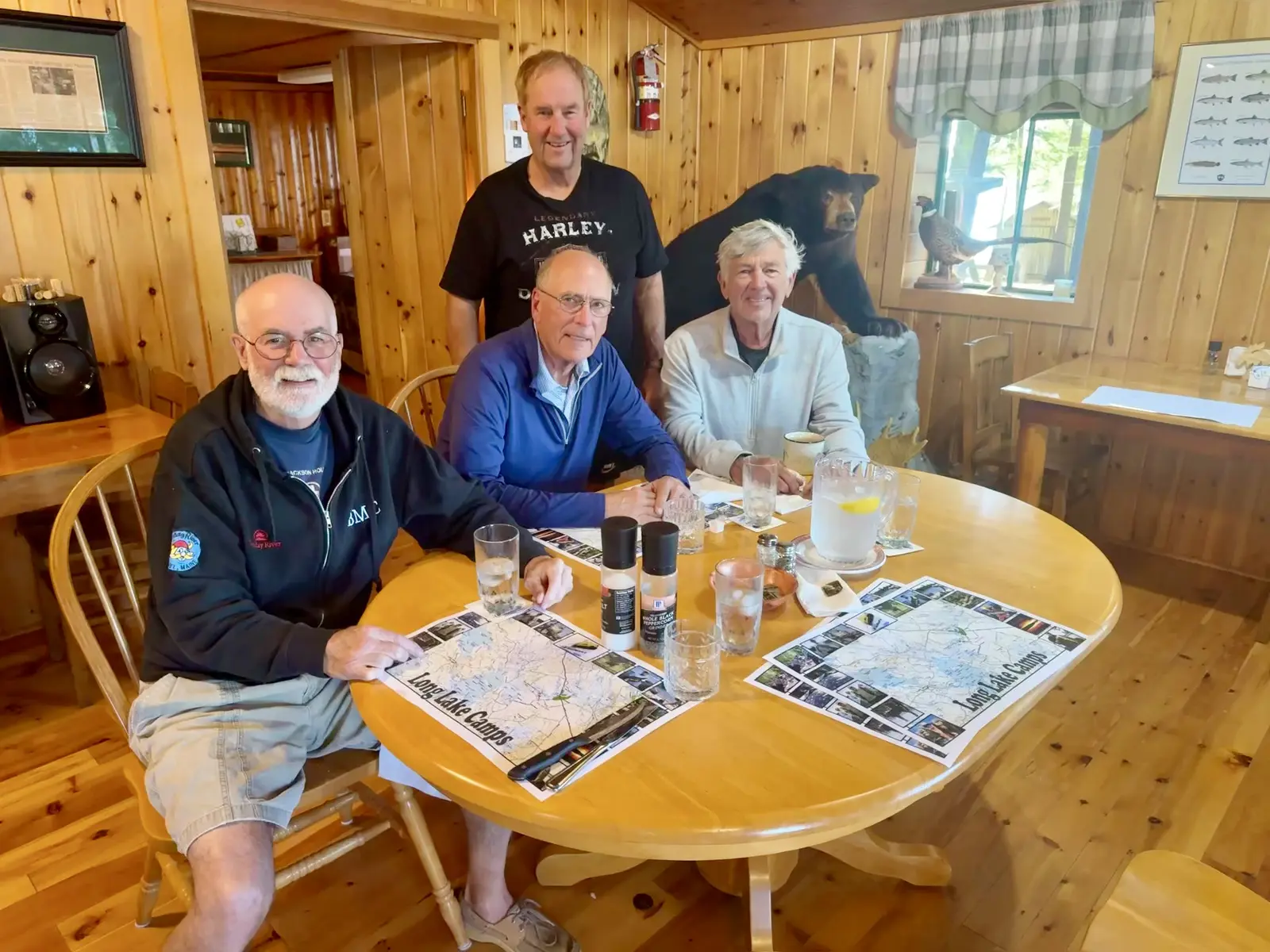
Long Lake Camps owner Steve Whitman ’75 stands behind Tappa Kegga Beer brothers, seated from left, Barry Boisvert ’76, Marv Olim ’75 and Jim Bender ’75.
They were in the middle of nowhere, surrounded by more eagles than people. Out on a boat last summer on Long Lake in Princeton, Maine, along the Canadian border, four members of the Lowell Technological Institute Class of 1975—Jim Bender, Marv Olim and Steve Whitman, along with their buddy Barry Boisvert ’76—were reeling in bass and pickerel as fast as they could.
“We were catching so many fish, our arms were tired,” Bender says. “Even the eagles were going, ‘Who are those guys?’”
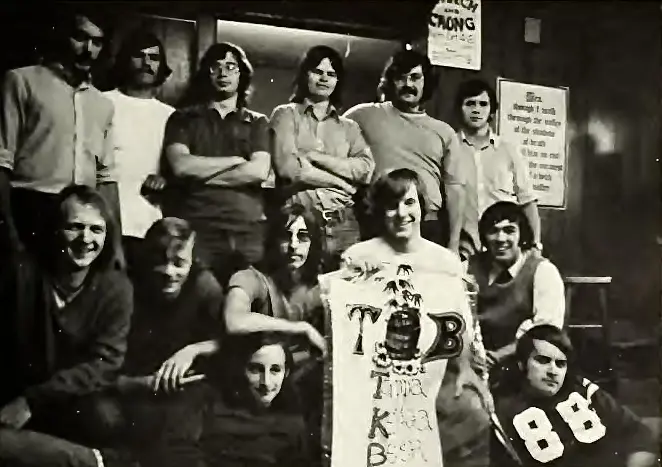
They were four members of Tappa Kegga Beer, a self-styled “fraternity” born in the early 1970s on the first floor of Leitch Hall. Headquartered in Allen “Doc” Sheppard’s dorm room, where there was a makeshift bar and the Tappa Keg in - signia painted on the wall, members had their own T-shirts and class rings. They were a lively group—football players and engineers-in-training—who knew how to work hard and play hard (back when the state’s drinking age was 18).
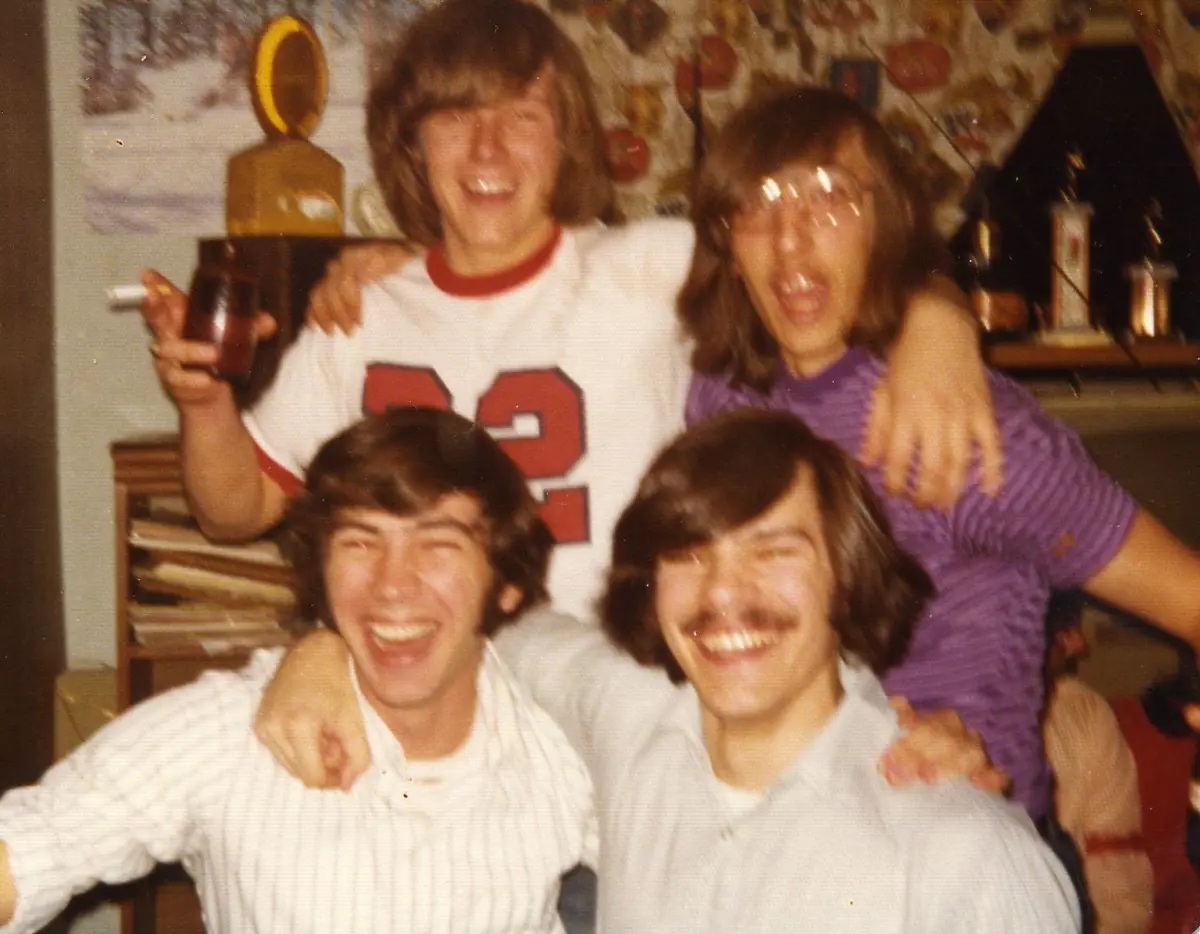
Tappa Keggers, clockwise from top left, Whitman, Tony Troiano ’76, Rocky D'Angelo ’76 and Bender live it up in the 1970s.
After graduating, they went their separate ways. Bender earned an MBA at Harvard Business School and went on to found multiple technology companies. Olim became a successful dentist in Houston. Boisvert started a construction firm that built CVS stores across the country. Whitman became a civil engineer and land surveyor, eventually running his own company in central Massachusetts.
When Whitman turned 50, he decided to sell his business and pursue his passion. He’d spent decades hunting and fishing in northern Maine, and in 2004, he and his wife, Linda, purchased Long Lake Camps in Princeton. Set on a private 40-acre peninsula, the traditional sporting camp featured 12 cabins, a dining hall and a recreational hall—all in desperate need of repair. Whitman’s engineering background proved handy as he oversaw renovations, rebuilt water and sewer systems and added amenities like guide services and a tackle shop. Today, the camp boasts 22 buildings and draws guests from around the world.
“It’s a wonderful, rustic place,” Bender says. “Steve is busting his ass to maintain it; he’s working a lot harder than I’d like to be in my 70s.”
“If we were ever going to do this again, it had to be now,” Bender says. “We’ve got the health, the wealth and the time, so let’s do one last hurrah before it’s too late.”
For Whitman, a licensed Master Maine Guide, hosting his old Lowell Tech friends made his heart “soar with happiness.” For four days, they fished, shared meals over campfires and reminisced about late nights in Leitch Hall, football games and professors who had challenged them. Their faces had a few more wrinkles, but their bond was unchanged.
“We still could laugh and kid each other about that time so long ago,” Whitman says. “Looking at their smiling faces, it made me think about how lucky we were to be able to reach out and see each other again. It became undeniably apparent that we were truly blessed, as some of the best years of our lives had come back to revisit us.”