Laboratories

Design and Synthesis Laboratory

Design and Synthesis LabA well equipped laboratory for the design and synthesis of functionalized polymeric systems is already in place. Design of molecules is aided by a molecular modeling laboratory where molecular properties and properties of the polymers can be anticipated. The promising molecules and polymers are then synthesized and purified. Investigation of the details of molecular organization, structure and dynamics can also be carried out.

UMass. Lowell Molecular Design Laboratory is equipped with a variety of computers (including parallel processing machines) and high resolution color graphics terminals. A vast array of software has been developed and acquired and will be utilized. The following pieces of hardware and software are in place:

  • Microvax workstation with Evans and Sutherland PS-390 graphics and associated CHEMLAB-II molecular modeling package.
  • Silicon Graphics Iris-3000 workstation with associated Polygen software CHARM and Quanta.
  • Stellar GS-1000 mini-supercomputer for molecular dynamics and Monte Carlo simulation studies.
  • IBM RISC 6000 Model 550 with dynamics simulation and protein engineering software.

Extensive synthesis capabilities are available in the laboratory of Dr. Tripathy at UMass. Lowell. This includes vacuum lines, glove boxes and separation and purification columns. Facilities for organic synthesis and characterization including FTIR, , GC and HPLC are routinely used. A Waters GPC with r.i. and UV detector is in place.


Processing and Fabrication Laboratory

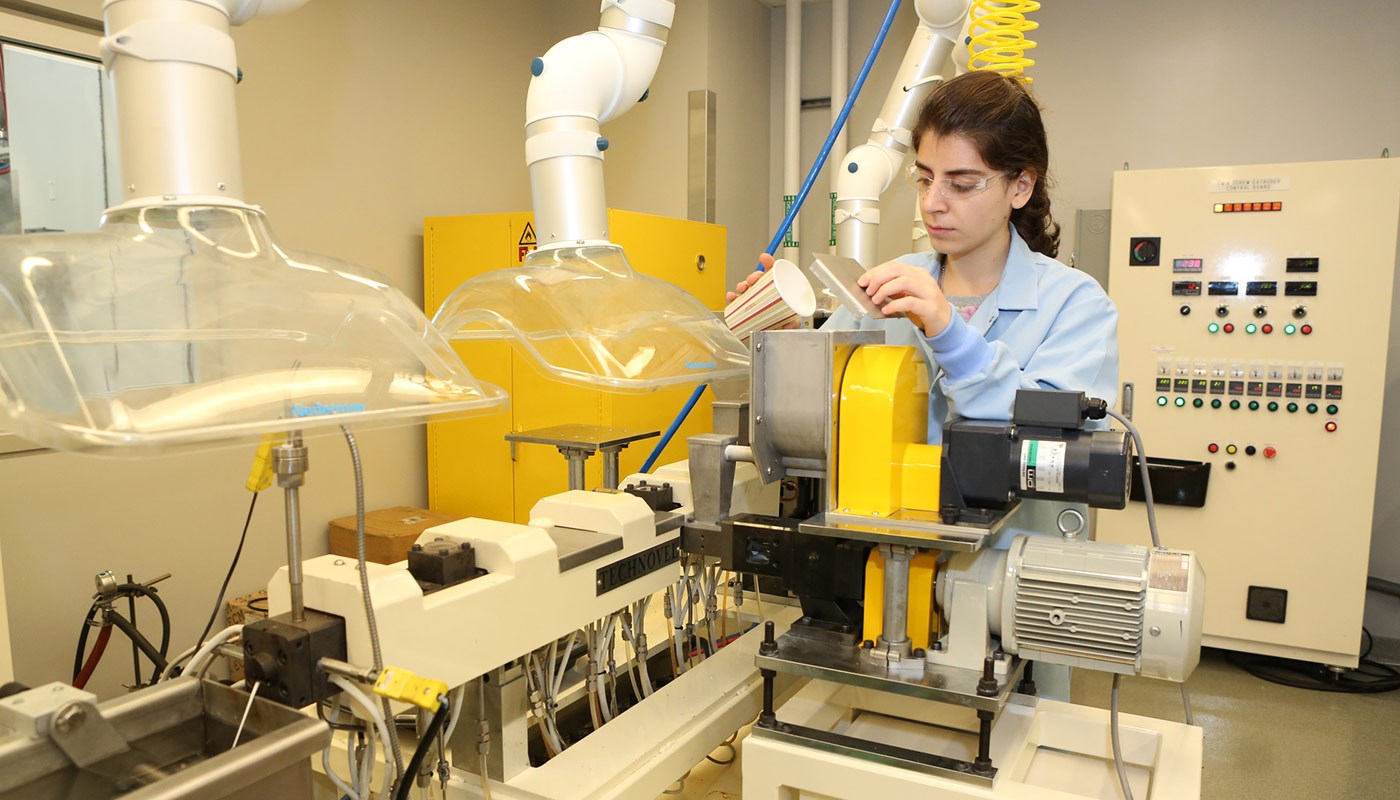
The technique of choice for thin film fabrication is the spin coating technique. This is especially suitable for UV and thermally curable polymers and the sol gel systems. Film thickness can be controlled by changing the viscosity of the solution or the speed of the spinner. A spinner made by Headway Inc. and capable of handling large substrates is currently used by the molecular optics and electronics group. To impart second order nonlinear optical properties to spin coated polymers we have developed the capability of poling the films by the corona poling technique as well as the electrode poling technique.

For device fabrication, a CLASS 100 microfabrication laboratory is established for our exclusive use. The laboratory is equipped with spinners, mask aligner, etch baths, and vacuum deposition units.


Electronic and Electrical Properties Measurements Laboratories

It is important to evaluate the electrical and electronic properties of the materials for device consideration. The Center has a number of instruments to accomplish these tasks. For measurements of dielectric properties in the low frequency regime (Hz to MHz) a Hewlett-Packard 4284 A LCR meter and a Micromet Instruments dielectric analyzer is available. In addition, the impedance, resistance and capacitance of devices can be measured. For measurements in the radio frequency and the microwave frequency regime Hewlett-Packard 8510B microwave network analyzer has been acquired. These instruments will also be used to investigate dielectric properties of polymers with oriented dipoles (and therefore) possessing a permanent electric polarization. Key equipment is described below.

Hewlett Packard model 8510B Vector Network Analyzer, equipped with S-parameter test sets capable of measurements in the range of 45 MHz to 40 GHz. This late model, state of the art equipment is capable of excellent accuracy.


Optical Properties Measurements Laboratory

LaserInstrumentation for evaluating the linear and NLO properties of materials are already in place. Pulsed and CW Nd-YAG lasers (Quantel model Y660A and Quantronix model 114), Argon ion laser and Dye laser, semiconductor laser and a variety of other lasers spanning UV to near IR are available for optical characterization as well as to monitor device performance. A variety of diagnostics research instrumentation such as lock in amplifiers, box car averager, photon counter (all made by Stanford Research systems) are routinely used. The linear optical properties are measured by UV-Vis-NIR absorption spectrometer and a research ellipsometer (Rudolph Research Inc). Thickness and refractive index measurements are further confirmed by waveguiding and prism coupling techniques.

  • Quantronix Nd:YAG laser model 114 cw Q-switched with peak power of 1 kw and 200 ns pulse.
  • Nitrogen pumped dye laser with peak power 20 kw and 3 ns pulse tunable from 580-900 nm.
  • Quantel Nd:YAG laser model 660A with peak power 20 MW and pulse duration of 10 ns.
  • Several other laser sources primarily used for the characterization of the optical properties.
  • Digikrome monochromator .3 mm - 1.3 mm.
  • Stanford Research Systems gated photon counter and other detection systems.
  • Coherent Ar+ Ion Laser Innova 90 with ring dye laser capable of producing picosecond pulses.
  • Rudolph Research Ellipsometer (from UV to NIR).
  • Optical Instrumentation, lock-in amplifier, box car averager etc.
  • Perkin-Elmer Lambda-9 spectrophotometer for UV-Vis-NIR.

Closed cycle cryostat for carrying out low temperature fluorescence using the nitrogen pumped dye laser system mentioned above.


Center for Advanced Materials - One University Avenue, Lowell, MA 01854
Phone: 978-934-3695 Fax: 978-934-9571 Contact Us